One Dieste Wall, Five Build Methods: The Full Report
Full report on the Oct 1–2, 2026 Dieste wall evaluation: five Rhino build methods, two Claude models, 23 graded runs, with inputs, metrics and failures.
On October 1 and 2, 2026 we asked two Claude models, Opus 5.5 and Sonnet 5.5, to build the same curved brick wall in Rhino 8 five ways: with Rhino commands, with one RhinoCommon Python script, and with three ways of building a Grasshopper definition (component by component, from one Python script that uses the Grasshopper SDK, and from one graph description). A deterministic checker graded the geometry, and a trace check graded whether each run used its assigned method. This is the full report on the evaluation that One Wall, Five Ways to Build It summarized on October 7. It was one of several Rhino evaluations we ran in fall 2026 while working on Rhino skills for Claude; no skill was used in this one.
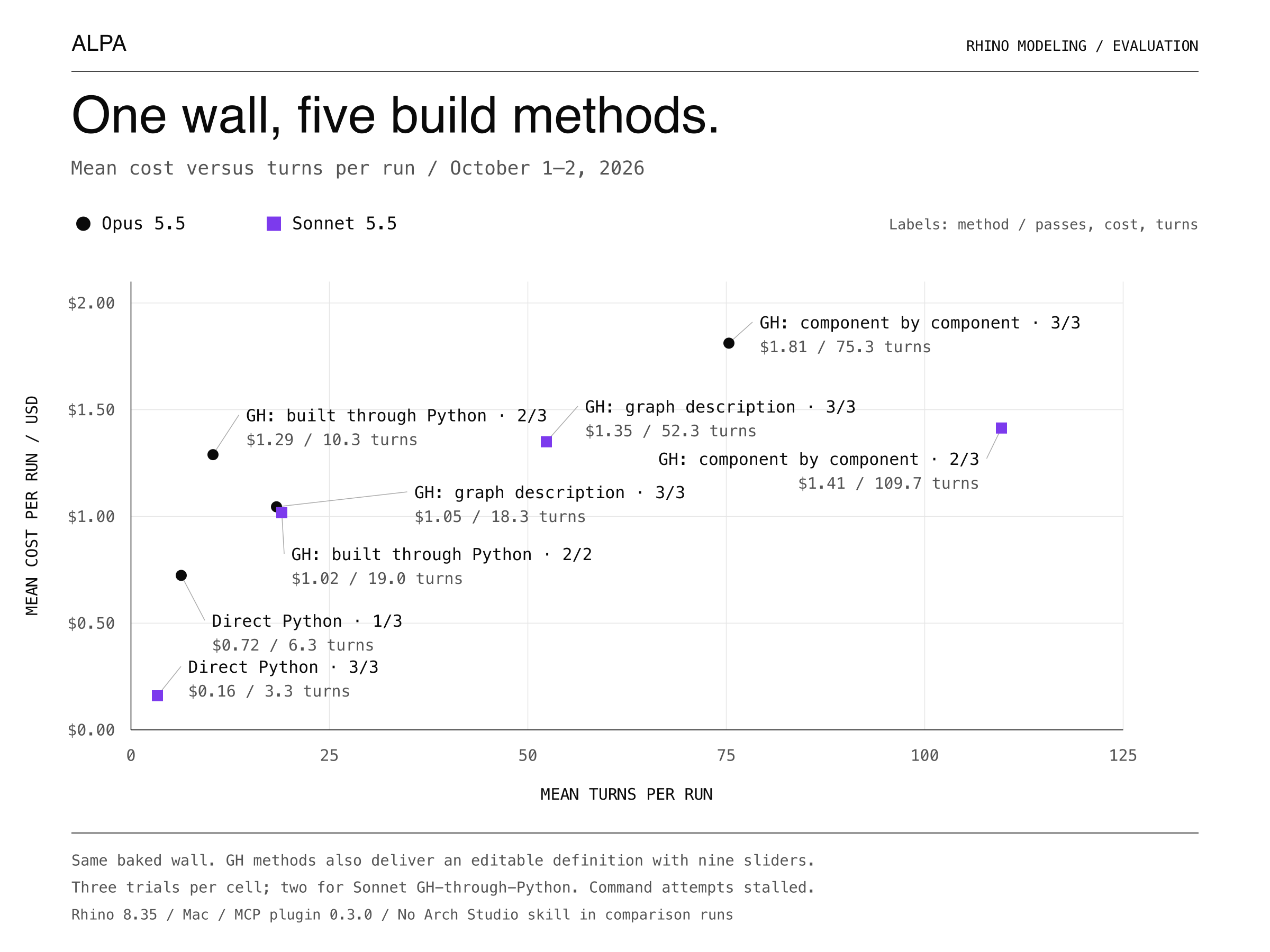
We graded 23 runs, 12 on Opus and 11 on Sonnet, and 19 passed (Opus 9 of 12, Sonnet 10 of 11). The command-line method produced no graded run: three attempts stopped at a dialog or a prompt that blocked Rhino. One RhinoCommon script was the cheapest method. Sonnet passed 3 of 3 at a mean of $0.16 and 36 seconds per run, and Opus passed 1 of 3 at $0.72 and 83 seconds. Among the Grasshopper methods, the two that built larger parts of the definition per call used fewer turns than component by component on both models: Opus 10 and 18 turns against 75, Sonnet 19 and 52 against 110. Mean cost fell by less than turns did. On Opus it fell 29% and 42% while turns fell 86% and 76%; on Sonnet it fell 28% and 5% while turns fell 83% and 52%.
The sections below follow the order of the work: results, inputs, workflow, metrics, outputs, corrections and failures, lessons and limits. The short version leaves out several facts that this report includes. They are collected under “Differences from the short version” in the corrections section.
Results at a glance
Figures are means per run. Cost per pass is the total cost of all runs in a cell divided by the number that passed. Each cell had three trials except Sonnet arm 4, which has two. Arm 1 (command line) has no graded run.
| Model | Method | Passed | Mean cost | Cost per pass | Mean time | Mean turns |
|---|---|---|---|---|---|---|
| Opus 5.5 | 2. One RhinoCommon script | 1/3 | $0.72 | $2.17 | 83 s | 6.3 |
| Opus 5.5 | 3. Grasshopper, component by component | 3/3 | $1.81 | $1.81 | 317 s | 75.3 |
| Opus 5.5 | 4. Grasshopper built by one script | 2/3 | $1.29 | $1.93 | 247 s | 10.3 |
| Opus 5.5 | 5. Grasshopper from one graph description | 3/3 | $1.05 | $1.05 | 232 s | 18.3 |
| Sonnet 5.5 | 2. One RhinoCommon script | 3/3 | $0.16 | $0.16 | 36 s | 3.3 |
| Sonnet 5.5 | 3. Grasshopper, component by component | 2/3 | $1.41 | $2.12 | 402 s | 109.7 |
| Sonnet 5.5 | 4. Grasshopper built by one script | 2/2 | $1.02 | $1.02 | 627 s | 19.0 |
| Sonnet 5.5 | 5. Grasshopper from one graph description | 3/3 | $1.35 | $1.35 | 473 s | 52.3 |
| Totals | Value |
|---|---|
| Graded runs | 23 (12 Opus, 11 Sonnet) |
| Passed | 19 (Opus 9, Sonnet 10) |
| Cost of the graded runs | $25.42 (Opus $14.61, Sonnet $10.81) |
| All runs executed | 40: 23 graded, 8 voided for leftover layers, 5 Sonnet smoke runs, 3 command-line attempts, 1 cancelled |
| Cost of all runs that reported a cost | $37.29 ($25.42 graded, $7.72 voided, $4.14 smoke) |
| Failures among the 23 | 4: one stacked joint (Opus arm 2), end bricks cut short (Opus arm 2), one control curve missing from its layer (Opus arm 4), bricks at double size (Sonnet arm 3) |
| Runs that complied with their assigned method | 23 of 23 |
| Grasshopper-specific checks (nine sliders, slider response, no script components, no component errors) | passed in all 17 Grasshopper runs |
All four failures were failures of the baked geometry. The Grasshopper checks passed in every Grasshopper run, including the three that failed on geometry.
Inputs
The brief
All five arms received the same geometry brief, followed by a method line. The geometry text, as given to the agent:
Model a Dieste-style ruled brick wall in the manner of the Atlantida church: a ruled surface between a straight base line and a sine curve at the crown, clad in running-bond brick. Wall 30 ft long and 20 ft high, wave amplitude 24 in, wavelength 10 ft, brick 9.75 by 2.25 by 4.75 in with 0.5 in joints, one course per brick height plus joint, each brick a closed box oriented to its course and the surface normal with its centroid on the surface. Put the surface, control curves, courses (one curve per course), brick centroids (points) and bricks on child layers named Surface, Control Curves, Courses, Brick Centroids and Bricks under a parent layer named Dieste Wall. The open document is empty and already in inches.
The method lines differed:
- Arm 1, command line: work as a person at the Rhino command line would, using
run_command, with the scripted hyphen form of any command that would otherwise open a dialog (for example-Layer,-SelLayer,-Properties). Do not run scripts or Grasshopper through it. - Arm 2, one RhinoCommon script: build it with RhinoCommon in one Python script through
run_pythonthat builds the whole wall; after a fix, rerun the whole script on a cleared layer rather than patching. Do not use Grasshopper. - Arm 3, component by component: build a live Grasshopper definition with the Grasshopper graph tools, placing each component with its own
g1_place_componentcall and wiring them withg1_connectorg1_connect_many. Place each slider withg1_place_component("Number Slider")(g1_place_slideris broken in Rhino MCP 0.3.0) and set only its name, range and value fromrun_python. Otherwise userun_pythononly to bake; do not create, wire or edit Grasshopper components from Python. - Arm 4, one script: build a live Grasshopper definition with one Python script through
run_pythonthat creates the components, sliders and wires through the Grasshopper SDK, solves it and bakes it; after a fix, rerun the whole script on a cleared canvas and layer rather than patching. - Arm 5, one graph description: build a live Grasshopper definition by describing the whole graph in one
g1_apply_graphcall; after a fix, apply the whole revised graph again rather than patching. Userun_pythononly to bake; do not create or edit Grasshopper components from Python.
Arms 3, 4 and 5 also carried one shared paragraph: give the definition number sliders named exactly Length, Height, Amplitude, Wavelength, Centroid Offset, Brick Length, Brick Height, Brick Depth and Joint, defaulting to the values above; use native Grasshopper components only (no script components); leave the definition open on the canvas; and bake the default result to those layers. The brief gives no value for Centroid Offset and does not say what it moves.
The wall is modeled on Dieste’s church at Atlántida. The brief implies 87 courses (240 in divided by a 2.75 in course pitch, rounded down). A hand-built reference wall, used to validate the checker, has 3,346 bricks.
Draft note: the Rhino screenshot of the wall proposed for this section (rhino-dieste-wall.png) is left out because its terminal pane shows a session and repository name.
Model, host and tools
- Models:
claude-opus-5-5andclaude-sonnet-5-5, one model per run. The run records show no other model used inside any graded run. - Agent host: Claude Code 2.1.287 in non-interactive mode (
claude -p), permission mode default, no session persistence. - Skills: none. No plugin directory was passed to any run, and no Rhino skill appears in the skill list of any run. No run called the Skill tool, or any tool other than the Rhino MCP tools and Claude Code’s tool search.
- Tools: the Rhino MCP server only (
--strict-mcp-config), plus Read, Glob, Grep and Skill. Bash, Write, Edit, NotebookEdit, WebFetch and WebSearch were denied, as wasask_userin every arm. The Rhino tools differed by arm:
| Arm | Allowed Rhino tools besides the read-only set | Denied |
|---|---|---|
| 1. Command line | run_command | run_python, all g1_* tools |
| 2. One script | run_python | run_command, all g1_* tools |
| 3. Components | run_python, g1_start, g1_search_components, g1_describe_component, g1_place_component, g1_connect, g1_connect_many, g1_solve_graph, g1_get_canvas_graph, g1_delete_component, g1_clear_canvas | run_command, g1_apply_graph, g1_place_slider |
| 4. One script, Grasshopper SDK | run_python | run_command, all g1_* tools |
| 5. One graph description | run_python, g1_start, g1_search_components, g1_describe_component, g1_solve_graph, g1_get_canvas_graph, g1_clear_canvas, g1_apply_graph | run_command, g1_place_component, g1_place_slider, g1_connect, g1_connect_many, g1_delete_component |
The read-only set, allowed in every arm, was get_context, list_objects, list_slots, get_selection, get_commands, get_viewport_image, set_camera, zoom_to_layer, zoom_to_object and set_selection. run_csharp, open_doc, close_doc, save_doc, spawn_slot and close_slot were denied everywhere.
The Rhino build
Rhino 8.35.26251.13002 for Mac, with McNeel’s Rhino MCP Platform router 0.3.0, document units in inches. Arm 3 needed one exception to its method. g1_place_slider fails on every call in 0.3.0 because its decimal parameters are advertised as object; we filed it as mcneel/RhinoAI#172. Arm 3 therefore placed its sliders as Number Slider components with g1_place_component and set their names, ranges and values from Python. The trace check allows that and nothing else in Python for arm 3.
The harness
A shell script runs each arm per model and trial. Before each run the open Rhino document and the Grasshopper canvas are backed up and emptied, and the run refuses to start if the document holds objects or any layer other than the default (this check was added during the evaluation; see the corrections section). The agent runs in its own working folder. After it stops, the harness reads the Rhino state and runs the checker straight against the Rhino router, so the grader uses no model and the agent cannot influence it. Every run keeps its full stream-json trace, the pre- and post-run Rhino state, the check results, the Rhino file and the Grasshopper file. A run is stopped if its trace shows no agent output for 6 minutes, because a Rhino dialog never returns. The launch script’s default cap is $6 per run. We did not record whether it was overridden; the most expensive graded run cost $1.88.
The grader
A deterministic checker runs inside Rhino. For the baked wall (12 checks, arm 2) it requires:
- units in inches and a parent layer named Dieste Wall;
- five child layers with the right object types and counts: Surface (1 surface), Control Curves (2 to 4 curves), Courses (85 to 89 curves), Brick Centroids (3,000 to 3,900 points), Bricks (3,000 to 3,900 objects, stored as Breps, Extrusions or block instances);
- a bounding box of 370 × 53.75 × 240 in within 12 in;
- valid geometry, closed bricks, and brick dimensions of 9.75 × 2.25 × 4.75 in within 0.01 in on at least 3,000 bricks;
- running bond: vertical joints in adjacent courses offset by at least 0.5 in at the 2.75 in course pitch.
The Grasshopper arms (18 checks) add: nine sliders; amplitude and wavelength sliders that change the definition’s outputs when set (the checker sets amplitude to 12 and a wavelength between 60.5 and 75 in the runs, and requires the outputs to change); no missing components; no component errors; and no script components. A run passes when the checker and the method check both pass. We validated the checker on 11 variants before the runs, and all 11 behaved as intended: the reference wall stored three ways (47.56 MB as Breps, 3.45 MB as Extrusions, 2.59 MB as block instances), four planted defects (a stacked bond, a wrong brick size, an open brick, missing courses) and four Grasshopper variants.
The method check reads the trace. It flags run_command calls that run scripts or Grasshopper, Grasshopper use in arm 2, Grasshopper objects created or wired from Python in arms 3 and 5, and an arm 3 run with no g1_place_component call or an arm 5 run with no g1_apply_graph call.
The operator’s configuration
The runs were not isolated from the operator’s Claude Code setup. From the init record of every graded run:
- Six non-built-in plugins were loaded: the Arch Studio plugin (
as, version 1.5.1.1), Compound Engineering 3.23.4, Ponytail 4.9.0, the Vercel plugin 0.50.0, Typesafe 0.5.7 and Cowork plugin management 0.2.2, plus three built-in plugins. No skill name in any run’s skill list mentions Rhino. - Session-start hooks returned text in every graded run, which Claude Code adds to the session context. Their outputs were 513 characters (an Arch Studio note: use Arch Studio for architecture and firm work, with Norma coordinating), 5,229 characters (a mode that opens “PONYTAIL MODE ACTIVE” and tells the model to act as a “lazy senior developer” who writes the least code that works), 8,414 characters (Vercel guidance) and 428 characters (a note that the project is greenfield, that the model should skip exploration and start executing, and that the Vercel CLI is outdated).
- The evaluation report of October 2 records the operator’s
CLAUDE.mdas loaded in every arm. The trace does not list it, and we did not audit its content for this article. - Each run’s auto-memory folder was keyed to the run’s own working folder, so no memory carried between runs.
Every arm and both models carried the same configuration, so it does not differ between arms. We did not run any arm without it, so we cannot say how much it changed the absolute numbers. See Limits.
Raw workflow
Order of events
Times are UTC, from the run records.
| When | What happened |
|---|---|
| Oct 1, 14:55 | The harness is committed. Arm 1 attempt 1 (Sonnet) starts. It makes 57 tool calls, 32 of them run_command, over 13 minutes and ends with 3 objects in the document. The evaluation report attributes the stop to SelLayer opening a dialog. |
| Oct 1, 15:09 | Arm 1 attempt 2. The first command, _-DocumentProperties _Units _Enter, opens the Settings dialog despite the hyphen. The trace ends at 15:15 with no further agent activity. Two harness changes follow the same day: runs are stopped when blocked by a dialog, and the stall check ignores the heartbeat lines that Claude Code writes every 30 seconds while a tool call is pending. |
| Oct 2, 10:21 to 10:59 | Five Sonnet smoke runs: arm 2 passes; arm 3 stops after 14 failing g1_place_slider calls; arm 4 passes; arm 5 fails on brick size; arm 3 is rerun after the harness change that lets it place sliders as components, and passes. |
| Oct 2, 11:11 to 11:41 | Arm 1 attempt 3 (Sonnet), about 30 minutes, 73 tool calls. It builds the surface and the course curves (92 objects in the document at 11:23), then stalls on _ArrayCrvOnSrf. |
| Oct 2, 12:47 to 14:12 | Graded batch 1, Sonnet, arms 2 to 5, three trials each (12 runs). Eight of them started with leftover layers; see the corrections section. |
| Oct 2, 14:12 to 15:03 | Graded batch 2, Opus, arms 2 to 5, three trials each (12 runs). All started from a document with only the default layer. |
| Oct 2, 15:28 to 16:09 | The reset is fixed to purge every layer. Sonnet reruns of the eight contaminated runs: arm 2 three times, arm 3 three times, arm 4 trial 1. The rerun of arm 4 trial 2 is cancelled. |
Within each batch the runs went in the order arm 2, 3, 4, 5 with trials 1 to 3 consecutively. The 23 graded runs are therefore Sonnet arm 5 and arm 4 trial 3 from batch 1, all 12 Opus runs from batch 2, and Sonnet arms 2, 3 and arm 4 trial 1 from the rerun.
What the agents did, by method
Every run began with one ToolSearch call that loaded the Rhino tool definitions. That call counts as a turn. A run’s turns equal its tool calls plus the final reply.
Arm 1, command line. In attempt 1 the agent set the document units, made layers and tried to build the control curves with _InterpCrv, which stalled waiting for input; it spent its remaining calls checking the document, which held no geometry until 3 objects appeared at 15:08. Attempt 2 stopped on its first command. In attempt 3 the agent made the layers, the base line and the crown curve, lofted the surface, contoured the courses (the document held 92 objects at 11:23), drew one seed brick, and issued _ArrayCrvOnSrf, which waits for input the agent cannot answer. The trace ends with that command.
Arm 2, one script. Sonnet wrote one script of 62 to 75 lines and ran it once in two trials; in trial 1 the first script failed and the second succeeded. Opus ran one to three scripts, the longest 91 lines. In Opus trial 1 two scripts failed (a Python import error and a point-type error, by its own report) before the third built the wall. In trial 3 Opus found overlapping bricks at the crown, where the wave bends with a radius of about 15 in, and reran the script with a spacing rule that keeps each joint at least 0.5 in at its narrowest point. That rule cut its brick count from 3,343 to 3,213. All three Opus runs requested two viewport captures.
Arm 3, component by component. Each run started the Grasshopper canvas with g1_start, then looked up components (6 to 15 lookups for Opus, 21 to 36 for Sonnet) and placed them one call at a time: 50, 51 and 54 g1_place_component calls for Opus, 60 to 64 for Sonnet. It wired them with two to six g1_connect_many calls (plus one g1_connect in one Opus run), and used run_python for the slider names, ranges and values, for solving checks and for the bake.
Arm 4, one script. Each run wrote a script of 160 to 194 lines that created the components, sliders and wires (49 to 63 canvas objects in the saved definitions), solved them and baked. Opus ran 0, 1 and 4 whole-script reruns (2, 4 and 11 run_python calls). Sonnet opened with short probe scripts of 4 to 13 lines that list component names and parameter types, then ran the long script 4 times in trial 1 and 6 times in trial 3 (18 and 14 run_python calls).
Arm 5, one graph description. Each run called g1_start, looked up components (6 to 13 lookups for Opus, 27 to 35 for Sonnet), then applied a graph of about 7,500 to 11,600 characters of JSON (one 304-character first call in Sonnet trial 1 aside). Opus applied the graph once in two trials and twice in one. Sonnet applied it 6, 4 and 5 times, calling g1_clear_canvas 5, 4 and 4 times between applications, and read the canvas back with g1_get_canvas_graph in two runs. Every run then baked with run_python.
Metrics
Definitions: turns is the number of model responses; input tokens is uncached input plus cache writes plus cache reads, as Claude Code reports them; cost is Claude Code’s reported cost per run at list prices, not an invoice; lookups are g1_search_components and g1_describe_component; graph calls are g1_place_component, g1_connect, g1_connect_many, g1_apply_graph and g1_delete_component; a call “returned an error” when its result was an error payload or a tool error. Rhino tool calls exclude the ToolSearch call.
Cost, time and turns
| Model | Arm | Cost, mean (range) | Time, s, mean (range) | Turns, mean (range) | Rhino tool calls, mean (range) |
|---|---|---|---|---|---|
| Opus 5.5 | 2 | $0.72 ($0.62–$0.79) | 83 (66–106) | 6.3 (5–7) | 4.3 (3–5) |
| Opus 5.5 | 3 | $1.81 ($1.76–$1.88) | 317 (291–345) | 75.3 (69–80) | 73.3 (67–78) |
| Opus 5.5 | 4 | $1.29 ($0.90–$1.79) | 247 (133–405) | 10.3 (7–16) | 8.3 (5–14) |
| Opus 5.5 | 5 | $1.05 ($0.93–$1.27) | 232 (199–276) | 18.3 (15–23) | 15.7 (12–20) |
| Sonnet 5.5 | 2 | $0.16 ($0.15–$0.18) | 36 (31–44) | 3.3 (3–4) | 1.3 (1–2) |
| Sonnet 5.5 | 3 | $1.41 ($1.26–$1.49) | 402 (352–464) | 109.7 (103–115) | 107.7 (101–113) |
| Sonnet 5.5 | 4 | $1.02 ($0.95–$1.08) | 627 (373–881) | 19.0 (17–21) | 17.0 (15–19) |
| Sonnet 5.5 | 5 | $1.35 ($1.17–$1.49) | 473 (354–696) | 52.3 (44–61) | 49.7 (42–58) |
Tokens
| Model | Arm | Input tokens, mean | Cache reads, share of input | Output tokens, mean | Of which thinking, mean |
|---|---|---|---|---|---|
| Opus 5.5 | 2 | 0.30 M | 78% | 7,177 | 2,280 |
| Opus 5.5 | 3 | 1.34 M | 91% | 32,379 | 12,705 |
| Opus 5.5 | 4 | 0.54 M | 83% | 23,313 | 7,005 |
| Opus 5.5 | 5 | 0.54 M | 88% | 20,950 | 8,668 |
| Sonnet 5.5 | 2 | 0.11 M | 77% | 4,210 | 1,510 |
| Sonnet 5.5 | 3 | 2.32 M | 95% | 48,990 | 23,562 |
| Sonnet 5.5 | 4 | 1.17 M | 93% | 46,940 | 19,036 |
| Sonnet 5.5 | 5 | 1.96 M | 94% | 53,330 | 16,002 |
Each turn resends the conversation so far, and 77% to 95% of the input tokens in every cell were cache reads. Input tokens rose with turns, and cost rose with them by less. For example, Sonnet arm 4 used 19.0 turns and 1.17 M input tokens against arm 3’s 109.7 turns and 2.32 M, but its output was 46,940 tokens against 48,990, so its cost was $1.02 against $1.41.
Tool calls, retries and errors
| Model | Arm | Lookups | Graph calls | g1_apply_graph | run_python | Calls that returned an error | Of those, run_python |
|---|---|---|---|---|---|---|---|
| Opus 5.5 | 2 | 0.0 | 0.0 | 0.0 | 2.3 | 5 of 13 | 2 of 7 |
| Opus 5.5 | 3 | 10.3 | 55.0 | 0.0 | 5.7 | 9 of 220 | 6 of 17 |
| Opus 5.5 | 4 | 0.0 | 0.0 | 0.0 | 5.7 | 6 of 25 | 4 of 17 |
| Opus 5.5 | 5 | 9.0 | 1.3 | 1.3 | 3.0 | 5 of 47 | 4 of 9 |
| Sonnet 5.5 | 2 | 0.0 | 0.0 | 0.0 | 1.3 | 1 of 4 | 1 of 4 |
| Sonnet 5.5 | 3 | 28.0 | 66.3 | 0.0 | 8.7 | 20 of 323 | 10 of 26 |
| Sonnet 5.5 | 4 | 0.0 | 0.0 | 0.0 | 16.0 | 12 of 34 | 12 of 32 |
| Sonnet 5.5 | 5 | 31.7 | 5.0 | 5.0 | 6.0 | 12 of 149 | 4 of 18 |
The first four columns are means per run; the last two are totals over the cell’s runs. Counted as calls that returned an error, the other failures were: g1_describe_component for a name that does not exist (7 calls, all Sonnet, for example “Isocurve” and “Surface CP”), g1_place_component for a name that does not exist (3 calls: “Shorten Curve” twice on Opus and “Curve Length” once on Sonnet), g1_solve_graph reporting component errors (1), g1_clear_canvas refused without confirm=true (2), zoom_to_layer on the empty parent layer (4), g1_get_canvas_graph over the response size limit (3, all Sonnet) and get_viewport_image over the response size limit (7, all Opus). The 43 run_python errors, 16 on Opus and 27 on Sonnet, were Python exceptions in the script.
Retries, by method. Arm 4 reruns of the whole script (the brief required whole-script reruns): Opus 0, 1 and 4; Sonnet 3 and 5. Arm 5 re-applications of the graph after the first: Opus 0, 1 and 0; Sonnet 5, 3 and 4. Arm 2 reruns: Opus trials 1 and 3 reran after errors or a spacing problem, Sonnet trial 1 after one error.
Where the time went
In most runs wall time is model time. Two runs spent half or more of it waiting on Rhino. Sonnet arm 4 trial 1 took 881 s, of which 579 s was the gap between a run_python call and its result; five of its calls took between 57 and 205 s each. Sonnet arm 4 trial 3 took 373 s with 18 s of that gap, so the arm’s 627 s mean time comes from the first run. Sonnet arm 5 trial 1 (696 s) spent 345 s waiting on tool results. In the other 21 graded runs the gap was 3 to 91 s.
Every graded run
| Run | Result | Cost | Time | Turns | Lookups / graph / Python | Errors | Bricks | Failed check |
|---|---|---|---|---|---|---|---|---|
| Opus arm 2 trial 1 | fail | $0.76 | 77 s | 7 | 0 / 0 / 3 | 3 | 3,321 | bond |
| Opus arm 2 trial 2 | fail | $0.62 | 66 s | 5 | 0 / 0 / 1 | 1 | 3,453 | object brick size |
| Opus arm 2 trial 3 | pass | $0.79 | 106 s | 7 | 0 / 0 / 3 | 1 | 3,213 | – |
| Opus arm 3 trial 1 | pass | $1.88 | 345 s | 80 | 15 / 53 / 7 | 4 | 3,330 | – |
| Opus arm 3 trial 2 | pass | $1.76 | 316 s | 69 | 6 / 55 / 4 | 3 | 3,334 | – |
| Opus arm 3 trial 3 | pass | $1.80 | 291 s | 77 | 10 / 57 / 6 | 2 | 3,333 | – |
| Opus arm 4 trial 1 | fail | $0.90 | 133 s | 7 | 0 / 0 / 2 | 1 | 3,333 | layer Control Curves |
| Opus arm 4 trial 2 | pass | $1.17 | 202 s | 8 | 0 / 0 / 4 | 1 | 3,334 | – |
| Opus arm 4 trial 3 | pass | $1.79 | 405 s | 16 | 0 / 0 / 11 | 4 | 3,334 | – |
| Opus arm 5 trial 1 | pass | $0.94 | 276 s | 23 | 13 / 1 / 4 | 3 | 3,336 | – |
| Opus arm 5 trial 2 | pass | $1.27 | 223 s | 15 | 6 / 2 / 1 | 0 | 3,346 | – |
| Opus arm 5 trial 3 | pass | $0.93 | 199 s | 17 | 8 / 1 / 4 | 2 | 3,333 | – |
| Sonnet arm 2 trial 1 | pass | $0.18 | 44 s | 4 | 0 / 0 / 2 | 1 | 3,345 | – |
| Sonnet arm 2 trial 2 | pass | $0.15 | 31 s | 3 | 0 / 0 / 1 | 0 | 3,346 | – |
| Sonnet arm 2 trial 3 | pass | $0.15 | 34 s | 3 | 0 / 0 / 1 | 0 | 3,345 | – |
| Sonnet arm 3 trial 1 | fail | $1.49 | 391 s | 115 | 36 / 64 / 6 | 7 | 3,335 | object brick size |
| Sonnet arm 3 trial 2 | pass | $1.26 | 352 s | 111 | 27 / 71 / 8 | 4 | 3,002 | – |
| Sonnet arm 3 trial 3 | pass | $1.49 | 464 s | 103 | 21 / 64 / 12 | 9 | 3,335 | – |
| Sonnet arm 4 trial 1 | pass | $0.95 | 881 s | 21 | 0 / 0 / 18 | 7 | 3,335 | – |
| Sonnet arm 4 trial 3 | pass | $1.08 | 373 s | 17 | 0 / 0 / 14 | 5 | 3,335 | – |
| Sonnet arm 5 trial 1 | pass | $1.49 | 696 s | 61 | 35 / 6 / 9 | 4 | 3,346 | – |
| Sonnet arm 5 trial 2 | pass | $1.17 | 354 s | 44 | 27 / 4 / 6 | 4 | 3,333 | – |
| Sonnet arm 5 trial 3 | pass | $1.38 | 370 s | 52 | 33 / 5 / 3 | 4 | 3,335 | – |
Sonnet arm 4 has no trial 2 in the graded set: its original trial 2 was one of the eight voided runs, and the rerun was cancelled.
Outputs
Each graded run left a Rhino document with the five child layers under Dieste Wall, and the 17 Grasshopper runs also left a live definition on the canvas with a saved .gh file.
| Output | Observed across the 23 graded runs |
|---|---|
| Courses | 87 curves in every run |
| Bricks | 3,002 to 3,453 per run. Arm 2: 3,213 to 3,453; arm 3: 3,002 to 3,335; arm 4: 3,333 to 3,335; arm 5: 3,333 to 3,346 |
| Brick centroids | One point per brick in every run |
| Control curves | 2 in 22 runs; 1 in Opus arm 4 trial 1 |
| Bounding box | About 363 × 54 × 240 in. Two runs differ: Sonnet arm 3 trial 1 (373 × 61 × 242 in, because its bricks were double size) and Sonnet arm 3 trial 2 (361 × 54 × 240 in; its report says bricks that would overrun the course ends were dropped) |
Geometry-only .3dm | 42.19 to 49.34 MB, all bricks stored as full Breps. The full files, with render meshes, are 58.52 to 68.11 MB |
| Grasshopper definition | 48 to 67 objects and 10.6 to 14.0 KB per .gh file, nine sliders in each |
Every run stored its bricks as Breps. No agent chose the Extrusion or block-instance storage that the checker also accepts. For the reference wall, the same bricks take 3.45 MB as Extrusions and 2.59 MB as block instances, about 14 times (Extrusions) and 18 times (block instances) smaller than the 47.56 MB of Breps.
None of the runs saved a screenshot. The harness records the size of each viewport capture the agent requested but not the image, and the run folders’ working directories are empty. The retained artifacts are the run folders (trace, checker output, Rhino and Grasshopper files for all 23 graded runs), the October 2 evaluation report in our internal studio repository and its results.json. The briefs, harness, graders and recorded results remain in our internal evaluation records. This article does not provide a public reproduction package.
Corrections and failures
Failures inside the 23 graded runs
- Opus arm 2 trial 1, bond. One vertical joint is stacked across the 87 courses. The agent’s final report says the running bond “is only roughly aligned” because the courses lengthen up the wall and the joints drift.
- Opus arm 2 trial 2, brick size. Bricks at the wall ends were cut to fit. The checker’s list of off-size bricks includes shortest dimensions of 2.025, 2.037, 2.145, 2.212 and 2.237 in, against 2.25 in specified, and the brief calls for full 9.75 in boxes. The agent’s report states that bricks running past the end of a course were cut and that cuts under 2 in were dropped, and it offered to use whole bricks only.
- Opus arm 4 trial 1, Control Curves. The layer held 1 curve where the checker requires 2 to 4. The agent’s final report said 2. Its bake function increments its counter for every item in the output list, including types that none of its branches adds to the document, so the count it printed (
'Control Curves': 2) did not follow what was baked. The base line is a Grasshopper Line output, and the function adds only items of type Curve. We have not opened the Rhino file to confirm that the base line is the missing curve. - Sonnet arm 3 trial 1, brick size. All 3,335 bricks measured 4.5 × 9.5 × 19.5 in, twice the specified size. Center Box takes half-extents, and the agent passed full dimensions. The agent’s final report says the bricks are closed solids and gives a bounding box of about 360 × 60 × 240 in, which is inside the checker’s tolerance; it does not state the brick size. The same error caused the failure of the Sonnet arm 5 smoke run (3,329 bricks at 4.5 × 9.5 × 19.5 in). In Sonnet arm 3 trial 2 the agent’s report says it feeds Center Box half the brick dimensions.
Harness defects found during the evaluation
- Command-line arm blocked by dialogs and prompts. A command that opens a dialog or waits at a prompt blocks Rhino, and the agent cannot see it. Three attempts stopped this way, each on a different command (
SelLayer,-DocumentProperties,ArrayCrvOnSrf). The harness now stops a run after 6 minutes without agent output and halts the batch. Arm 1 has no graded run, and whether to record it as not runnable unattended or to run it attended is open. - Heartbeat lines hid stalls.
claude -pwrites a heartbeat line every 30 seconds while a tool call is pending, so a run that was waiting on a blocked tool call still showed new lines and looked active. The check now ignores those lines. g1_place_sliderfails on every call in Rhino MCP 0.3.0. The 14 calls in the first arm 3 smoke run all failed, and the run ended without the surface baked. Arm 3’s method line and the trace check were changed to allow placing sliders as components (the exception described under Inputs).- Leftover layers contaminated eight Sonnet runs. The reset kept the current layer, so eight runs started with a leftover
Dieste Wall::Brickslayer and an empty document. In two of them the agent built its layers under it: the Bricks layer held curves as well as boxes, and the checker failedlayer Bricks,closed Bricksandobject brick size. The reset now purges every layer, and a run refuses to start if any layer other than the default exists. The eight original runs were set aside and not counted. Seven were rerun to completion; the eighth rerun was cancelled.
| Voided run (Sonnet) | Result as run | Cost | Time | Turns |
|---|---|---|---|---|
| Arm 2 trial 1 | pass | $0.18 | 42 s | 4 |
| Arm 2 trial 2 | pass | $0.15 | 45 s | 3 |
| Arm 2 trial 3 | pass | $0.18 | 49 s | 4 |
| Arm 3 trial 1 | pass | $1.40 | 599 s | 100 |
| Arm 3 trial 2 | pass | $1.21 | 380 s | 95 |
| Arm 3 trial 3 | fail (layer Bricks, closed Bricks, object brick size) | $1.29 | 379 s | 100 |
| Arm 4 trial 1 | fail (same three checks) | $1.42 | 402 s | 25 |
| Arm 4 trial 2 | pass | $1.89 | 1,170 s | 41 |
The eight cost $7.72 in total. The record does not say what removed the leftover layers before Sonnet arm 4 trial 3 and the three arm 5 runs, which started with only the default layer. The arm 4 trial 2 agent’s scripts delete the Dieste Wall layers, which is a possible cause; we have not confirmed it.
The cancelled run. The rerun of Sonnet arm 4 trial 2 started at 16:08 UTC. Its trace ends 52 seconds later with a “Connection closed” tool error. The run folder holds no cost or result record, and the evaluation report records it as cancelled. We do not know the reason beyond that trace line. This is why Sonnet arm 4 has two trials.
Smoke runs
| Run (Sonnet) | Result | Cost | Notes |
|---|---|---|---|
| Arm 1, attempt 1 (Oct 1) | stopped | none reported | SelLayer dialog |
| Arm 1, attempt 2 (Oct 1) | stopped | none reported | -DocumentProperties opened Settings |
| Arm 1, attempt 3 (Oct 2) | stopped | none reported | ArrayCrvOnSrf prompt, about 30 min |
| Arm 2 | pass | $0.16 | 41 s, 3 turns |
| Arm 3, first | fail | $0.60 | 14 failing g1_place_slider calls, 198 s, 45 turns |
| Arm 3, second | pass | $1.60 | 646 s, 110 turns |
| Arm 4 | pass | $0.84 | 883 s, 16 turns |
| Arm 5 | fail | $0.94 | Center Box at full size, 258 s, 47 turns |
The smoke runs cost $4.14 in total and are not in the graded results.
Differences from the short version
The short version and this report agree on every number in its results table: we recomputed each cell’s pass count, mean cost, time and turns, and each plotted value in its chart, from the run records, and all match. They also agree on the 42–49 MB file sizes, the 1.34 million and 2.32 million input tokens for component by component, the Opus failure causes, and the 23 graded runs. The data adds to or qualifies the short version in these places.
- The run count. The short version says “23 graded runs … plus separate command-based smoke attempts.” Forty runs were executed. Besides the 23 graded runs and the 3 command-line attempts there were 5 Sonnet smoke runs, 8 voided runs and 1 cancelled run. Total reported cost was $37.29, of which the graded runs were $25.42.
- Why Sonnet arm 4 has two trials. The short version gives two trials without a reason. One trial was voided with leftover layers and its rerun was cancelled.
- Which Sonnet runs are reruns. Seven of the eleven graded Sonnet runs (arm 2, arm 3 and arm 4 trial 1) are from the rerun after the harness fix. Arm 4 trial 3 and arm 5 are from the first Sonnet batch.
- The operator’s configuration. The short version says the operator’s existing configuration was loaded. The run records show what that was: nine plugins including the Arch Studio plugin, and session-start hooks that returned 513, 5,229, 8,414 and 428 characters of text in every run (Inputs). The chart’s footer says “No Arch Studio skill in comparison runs.” That holds in the sense that no skill was called, and no skill list contains a Rhino skill. The Arch Studio plugin was nonetheless loaded and its session-start note was in context.
- Arm 3’s exception. The short version says the method was “enforced through the available tools.” Arm 3 had one allowed deviation: sliders placed as components and set from Python, because
g1_place_sliderfails in the installed plugin. - “Placing any bricks” in arm 1. The short version says the furthest command-line attempt reached 30 minutes “without placing any bricks.” The trace shows a single seed brick drawn on the Bricks layer at about 11:25 UTC; the array that would place the rest never ran.
- Time against turns. The short version says Sonnet’s Grasshopper-through-Python approach took longer than component by component despite fewer turns. The 627 s mean is one 881 s run, 579 s of which was waiting on
run_python; the other run took 373 s, below arm 3’s 402 s mean. - What passing allows. Passing runs ranged from 3,002 to 3,346 bricks against a reference of 3,346, because the checker accepts 3,000 to 3,900. The page’s “roughly 3,350 bricks” holds for 20 of the 23 runs, which have 3,321 to 3,346. The three others have 3,002 (a pass), 3,213 (a pass) and 3,453 (a fail).
- Self-checks. The agents’ own checks did not catch any of the four failures, and two agents disclosed the defect in their reports without treating it as a failure (Opus arm 2 trials 1 and 2).
- Centroid Offset. The brief gives no meaning for this slider. In 13 of the 17 graded Grasshopper runs the final report says it shifts the bricks along the surface normal, with a default of 0. In 3 the report gives the default of 0 without saying what the slider moves. In Sonnet arm 3 trial 2 the agent read it as the running-bond stagger and set it to 5.125 in. That run passed, with 3,002 bricks, because the checker does not test the slider’s meaning.
- Cost per pass. The short version gives mean cost. Cost per pass differs where a run failed: Opus arm 2 $2.17 and Sonnet arm 3 $2.12.
We found no disagreement between the short version and the data on the figures it reports. Two statements in the evaluation report differ slightly from the run folders. The report gives smoke-run spend as $4.15, and the folders sum to $4.14 ($4.1446). It also says four command-line runs reported no cost; the four are three command-line attempts and the cancelled arm 4 run.
What later records say about this evaluation
We found no later record that reverses a result of this evaluation. Two later records bear on it. A later evaluation, on October 10 and 11, of a helper for Rhino scripts was the first of our Rhino evaluations to isolate each run from the operator’s Claude Code configuration, and its report states that earlier Rhino evaluations loaded the operator’s configuration in every arm, so absolute costs are not directly comparable with them. This evaluation is one of those. A feasibility check on October 22 found that feeding a canvas graph back into g1_apply_graph returns the wires and geometry but loses the sliders’ settings, which bears on arm 5’s use of the tool for an editable definition. That check used a different, smaller definition, and we did not repeat it on this wall.
Lessons learned
Each lesson is tied to a record of this evaluation and states how to check it.
- Cost fell with turns, by less than turns fell. On Sonnet, arm 4 used 83% fewer turns than arm 3 and cost 28% less, and arm 5 used 52% fewer turns and cost 5% less. Mean output tokens were 46,940 in arm 4 and 53,330 in arm 5 against 48,990 in arm 3, so output did not fall with turns. Check: recompute from the per-run table. This covers the 17 graded Grasshopper runs and says nothing about arm 2.
- Turns do not predict wall time. Sonnet arm 4 used the fewest turns of any Sonnet Grasshopper arm and the longest mean time, because one run waited 579 s on Rhino executing its scripts. Check: compare the gap between each
run_pythoncall and its result in the traces. - A script’s own count is not a check of the document. Opus arm 4 trial 1 reported two control curves and the document held one. Check: count objects per layer in the document after the bake, as the checker does, and compare with the script’s printed counts.
- Both failing Opus arm 2 runs disclosed their deviation. Each stated it in its final report (drifting joints, cut end bricks). Their own checks covered closed solids and centroid distance, which are not the checks that failed. Check: read the final messages of those two runs against
check.jsonl. We have not tested whether stating the full-brick and bond requirements as checks the agent must run changes the pass rate. - One component convention caused one graded failure and one smoke failure. Center Box takes half-extents. Two Sonnet runs passed full sizes to it: graded arm 3 trial 1 and the arm 5 smoke run. The other graded Grasshopper runs produced the specified brick size, and in Sonnet arm 3 trial 2 the agent’s report states the half-extent rule. Check: add one sentence about Center Box to the brief and rerun Sonnet arms 3 and 5. We have not run it.
- A wide pass band lets different walls pass. The checker accepts 3,000 to 3,900 bricks, and two passing runs have 3,002 and 3,213. A band of 3% around the reference wall’s 3,346 bricks (3,246 to 3,446) would fail both, which is 2 of the 19 passing runs. Check: apply that band to the per-run table.
- Viewport captures above 480 × 270 failed. All 7 captures larger than 480 × 270 (800 × 450 or 900 × 540) returned a result-size error, and all 11 captures at 480 × 270 returned an image. All 7 failures were in Opus runs. Check: compare
capturesandcaptures_over_limitin eachrun.jsonwith the error results in the traces. - Three different commands blocked the command-line arm. The three arm 1 attempts stalled on
SelLayer,-DocumentPropertiesandArrayCrvOnSrf, and the hyphen form ofDocumentPropertiesstill opened a dialog. Check: the three smoke traces. - Environment state needs a check at run start. Eight runs started on leftover layers and two agents built under them. After the fix, the
state-before.jsonof every graded run shows zero objects and only the default layer. Check: open those 23 files. - Injected session context is part of the input. All 23 graded runs received four blocks of hook text, one of which tells the model to write the least code and another to skip exploration and start executing. We did not vary them. Check: rerun arms 2 and 4 with the operator’s configuration disabled, as that later evaluation did, and compare cost and pass counts.
Limits
- Run counts. Three trials per cell, two for Sonnet arm 4, none for arm 1. Cost ranges within a cell are as wide as some between-method differences. On Opus, arms 4 and 5 overlap ($0.90–$1.79 against $0.93–$1.27). On Sonnet, arms 4 and 5 do not overlap ($0.95–$1.08 against $1.17–$1.49), with two trials in one cell.
- One operator, one machine. One person ran the evaluation, on one Mac, between 10:21 and 16:09 UTC on October 2 for the Rhino runs.
- Batches. Sonnet runs come from two batches, starting at 12:47 and 15:28 UTC, and Opus from one between them. We did not control cache state. Within a batch, runs followed one another within minutes, and the first turn of Opus arm 3 trial 1 read 10,135 tokens from cache and wrote 21,222.
- Configuration. The runs were not isolated from the operator’s plugins and hooks, and
CLAUDE.mdis recorded as loaded. No arm ran without them. - One wall. One regular, repetitive geometry with a fixed brick pitch. The results do not say how the methods perform on irregular geometry, on components the model has not seen, on Windows, with other models or with different prompts.
- Extra deliverable. Arms 3 to 5 also had to leave an editable definition with nine sliders, so their costs are not comparable with producing baked geometry alone, and arm 3 had its slider exception.
- Checker coverage. The checker does not measure joint width, the meaning of Centroid Offset, or end treatment beyond brick size and the bond offset. Opus arm 2 trial 3 passed with joints that its own report says open wider on the outside of bends.
- Costs are Claude Code’s list-price estimates for each run, not invoices.
- Not tested: any skill or plugin that targets Rhino, a rerun of arm 1 with an operator watching for dialogs, brief changes (the Center Box sentence, a stated meaning for Centroid Offset), isolation from the operator’s configuration, and runs of arm 1 on Opus.