Rhino Modeling Ladder, September 28 to 29: 20 Cases With No Skill, Then the First Skill and Its Fixes
We ran Opus 5.5 on a 20-case Rhino ladder with no skill, then with a first skill and four fixes: pass counts, cost, time, tool calls, errors, corrections.
On September 28 and 29, 2026 we ran Claude Opus 5.5 through a ladder of 20 Rhino modeling cases three ways: with no Rhino skill, with the first skill we wrote (version 1), and with that skill after four fixes (version 2). Each arm passed 20 of 20 cases and 171 of 171 checks. Because the pass rate did not move, the comparison rests on cost, time, turns, tool calls, script errors and what the final report contained.
With no skill the 20 cases cost $6.31, took 13.0 minutes and averaged 5.5 turns. Version 1 cost $11.56 (1.83 times), took 13.5 minutes and averaged 9.1 turns; it took 21 screenshots against 3 and read reference files 17 times. Version 2 cost $6.44 (1.02 times), took 11.5 minutes, averaged 6.5 turns and took no screenshots. Version 2’s time saving came from the two Grasshopper cases at level 10 (200 s less); across the 18 cases at levels 1 to 9 together it cost more and took longer than no skill. Every number below comes from the run records we kept, which we parsed again for this article, except where we cite an evaluation report.
This is a factual report of runs made over two days. The skill is the first rhino-modeling skill in our 3D cluster; what we built after it is outside this article.
Results at a glance
Opus 5.5, one run per case, first attempts, graded by the final version of the checker. Cost is the total_cost_usd each run reported.
| Measure | No skill | Skill v1 | Skill v2 |
|---|---|---|---|
| Cases passed | 20 of 20 | 20 of 20 | 20 of 20 |
| Checker checks passed | 171 of 171 | 171 of 171 | 171 of 171 |
| Cost, 20 runs | $6.31 | $11.56 | $6.44 |
| Cost relative to no skill | 1.00 | 1.83 | 1.02 |
| Total run time | 13.0 min | 13.5 min | 11.5 min |
| Turns per case | 5.5 | 9.1 | 6.5 |
| Tokens (input including cache, plus output) | 3.73M | 5.78M | 3.76M |
| Tool calls, all kinds | 90 | 142 | 90 |
| Of those, Rhino tool calls | 70 | 82 | 46 |
Screenshots (get_viewport_image) | 3 | 21 | 0 |
| Reference file reads | 0 | 17 | 4 |
| Script errors, all followed by a passing model | 12 | 5 | 5 |
| Final reports with all four required lines | 0 of 20 | 5 of 20 | 20 of 20 |
Splitting the same runs by level group:
| No skill | Skill v1 | Skill v2 | |
|---|---|---|---|
| Levels 1 to 9 (18 cases), cost | $5.08 | $9.98 | $5.54 |
| Levels 1 to 9, time | 464 s | 622 s | 579 s |
| Level 10 (2 Grasshopper cases), cost | $1.24 | $1.57 | $0.90 |
| Level 10, time | 313 s | 187 s | 114 s |
A separate run of Sonnet on levels 1 to 4, with no skill, passed 8 of 8 cases on first attempts for $1.12 (see “Metrics”).
Inputs
The cases
The ladder has 20 cases in ten levels, in evals/rhino-modeling/cases.tsv in our private skills repository. Each level adds one geometric idea, two cases per level:
| Level | Idea | Cases |
|---|---|---|
| 1 | Points and vectors | column grid; wall normal offset |
| 2 | 2D curves | plan outline with an arc bay; stair plan |
| 3 | Planar surfaces with holes | wall with openings; slab with opening |
| 4 | 2D to 3D | extruded plan; wall ring as one solid |
| 5 | Transforms and arrays | column array on an arc; 3D stair treads |
| 6 | Ruled surfaces | hyperboloid with rulings; Dieste-style wall |
| 7 | Double-curved surfaces | dome; Gaussian vault from catenary sections |
| 8 | Booleans | punched wall as one solid; slab joined to four columns |
| 9 | SubD | SubD box from a cage; SubD canopy from a 5 by 5 cage |
| 10 | Parametric control | window wall in Grasshopper; column grid in Grasshopper |
The agent received the brief and nothing else: the brief text was the prompt. The briefs give absolute coordinates, so they test execution, not design judgement. Two examples, verbatim:
- Level 1, column grid: “Place a structural column grid: 6 grid lines A to F at 20 ft on center along X starting at x = 0, and 5 grid lines 1 to 5 at 20 ft on center along Y starting at y = 0. Draw each grid line across the full grid and put a point at every intersection. Put the model under a parent layer named L1 Column Grid and give every object a name.”
- Level 10, window wall: “Build a live Grasshopper definition for a planar wall in the plane y = 0, from x = 0 and z = 0, with number sliders named exactly Wall length (default 360 in), Wall height (default 120 in) and Window count (default 3). Windows are 36 by 48 in with 36 in sills, cut as holes in one surface, with window k (k = 1 to count) centred at x = k times length divided by (count + 1). Bake the default result as one surface. Put the model under a parent layer named L10 Window Wall GH and give every object a name.”
Each case also has a “required observation” and an expected file for the grader. The agent never saw those.
Model, software and harness
- Models. Opus 5.5,
claude-opus-5-5, on all 61 Opus runs. A Sonnet comparison on levels 1 to 4 used thesonnetalias: the first run resolved toclaude-sonnet-5and the other nine toclaude-sonnet-5-5. The runner now pins full model IDs. - Claude Code. Version 2.1.284 for the no-skill and Sonnet batches; 2.1.285 for both skill batches. Each run used
claude -p(non-interactive) with the permission modedefault. No run recorded a permission denial. - Rhino. Rhino 8.35 for Mac (build 8.35.26251.13002), McNeel’s Rhino MCP Platform 0.1.5 (router 0.1.5.0), document units inches.
- Tools the agent had. Only the Rhino MCP server, through
--strict-mcp-config: 29 Rhino tools, plus Claude Code’s built-in tools (50 tools in all).Read,Glob,Grep,Skilland the Rhino tools were allowed;Bash,Write,Edit,NotebookEdit,WebFetchandWebSearchwere denied. Claude Code loads tool schemas on demand, so every run starts with aToolSearchcall to loadrun_python; we count it as a tool call. - Skill arms. The runner loaded the Arch Studio plugin from a local checkout of the skill’s branch (
--plugin-dir). Version 1 is commit6997cd0and version 2 is commitfaf2f00(between them, four changes; see “The skill, versions 1 and 2”). In each of the 40 skill runs, the injected skill text contains theSKILL.mdbody of the commit we name, and the agent’s first tool call wasSkillwithas:rhino-modeling. We did not tell it to use the skill; the prompt was the brief. - Operator configuration. The runs loaded the operator’s own Claude configuration: eight plugins (Arch Studio 1.5.1, Compound Engineering 3.23.4, ponytail 4.9.0, vercel 0.50.0, typesafe 0.5.7, cowork-plugin-management 0.2.2 and two small ones), 173 skills, the operator’s
CLAUDE.mdand settings, and Claude Code’s automatic memory (the memory path is recorded per run). The no-skill arm therefore had Arch Studio 1.5.1 loaded without a Rhino skill; the skill arms had the same plugin as an inline copy (1.5.1.1) that adds one skill (as:rhino-modeling) and one agent (as:rhino-modeler). The no-skill arm never calledSkill. - Harness.
run-ladder.shwalks the levels in order. Before each case it backs up and empties the open Rhino document. It retries a failed case once and stops at the first case that fails twice.run-case.shruns one case and records the trace, cost and tool calls. - Grader. A deterministic checker,
as-check-model.py, run inside Rhino through a direct client with no model in the loop. It reads the live document and compares it with an expected JSON file per case: units, parent layer, per-layer counts and types, bounding box, names, validity, case-specific properties (areas, volumes, inner loops, curvature, centroids) and, for the Grasshopper cases, slider count, slider response and error components. The trace grader and the capture judge were not run on these batches. - Budget. The baseline report records a $3 cap per case. The runner’s default is $10, and the run records do not store the cap. The most expensive run cost $0.81, so neither cap bound.
- Spend. The six batches total 71 runs, $26.32 and 43.1 minutes of run time, counting the retries.
The skill, versions 1 and 2
Version 1 (SKILL.md, 7,194 bytes) has ten invariants (script first, rebuild do not patch, units before numbers, layers by function, centerlines for structure, derive the consequences, build in stages, verify before reporting, report as tables, parametric means live), a seven-step procedure, a verification section and four reference files: rhinocommon.md, grasshopper.md, elements.md and report-template.md. Its procedure said to capture a viewport image once at the end of a build.
Version 2 (5,996 bytes) made four changes, drawn from version 1’s runs:
- Capture only when the user is watching or asks, or when a printed check cannot settle a question.
- Read references only when the task needs them; the scripting rules that prevent common failures move inline.
- Three gotchas: RhinoCommon property setters in constructors fail in Rhino 8’s Python; curvature comes from
CurvatureAt; read Grasshopper input names before wiring. - Every report ends with four lines: Assumptions, Checks, Capture, Document.
grasshopper.md tells the agent to build a definition in one run_python script through the Grasshopper SDK instead of placing components with the g1_* tools. It carries a table of worked definitions that includes the window wall and the column grid, with the same slider results the checker expects for level 10 (window count 5 gives 34,560 sq in and 5 holes; wall length 480 gives 52,416 sq in and 3 holes). Both versions carry that table. We return to this in “Limits”.
Raw workflow
All times are UTC.
- September 28, runs started 21:32 to 21:35. Sonnet, levels 1 to 4 (10 runs). The operator chose Sonnet first, to keep cost down. Two live verdicts failed (the column grid and the wall solid); both retries passed. The first column-grid run used
claude-sonnet-5through alias drift. - September 28, runs started 21:42 to 21:45. Opus, levels 1 to 4 (8 runs). No skill. 8 of 8 passed on the first attempt.
- September 28, runs started 21:54 to 21:57. Opus, levels 5 to 7 (6 runs). 6 of 6 passed on the first attempt. Two runs took a screenshot.
- September 29, runs started 12:29 to 12:39. Opus, levels 8 to 10 (7 runs). Levels 8 and 9 passed (4 of 4). The window wall at level 10 failed its live check twice, so the ladder stopped there. Both definitions were correct; the checker could not find their sliders (see “Corrections and failures”). We fixed the checker, regraded both window-wall runs from their saved models (both pass), and ran the level 10 column grid, which had not run, with the fixed checker. It passed on its first attempt.
- September 29, 20:49 (17:49 at UTC−3). Skill version 1 committed. The 20 runs of version 1 started between 21:02 and 21:15, one per case in level order, and all passed live.
- September 29, 21:20 (18:20 at UTC−3). Skill version 2 committed. The 20 version 2 runs started between 21:20 and 21:32 and all passed live.
- September 29, 21:35 (18:35 at UTC−3). One more commit added an import rule to the skill (partial
from Rhino.Geometry importlists caused three errors in version 2). It came after the version 2 runs and was not measured in these batches.
What the agent did
No skill, a simple case (level 1 column grid, $0.22, 3 turns, 16 s). The agent loaded the run_python schema, wrote one 1,572-character script that read nothing first, built the lines and points on two child layers and named every object, and wrote a report: a table of sublayers and contents, the unit, and an offer to add grid bubbles. At levels 1 to 9 the no-skill runs used one to three scripts each and typed no commands.
No skill, a Grasshopper case (level 10 window wall, trial 1, $0.81, 15 turns, 149 s). The agent loaded schemas for the g1_* Grasshopper tools, started Grasshopper with g1_start, then wrote 11 run_python scripts. Five of them errored: a wrong import location for GH_SliderAccuracy, a missing document object, a wrong method on a rectangle, and two Decimal conversions. It took one front-view screenshot. It set each slider’s Name as well as its nickname to the requested label, which is what the checker could not read.
Skill version 1, the same level 1 case ($0.67, 9 turns, 34 s). The agent called Skill, loaded the schemas for run_python, list_slots and get_viewport_image while it read report-template.md, ran one script to read the document, ran one build script that printed 9 of 9 checks passed, then took two screenshots. The first showed 2 visible objects by its metadata, so the agent re-took it in wireframe (41 visible). The report followed.
Skill version 2, the same case ($0.29, 6 turns, 25 s). Skill, a schema load, one short script that read units, layers and object count, one build script, then a report that ends with Assumptions, Checks (6 of 6 passed), Capture (“none; geometry checks only”) and Document (“unsaved”). No file was read and no screenshot taken.
Skill version 2, the window wall ($0.44, 7 turns, 61 s). Skill, a read of grasshopper.md, a schema load, one 247-character script that read units, layers, object count and whether a Grasshopper canvas was active, and one 6,042-character script that built the definition, solved it, moved sliders and restored them, baked the default and printed document checks. The g1_* tools were not called in any of the 40 skill runs.
Metrics
By batch
| Batch | Arm | Levels | Runs | Live verdicts | Cost | Run time |
|---|---|---|---|---|---|---|
| 2026-09-28-ladder-sonnet | No skill, Sonnet | 1 to 4 | 10 | 8 pass, 2 fail | $1.38 | 3.2 min |
| 2026-09-28-ladder-opus-5-5 | No skill, Opus | 1 to 4 | 8 | 8 pass | $1.92 | 2.7 min |
| 2026-09-28-ladder-opus-5-5-L5-7 | No skill, Opus | 5 to 7 | 6 | 6 pass | $2.15 | 2.6 min |
| 2026-09-29-ladder-opus-5-5-L8-10 | No skill, Opus | 8 to 10 | 7 | 5 pass, 2 fail | $2.87 | 9.5 min |
| 2026-09-29-ladder-opus-5-5-with-skill | Skill v1, Opus | 1 to 10 | 20 | 20 pass | $11.56 | 13.5 min |
| 2026-09-29-ladder-opus-5-5-with-skill-v2 | Skill v2, Opus | 1 to 10 | 20 | 20 pass | $6.44 | 11.5 min |
The no-skill Opus total is $6.94 for 21 runs. The extra $0.63 is the second window-wall trial, which ran only because of the checker defect. The $6.31 in the table at the top counts the first attempt of each of the 20 cases.
By level and case (Opus, first attempts)
Cost in dollars, wall time in seconds, turns.
| Level | Case | No skill | Skill v1 | Skill v2 |
|---|---|---|---|---|
| 1 | l1-column-grid | 0.22, 16 s, 3 | 0.67, 34 s, 9 | 0.29, 25 s, 6 |
| 1 | l1-wall-normal | 0.23, 22 s, 4 | 0.54, 27 s, 8 | 0.28, 26 s, 6 |
| 2 | l2-plan-outline | 0.25, 23 s, 4 | 0.46, 27 s, 8 | 0.29, 27 s, 6 |
| 2 | l2-stair-plan | 0.24, 17 s, 4 | 0.59, 26 s, 8 | 0.28, 22 s, 6 |
| 3 | l3-slab-opening | 0.23, 17 s, 4 | 0.45, 31 s, 9 | 0.27, 28 s, 6 |
| 3 | l3-wall-openings | 0.23, 17 s, 3 | 0.55, 35 s, 9 | 0.29, 29 s, 6 |
| 4 | l4-extruded-plan | 0.26, 26 s, 5 | 0.50, 37 s, 8 | 0.30, 28 s, 6 |
| 4 | l4-wall-solid | 0.26, 24 s, 5 | 0.55, 36 s, 10 | 0.29, 25 s, 6 |
| 5 | l5-column-array | 0.22, 15 s, 3 | 0.44, 28 s, 9 | 0.28, 23 s, 6 |
| 5 | l5-stair-3d | 0.25, 26 s, 5 | 0.59, 25 s, 8 | 0.28, 23 s, 6 |
| 6 | l6-dieste-wall | 0.33, 43 s, 8 | 0.59, 52 s, 10 | 0.43, 75 s, 8 |
| 6 | l6-hyperboloid | 0.53, 31 s, 5 | 0.63, 43 s, 10 | 0.37, 47 s, 7 |
| 7 | l7-dome | 0.22, 17 s, 3 | 0.42, 31 s, 8 | 0.34, 40 s, 7 |
| 7 | l7-gaussian-vault | 0.58, 27 s, 5 | 0.73, 53 s, 9 | 0.33, 42 s, 6 |
| 8 | l8-column-slab | 0.28, 53 s, 5 | 0.54, 32 s, 10 | 0.33, 38 s, 7 |
| 8 | l8-punched-wall | 0.27, 41 s, 5 | 0.50, 35 s, 8 | 0.28, 29 s, 6 |
| 9 | l9-subd-box | 0.23, 24 s, 4 | 0.67, 31 s, 8 | 0.30, 24 s, 7 |
| 9 | l9-subd-canopy | 0.23, 27 s, 4 | 0.55, 38 s, 9 | 0.31, 29 s, 6 |
| 10 | l10-grid-gh | 0.43, 165 s, 16 | 0.76, 83 s, 13 | 0.47, 53 s, 9 |
| 10 | l10-window-wall-gh | 0.81, 149 s, 15 | 0.81, 104 s, 11 | 0.44, 61 s, 7 |
Reading the table:
- Version 1 cost more than no skill on all 18 cases at levels 1 to 9. Version 2 cost more on 16 of 18; the two exceptions are the hyperboloid ($0.37 against $0.53) and the Gaussian vault ($0.33 against $0.58), the two cases where the no-skill runs took a screenshot. Version 2 took longer than no skill on 15 of those 18.
- Per case at levels 1 to 9, version 2 averaged $0.31 and 32 s against $0.28 and 26 s with no skill. Its simple-case sequence has two scripts (read the document, build) and a
Skillcall where the no-skill agent often used one or two scripts and noSkillcall. - Version 2 took less total time than no skill at two levels: level 8 (66 s against 94 s) and level 10 (114 s against 313 s). Over the 18 cases at levels 1 to 9 it took 114 s longer in total (579 s against 464 s); over all 20 cases it took 85 s less.
- The two no-skill window-wall trials cost $0.81 and $0.62 (149 s and 110 s); version 2 cost $0.44 (61 s). The with-skill report compares version 2 with the first trial.
Tool calls
| Tool | No skill | Skill v1 | Skill v2 |
|---|---|---|---|
ToolSearch | 20 | 20 | 20 |
Skill | 0 | 20 | 20 |
Read | 0 | 17 | 4 |
Grep | 0 | 3 | 0 |
run_python | 54 | 50 | 46 |
get_viewport_image | 3 | 21 | 0 |
list_slots | 0 | 11 | 0 |
g1_* Grasshopper tools | 9 | 0 | 0 |
zoom_to_layer, list_objects | 4 | 0 | 0 |
| Total | 90 | 142 | 90 |
No run in any arm called run_command. The 17 version 1 reads were rhinocommon.md (10), report-template.md (5) and grasshopper.md (2); the 3 Grep calls searched rhinocommon.md or the references folder for a term (hyperboloid, SubD). The 4 version 2 reads were grasshopper.md on both level 10 cases and rhinocommon.md on the two SubD cases.
Screenshots
Version 1 took a screenshot in all 20 runs: 19 runs took one and the column grid took two. No version 1 run ran another script after its last capture, so none of the 21 captures was followed by a change to the model. The baseline’s 3 screenshots were on the hyperboloid, the Gaussian vault and the first window-wall trial.
We estimated each capture’s cost as the cache-write tokens of the request after it, minus that run’s median cache write, at $8 per million tokens. For version 1 that gives a median of 20,357 tokens per capture (range 8,439 to 42,555) and $3.72 across 21 captures. The with-skill report gave about 20k, a range of 7.6k to 42.5k, and a cost without screenshots of $7.87, which implies $3.69; our minimum and total differ slightly from those. For the no-skill arm our estimate is $0.74 for its 3 captures, which gives $5.58 without them, the report’s figure. By the report’s figures version 1 without captures costs 1.41 times the no-skill arm without captures ($7.87 against $5.58); the $2.29 difference between those two is the skill text and the extra turns. Of version 1’s $5.25 extra over no skill, about $2.96 is the difference in capture cost ($3.72 less $0.74) and the rest is not captures.
The pricing we used, $4 per million input tokens, $8 per million cache-write tokens, $0.20 per million cache-read tokens and $20 per million output tokens, reproduces the reported cost of all 61 Opus runs to within a floating-point rounding error.
Script errors
An error is a run_python result that carries a non-empty error. Every errored run ended with a passing model.
| Arm | Scripts | Errors | What the errors were |
|---|---|---|---|
| No skill | 54 | 12 | 5 NameError for names missing from an import list (PolyCurve, Box three times, Point3d); 2 ImportError for GH_SliderAccuracy; 4 other Grasshopper API errors (an empty document object, a wrong method on a rectangle, two Decimal conversions); 1 Layer(Name=...) constructor error |
| Skill v1 | 50 | 5 | 3 Layer(Name=...) constructor errors; SurfaceCurvature.Evaluate, which does not exist; a guessed Grasshopper input name (KeyError: 'S') |
| Skill v2 | 46 | 5 | 3 NameError for partial import lists (Circle, Arc, Box); a ZeroDivisionError in the Dieste layout; an AssertionError raised by the agent’s own self-check |
The second no-skill window-wall trial, outside the 20, had 5 more errors, including one Layer(Name=...) error and one GH_SliderAccuracy error. In the no-skill arm 5 of the 12 errors were in one run, the first window-wall trial.
Final reports
We counted a report as complete when its text had all four lines (Assumptions, Checks, Capture, Document). No skill: 0 of 20. Version 1: 5 of 20. Version 2: 20 of 20. The no-skill brief never asked for these lines, so the 0 of 20 is not a failure to follow an instruction. In version 1 the four lines were a report-template convention, and 5 runs included all of them.
Sonnet, levels 1 to 4, no skill
| Level | First-attempt pass (regraded) | Cost, first attempts | Turns |
|---|---|---|---|
| 1 | 2 of 2 | $0.30 | 3, 3 |
| 2 | 2 of 2 | $0.23 | 3, 3 |
| 3 | 2 of 2 | $0.27 | 5, 3 |
| 4 | 2 of 2 | $0.32 | 9, 3 |
Ten runs cost $1.38 in total, averaged $0.14 and 19 s, and took 3.9 turns and about 127,000 input tokens. Every case was built with one to six run_python scripts, with no typed commands and no screenshots. The Opus runs on the same levels cost $1.92 for 8 runs, 1.7 times the Sonnet cost for the same pass count (8 of 8). The first-attempt row for level 1 includes the claude-sonnet-5 run; the table in the baseline report shows $0.28 for level 3 where the two runs sum to $0.2745.
Baseline by level group (Opus, no skill)
Levels 1 to 4: 8 runs, $1.92, $0.24 and 20 s per run, 4.0 turns. Levels 5 to 7: 6 runs, $2.15, with the two screenshots on the hyperboloid ($0.53) and the Gaussian vault ($0.58), the two most expensive runs of the batch. The request after each of those two captures wrote 32,400 and 39,700 cache tokens, $0.26 and $0.32, about the cost of a whole run without a screenshot. Levels 8 to 10: 7 runs, $2.87. The two level 10 cases averaged 15.5 turns, $0.62 and 157 s per run with no skill, against 4.4 turns, $0.28 and 26 s per run at levels 1 to 9. The baseline report puts level 10 at “2 to 3 times the turns, cost and time of levels 1 to 9”; the run data give 3.5 times the turns, 2.2 times the cost and 6.1 times the time, so we use the run data.
Outputs
Each run left a folder with trace.jsonl (the full claude -p stream), run.json (cost, time, tokens, tool calls, verdict), meta.json, state-before.json, state-after.json, check.jsonl (the live verdict), model.3dm and, for regraded runs, check-regrade.jsonl. Each batch also has a log of verdicts, and the runner backs up the Rhino document before each reset. The 71 run folders are local files on the operator’s machine and are not published. The skill’s two commits, the harness and the two evaluation reports are in our repositories:
- The ladder baseline report (September 28) and the with-skill report (September 29) in our studio evaluation records.
- The skill and its harness in the private skills repository: commits
6997cd0(version 1),faf2f00(version 2) and2854ae5(import rule and the record of both with-skill runs); the harness fix233b235.
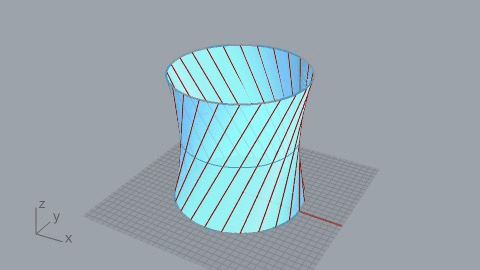
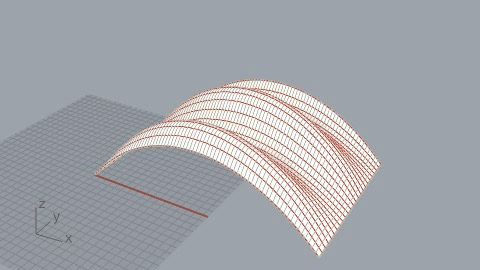
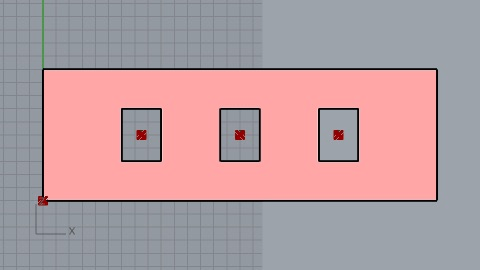
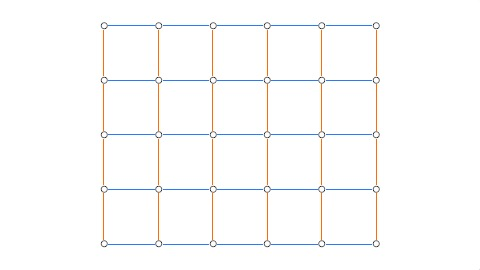
The viewport captures are in the traces. We extracted the four below and opened each one before choosing it. They are 480 by 270 pixel JPEGs, the size the harness allows.
Corrections and failures
Harness defects found while the ladder ran
- The first launch never started the agent. macOS bash 3.2 treats an empty array as unbound under
set -u, sorun-case.shstopped beforeclaude -pran. It cost $0, but it emptied the working document; the backup restored it. The control-flow test had stubbed outrun-case.sh, so it never ran the failing line. We deleted that folder on September 29. open_docwithclearFirstthrewNullReferenceExceptionand did nothing, and the client read the error as an ordinary payload. Regrading now loads saved models withrhino_call.py load.close_docon Mac left the document open while it closed the Grasshopper definitions. The reset now purges the document.- Alias drift. One Sonnet run used
claude-sonnet-5because the alias resolved differently; the other nine usedclaude-sonnet-5-5.
Checker defects and the regrade
The live checker produced four false failures from two defects:
- Layer lookup. The checker looked for objects in child layers only. Two Sonnet models (the column grid and the wall solid) had put correct geometry directly under the parent layer: 30 grid points plus 11 grid lines at 240 in, and one closed solid of exactly 1,643,520 cu in. The checker now falls back to objects of the required type anywhere under the parent.
- Slider lookup. The checker recognised Grasshopper sliders by
Name == "Number Slider". The agent had set each slider’sNameto the requested label, so both Opus window-wall runs reported 0 sliders found and failed three checks. Sliders are now identified by type. The regraded models pass all 12 checks, including the slider responses: window count 5 gives 34,560 sq in and 5 holes; wall length 480 gives 52,416 sq in and 3 holes.
We regraded the 10 saved Sonnet models and the two window-wall models from their saved files. The two false Sonnet failures became passes and every original pass held. The baseline report counts the ladder’s failures as “three checker false negatives, one empty-array crash and one open_doc failure.” We count four runs that failed live and passed on regrade, from two defects, and we could not match “three” to the run data.
The retries did not show recovery. The two Sonnet retries passed live only because the agent happened to create child layers that time. The second window-wall trial ($0.63) failed live for the same slider reason as the first and was spent only because of the defect.
Descriptions that the run data corrects
- “No plugin.” The baseline report labels the arm
withoutand “no plugin.” The init event of every no-skill run lists eight loaded plugins, including Arch Studio 1.5.1, with 173 skills. The arm had no Rhino skill; it did not have no plugin. - Claude Code version. The baseline records 2.1.284. The skill runs used 2.1.285, which the with-skill report does not mention. The Claude Code version changed between the arms.
- Budget cap. The report says $3 per case; the runner default is $10 and the runs do not record the cap (see “Inputs”).
- Level 3 Sonnet cost. $0.28 in the report, $0.2745 summed from the runs.
- Level 10 against levels 1 to 9. The baseline report says “2 to 3 times”; the run data say 3.5 times the turns, 2.2 times the cost and 6.1 times the time (see “Metrics”).
Records written after this ladder
Our later records do not change the Opus numbers: the September 30 comparison report repeats them (20 of 20, $6.31 first attempts, $6.94 with retries, 13.0 minutes, 5.5 turns for no skill; $6.44, 11.5 minutes, 6.5 turns for version 2). They qualify the ladder in three ways:
- Sonnet. A bare Sonnet 5.5 run of all 20 cases on September 30 recorded 2 real first-attempt failures and one checker false failure. The Sonnet 20 of 20 on this ladder is levels 1 to 4 only.
- Grasshopper grading. On September 30 the checker was changed to grade the active Grasshopper canvas document, because the
g1_*tools do not register theirs. We did not regrade these batches with that later version. - Isolation. The harness first isolated each run from the operator’s Claude configuration in the October 10 to 11 evaluation. Nothing in this ladder was isolated.
The import rule that followed version 2 (2854ae5) is not part of these results. Later skill versions include it, and no run isolates its effect.
Lessons learned
- When the bare model passes everything, the pass rate cannot rank the arms. All three arms passed 171 of 171 checks. The record of cost, time, turns, tool calls and errors per run is what separated them, and we had recorded it for every run. The ladder found no capability limit for Opus 5.5 with the bare MCP. The failures it produced were harness failures: the baseline report counts five.
- A capture instruction costs as much as it is followed. Version 1 took 21 captures in 20 runs and none was followed by a change to the model. By our estimate they cost $3.72, and the capture cost accounts for about $2.96 of version 1’s $5.25 extra over the baseline. Version 2 captures only when asked or needed, took none, and cost 1.02 times the baseline.
- Fixed overhead per case shows on simple cases. Version 2 added a
Skillcall and a read-the-document script to each run. At levels 1 to 9 that was about $0.03 and 6 s per case. A skill’s cost on simple cases has to be reported with its effect on hard ones: version 2’s level 10 time saving was 200 s, and its saving over all 20 cases was 85 s. - Put a gotcha in the skill where the failure recurs. The no-skill arm hit the
GH_SliderAccuracyimport location in both Grasshopper cases (and again in the second window-wall trial); the skill arms, which state the namespace ingrasshopper.md, never did. Version 1 hit theLayer(Name=...)constructor error 3 times; version 2, which states the rule, 0 times. Where no rule was stated the error recurred: version 2 had threeNameErrorimport failures (the no-skill arm had five), and the import rule was added after those runs. - Check the checker before trusting a stop. The live ladder stopped at level 10 because of a checker defect, on definitions that were correct. Four live failures out of 71 runs were checker false failures, and the
Name == "Number Slider"test failed because the agent did something the briefs allowed. Regrading saved models turned them into passes; a retry would not have. - A required report line is followed when it is required. The four-line requirement took reports from 5 of 20 to 20 of 20. That shows the agent followed an instruction; it is not a measure of report quality.
- A Grasshopper gain measured against worked examples is not a general gain. Level 10 time fell from 313 s to 114 s and cost from $1.24 to $0.90, and the skill’s reference holds a worked window wall and column grid with the checker’s own expected numbers. The measurement shows what the skill does on these two cases with their answers in the reference.
- A single run per case cannot separate a difference of about a quarter from noise. The no-skill window wall cost $0.81 on trial 1 and $0.62 on trial 2, 23 percent apart in the same arm, case and checker.
Limits
- One run per case per arm. Version 1 and version 2 each ran every case once; the no-skill arm ran each case once apart from two checker-driven retries. No variance estimate exists.
- Not held out. The four fixes in version 2 came from version 1’s runs on these 20 cases, and the Grasshopper reference carries worked definitions of two of them. Version 2’s result on these cases says little about cases the skill’s authors had not seen.
- Arms differ in more than the skill. The Claude Code version differs between the no-skill and skill arms (2.1.284 and 2.1.285), and the no-skill level 8 to 10 batch ran at 12:29 to 12:39 UTC while the skill arms ran about eight to nine hours later. Cost and time were not controlled for API latency.
- Operator configuration loaded in every arm: eight plugins, 173 skills (174 with the skill), the operator’s
CLAUDE.md, settings and automatic memory. We did not isolate runs. - Single operator and one model of record. Opus 5.5 at levels 1 to 10; Sonnet at levels 1 to 4 and no skill only. No Haiku. No second operator.
- What the grader covers. A deterministic checker of the model in the document. The trace grader and the capture judge were not run. Report content was counted by pattern, not scored. A passing check does not show that the model reads correctly as a building element.
- What the briefs test. Execution of given coordinates. Design judgement, open-ended briefs, ambiguous or conflicting briefs, Windows, Rhino 9 and irregular geometry were not tested.
- Harness changed between runs. Checker fixes and the model default changed during the batches; verdicts are from the final checker. The Sonnet batch is partly on a different model ID for one run.
- Estimates. Per-screenshot costs are our estimate from cache-write tokens, not a measured figure; the reported total costs are measured.