The rh_help Evaluation: 36 Rhino Runs With and Without an Error Helper
We ran 36 Rhino modeling runs with and without rh_help, a helper for API errors. It passed 17 of 18 and 18 of 18 runs, was installed in 9, and we removed it.
On October 11, 2026 we ran Sonnet 5.5 through 36 Rhino modeling runs to test one thing: whether rh_help, a reflection helper in version 6 of our Rhino modeling skill, changes the pass rate or the number of repeated errors, and what it costs. We had added rh_help to the skill on September 30. This was the first test of it on its own.
The helper did not change the pass rate or the number of repeated errors in these runs. With it, the checker passed 17 of 18 runs. Without it, the checker passed 18 of 18. The one failure had no script error. The agent installed the helper in 9 of 18 runs and it printed a lookup twice. Runs with the helper cost $0.44 on average and runs without it cost $0.38. We removed the helper from the skill the same day.
Results at a glance
Sonnet 5.5, six cases, three trials per case, 18 runs per arm.
v6 (with rh_help) | No rh_help | |
|---|---|---|
| Checker pass | 17/18 | 18/18 |
| Total cost | $7.90 | $6.83 |
| Cost per run | $0.44 | $0.38 |
| Total agent time | 51.4 min | 44.1 min |
| Turns | 223 | 206 |
| Output tokens | 424,611 | 355,838 |
| Scripts run | 116 | 102 |
| Script errors | 28 (24.1%) | 17 (16.7%) |
| Runs with at least one script error | 11 | 11 |
| Repeated errors (same signature again in a run) | 1 | 0 |
| Retries that ran clean on the next script | 26/28 | 16/17 |
| Runs that invoked the skill | 15/18 | 18/18 |
| Runs where the helper was installed | 9/18 | – |
| Times the helper printed a lookup | 2 | – |
Inputs
What rh_help is
rh_help is a Python function of about 20 lines. The first script of a Rhino session pastes it into Rhino’s session store (scriptcontext.sticky). Every later script’s except block calls rh_help(e), after printing the traceback. When a script fails, the helper reads the loaded RhinoCommon and Grasshopper assemblies and prints one of three things:
- For
'X' object has no attribute 'y'on a Rhino or Grasshopper type, the closest member names onXand the types that do havey. - For
'X' object is not iterableornot subscriptableon a Rhino type, the members of the .NET collectionX. - For a failed overload (
in method ... Name(), the real overloads, but only when the declaring type’s name appears in the error text.
It prints nothing for other errors. The skill told the agent to install it in the first script and to end every except block with the call.
Arms
- v6. The
rhino-modelskill at commitd66f132, with a section titled “Errors explain themselves” containing the helper, the install step in step 2, and therh_help(e)clause in the scripting rules. The skill file is 1,740 words. - No
rh_help. The same skill at commit92cd802(version 5), which is version 6 with that section and its two references removed. The diff is two files, 4 lines added and 41 removed. The skill file is 1,453 words. The commit that removed the helper from the version 6 branch (d9963bd, October 11, 13:35) has an empty diff against92cd802.
Each arm was a separate checkout, loaded into Claude Code as a plugin directory.
Cases
Six cases, three trials each. Every brief fixes the units (inches), the layer structure and the numbers; the agent chooses how to build.
| Case | Brief, abridged | Checks |
|---|---|---|
| SubD box | A SubD from a box cage with one face per side, 36 in per side from (0, 0, 0) to (36, 36, 36), default SubD options, kept as a SubD, under parent layer “L9 SubD Box”, every object named | 9 |
| SubD canopy | A SubD from a 4 by 4 face control mesh, 5 by 5 vertices at x and y = 0, 90, 180, 270, 360 in, z = 120 except the four corners at z = 0, kept as a SubD, under “L9 SubD Canopy” | 9 |
| Window wall (GH) | A live Grasshopper definition for a planar wall with sliders named Wall length (360 in), Wall height (120 in) and Window count (3); 36 by 48 in windows with 36 in sills cut as holes in one surface; default result baked as one surface | 12 |
| Column grid (GH) | A live Grasshopper definition with sliders Bays X (5), Bays Y (4) and Spacing (240 in); a (Bays X + 1) by (Bays Y + 1) point grid from the origin; default points baked | 11 |
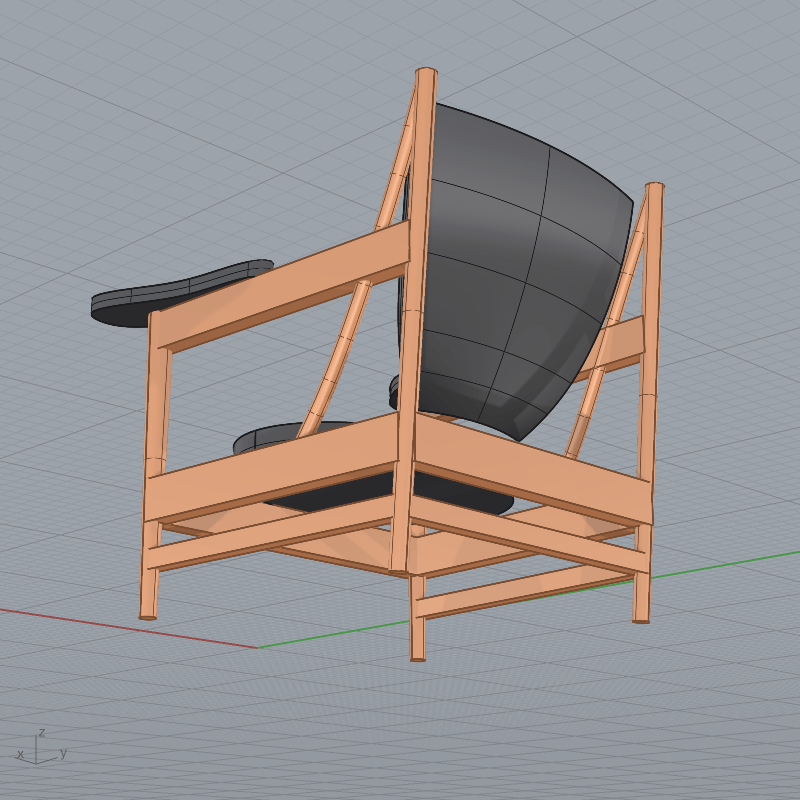
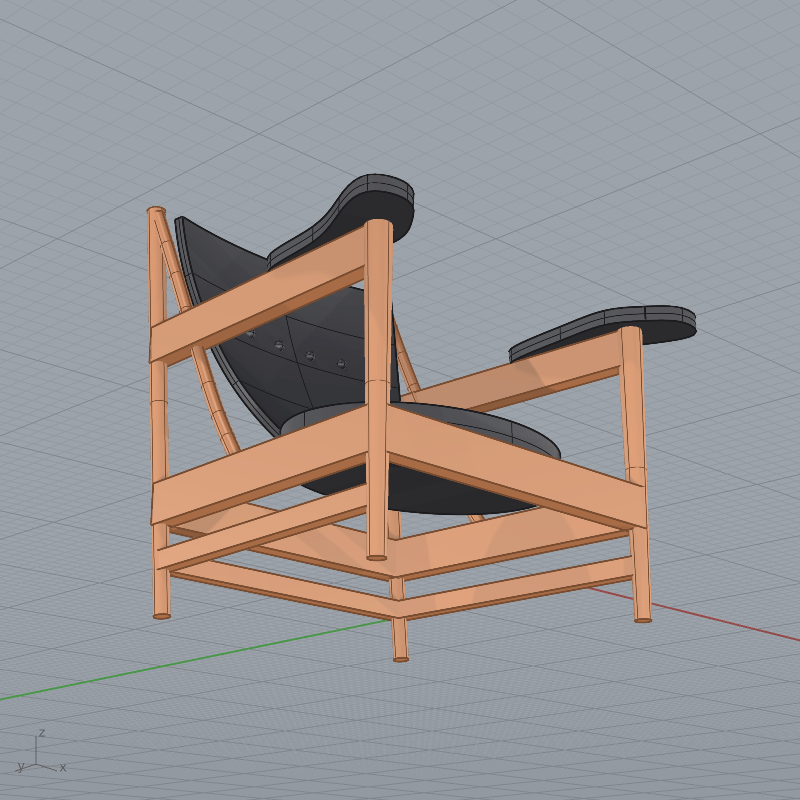
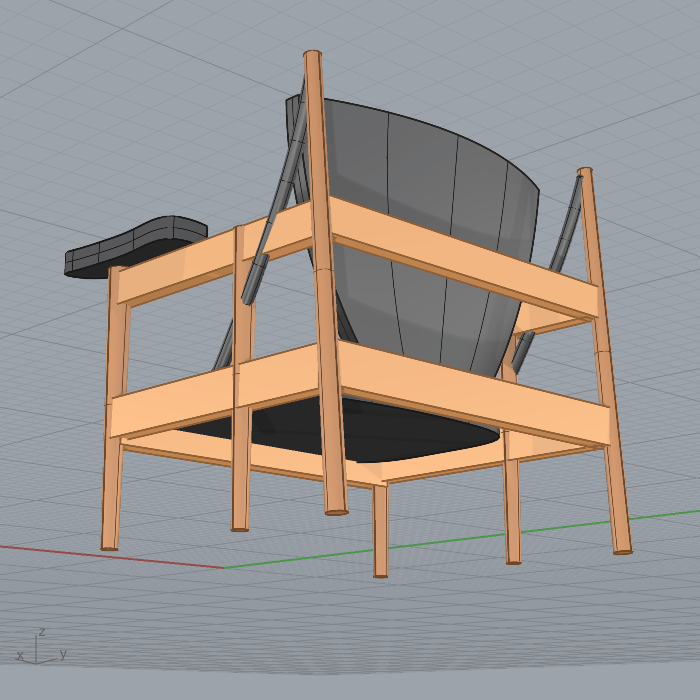
| Chieftain chair | A lounge chair modeled from four reference photos, 39 in wide, 34.5 in deep, 36.5 in high, 13.5 in seat height, with six named child layers | 18 |
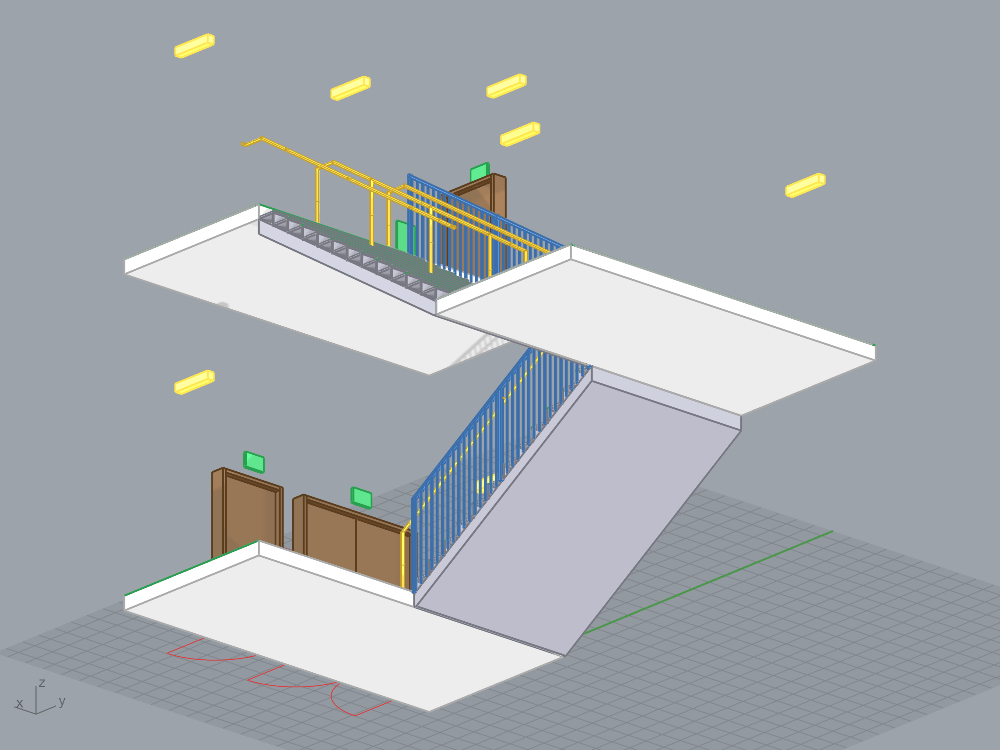
| Egress stair | A code-compliant egress stair for a 10-story office building under the 2021 IBC, one of two required stairs, two floors modeled, with ten named child layers, and a report of the code basis for each decision. Web access on for this case only | 14 |
Model, tools and versions
- Model:
claude-sonnet-5-5only. Opus was not run (see Limits). - Agent: Claude Code 2.1.296, headless (
claude -p), with the Rhino MCP connection (router version 0.3.0) to Rhino 8.35 (build 8.35.26251.13002) on Mac. - Tools allowed: all Rhino MCP tools except
ask_user, plusRead,Glob,GrepandSkill.WebFetchandWebSearchwere allowed for the egress case only.Bash,Write,EditandNotebookEditwere disallowed. - Isolation. This was the first Rhino evaluation of ours run in a scrubbed environment:
--setting-sources "", auto-memory off, a stripped process environment, and--strict-mcp-config. In all 36 runsrun.jsonrecords the loaded plugins asas(the arm’s own plugin) and three more namedcc-plugin-agents-md,cc-plugin-telemetryandcc-plugin-plugin-authoring, and no memory path. Earlier evaluations loaded the operator’s own Claude configuration, so the costs here are not comparable with theirs. - Grader: a deterministic checker (
check_model.pywith one expected-values file per case) run against the live Rhino document after each run. A run passes when every check passes. No model judge was run. The checks cover units, parent layer, per-layer object counts and types, bounding boxes, names, validity and closed solids, and for the Grasshopper cases the slider names and live components. - Budget: the harness defaults are $10 per run and a $100 cap on the matrix. The values passed to this batch are not recorded in the run folders. The 36 runs cost $14.73.
- Stall watchdog: a run with no agent output for 6 minutes (the harness default) stops the matrix. No run folder holds a stall marker.
Raw workflow
All times are Uruguay time on October 11, 2026.
- 11:43. Smoke run. One Sonnet run of the SubD box case with the v6 plugin, isolated. It passed 9 of 9 checks in 19 seconds for $0.10, with 6 turns and 2 scripts.
- 11:44. Matrix start. The A/B driver ran every case for every trial, both arms, serially in one Rhino session. Trial 1 ran v6 first, trial 2 ran the no-
rh_helparm first, trial 3 ran v6 first. Cases ran in the order SubD box, SubD canopy, window wall, column grid, chair, egress stair. - Before each run. The driver reset the Rhino document and purged layers, keeping a copy of the previous document, cleared the
rh_*keys from the session store (so the helper had to be installed again by the arm that carries it), and refused to start unless the document held no objects and no layers other than Default. All 36 runs started from an empty document in inches. - Each run. The driver gave the agent the brief as its only prompt and recorded the full stream-json trace. It then saved the document state, ran the checker through the Rhino router, saved the model as a 3dm file, and summarized the run (
run.json). - What the agent did. In 33 of 36 runs it invoked the
rhino-modelskill, loaded the Rhino tools with a tool search, and wrote RhinoCommon Python throughrun_python: 218 scripts in total, 102 without the helper and 116 with it. The Grasshopper cases read the skill’s Grasshopper reference in all 12 of their runs. The chair runs read all four photos in all 6 of theirs. The egress runs calledWebFetch3 times in the v6 arm and 2 times in the other. No run called the viewport capture tool; the images in the run folders were saved by scripts. - In the v6 arm. In the 15 runs that invoked the skill, the first script was meant to read the document and install the helper. It did so in 9 of them.
- About 13:29. End of the Sonnet runs. The matrix moved on to its first Opus run, which was refused because the run folder already existed. No Opus run exists (see Corrections).
- 13:30 to 13:32. Regrade. We corrected the error-signature parser, which had missed bare
Exception:lines, and regraded all 36 runs from their saved traces. - 13:35 and 13:36. Removal. We committed “rhino-model: drop rh_help for now” to the version 6 branch and merged the harness changes. The evaluation report was filed the same day, under a request dated October 10.
Metrics
By case
Time per run is the mean agent time. Turns, scripts, errors and repeated errors are totals over three runs. The cost range is the cheapest and most expensive of the three runs.
| Case (checks) | Arm | Pass | Cost per run (range) | Time per run | Turns | Scripts | Script errors | Repeated errors | Helper installed | Helper fired |
|---|---|---|---|---|---|---|---|---|---|---|
| SubD box (9) | v6 | 3/3 | $0.11 ($0.11–$0.12) | 18 s | 21 | 6 | 0 | 0 | 0/3 | 0 |
| SubD box (9) | No rh_help | 3/3 | $0.10 ($0.10–$0.10) | 18 s | 19 | 7 | 0 | 0 | – | – |
| SubD canopy (9) | v6 | 3/3 | $0.08 ($0.07–$0.09) | 16 s | 17 | 8 | 2 | 0 | 0/3 | 0 |
| SubD canopy (9) | No rh_help | 3/3 | $0.11 ($0.10–$0.11) | 23 s | 23 | 10 | 3 | 0 | – | – |
| Window wall (GH) (12) | v6 | 3/3 | $0.46 ($0.44–$0.48) | 154 s | 52 | 34 | 9 | 1 | 2/3 | 1 |
| Window wall (GH) (12) | No rh_help | 3/3 | $0.26 ($0.21–$0.30) | 77 s | 39 | 23 | 5 | 0 | – | – |
| Column grid (GH) (11) | v6 | 3/3 | $0.33 ($0.26–$0.43) | 90 s | 49 | 32 | 8 | 0 | 1/3 | 0 |
| Column grid (GH) (11) | No rh_help | 3/3 | $0.28 ($0.25–$0.31) | 77 s | 43 | 25 | 4 | 0 | – | – |
| Chieftain chair (18) | v6 | 3/3 | $0.43 ($0.32–$0.54) | 150 s | 50 | 24 | 6 | 0 | 3/3 | 1 |
| Chieftain chair (18) | No rh_help | 3/3 | $0.36 ($0.26–$0.53) | 134 s | 44 | 19 | 1 | 0 | – | – |
| Egress stair (14) | v6 | 2/3 | $1.22 ($0.89–$1.60) | 600 s | 34 | 12 | 3 | 0 | 3/3 | 0 |
| Egress stair (14) | No rh_help | 3/3 | $1.18 ($0.67–$1.65) | 552 s | 38 | 18 | 4 | 0 | – | – |
Cost, time and turns
With the helper, the 18 runs cost $1.07 more in total ($7.90 against $6.83), 15.6% more per run. The 18 runs took 7.3 minutes longer (51.4 against 44.1) and used 17 more turns (223 against 206), 14 more scripts (116 against 102) and 68,773 more output tokens (424,611 against 355,838). Input tokens, counting cache reads and writes, were 7,190,187 against 6,624,563.
By case, v6 cost more per run in five of six cases and less in one (SubD canopy, $0.08 against $0.11). The window wall case accounts for $0.61 of the $1.07 difference. Its three v6 runs cost $0.44 to $0.48 and its three runs without the helper cost $0.21 to $0.30. In the column grid, chair and egress cases the cost ranges of the two arms overlap.
Tool calls
| v6 | No rh_help | |
|---|---|---|
run_python | 116 | 102 |
Skill | 15 | 18 |
ToolSearch | 20 | 18 |
Read | 23 | 23 |
list_slots | 8 | 5 |
get_context | 3 | 1 |
WebFetch | 3 | 2 |
save_doc | 1 | 0 |
Grep | 1 | 1 |
| Total | 190 | 170 |
Errors and retries
A script counts as an error when its run_python result holds a traceback or a Rhino MCP “Failed” payload. A retry is the script that follows a failed script. It recovers when it runs clean.
| v6 | No rh_help | |
|---|---|---|
| Scripts | 116 | 102 |
| Script errors | 28 | 17 |
| Error rate | 24.1% | 16.7% |
| Runs with at least one error | 11 of 18 | 11 of 18 |
| Retries | 28 | 17 |
| Retries recovered on the next script | 26 | 16 |
| Repeated errors | 1 | 0 |
| Errors in API names or types | 11 | 5 |
| Other errors | 17 | 12 |
“API names or types” means a missing member on a Rhino or Grasshopper type, a .NET collection used as a Python list, or a type or overload mismatch. “Other” means results of None, empty lists, index errors, the agent’s own assertions and exceptions, and one compile error. The v6 split (11 and 17) is in the evaluation report. We applied the same rule to the other arm.
The one repeated error was in the v6 window wall trial 2, which raised the same Grasshopper type error (GH_Number into Append(GH_Interval)) twice. That run never installed the helper.
How the helper was delivered
Of the 18 v6 runs, 15 invoked the skill and 3 did not. The three were the SubD canopy runs. The helper was installed in 9 of the 15 runs that invoked the skill.
| Case | Skill invoked | Helper installed | Helper fired |
|---|---|---|---|
| SubD box | 3/3 | 0/3 | 0 |
| SubD canopy | 0/3 | 0/3 | 0 |
| Window wall (GH) | 3/3 | 2/3 | 1 |
| Column grid (GH) | 3/3 | 1/3 | 0 |
| Chieftain chair | 3/3 | 3/3 | 1 |
| Egress stair | 3/3 | 3/3 | 0 |
The harness counts a script as “wired” when its source contains the text rh_help(. That count is 35 of 116 scripts. It includes 6 scripts that installed the helper but did not call it, because the pasted definition itself contains def rh_help(e):. Scripts that call it: 29 of 116.
In the 9 runs that installed the helper, 57 scripts ran after the installing script. 32 of them had an except clause (by string match) and 24 called rh_help.
Of the 28 failed v6 scripts, 12 were in the 4 runs where the helper was never installed, and 16 were in the 9 runs where it was installed. Of those 16, 9 were in scripts that called the helper, and the helper printed a lookup for 2 of the 9. The other 7:
- 1 was a
Noneresult ('NoneType' object has no attribute 'IsSolid') and 1 was an exception the agent raised itself (“no geometry: Seat Cushion”), both on the chair. - 2 were the agent’s own assertions on the egress stair.
- 1 was a compile error (
invalid syntax), raised before anyexceptblock could run. - 2 were the Grasshopper overload error
Append(GH_Interval), one in window wall trial 1 and one in trial 3. The helper’s overload branch printed nothing in either.
The two times it fired
- Chair, trial 1, script 2.
AttributeError: type object 'CurveKnotStyle' has no attribute 'Periodic'. The helper printed:CurveKnotStyle has no Periodic; closest ['ChordPeriodic', 'UniformPeriodic', 'ChordSquareRootPeriodic']. Script 3 ran clean. - Window wall, trial 3, script 9.
AttributeError: 'Param_GenericObject' object has no attribute 'ClearPersistentData'. The helper printed:closest ['PersistentData', 'Script_ClearPersistentData', 'SetPersistentData', 'AddPersistentData']; types with ClearPersistentData: []. Script 10 ran clean.
On September 30 the helper had fired once, on an Opus SubD canopy run, and the next script was clean. That is three firings in our records, and the next script was clean after each.
Recovery without the helper
The evaluation report names 'SubDVertexList' object is not iterable as the error the helper was built for. In the three no-rh_help SubD canopy runs it occurred in two of them: two errors of that family in trial 1 (not iterable, then not subscriptable) and one in trial 2 (not iterable). In trial 1 the errors came in scripts 2 and 3 and script 4 ran clean. In trial 2 the next script ran clean. All three canopy runs passed. Across the arm, 16 of 17 retries ran clean on the next script. The one that did not was the first of the two consecutive errors in canopy trial 1.
In the v6 arm the SubD canopy runs did not invoke the skill, and none hit a SubDVertexList error.
Every run
| Case | Trial | Arm | Pass | Cost | Time | Turns | Scripts | Errors | Skill loaded | Helper installed | Helper fired |
|---|---|---|---|---|---|---|---|---|---|---|---|
| SubD box | 1 | v6 | Yes | $0.11 | 18 s | 7 | 2 | 0 | Yes | No | 0 |
| SubD box | 1 | No rh_help | Yes | $0.10 | 16 s | 6 | 2 | 0 | Yes | – | – |
| SubD box | 2 | v6 | Yes | $0.12 | 19 s | 7 | 2 | 0 | Yes | No | 0 |
| SubD box | 2 | No rh_help | Yes | $0.10 | 20 s | 7 | 3 | 0 | Yes | – | – |
| SubD box | 3 | v6 | Yes | $0.11 | 17 s | 7 | 2 | 0 | Yes | No | 0 |
| SubD box | 3 | No rh_help | Yes | $0.10 | 18 s | 6 | 2 | 0 | Yes | – | – |
| SubD canopy | 1 | v6 | Yes | $0.08 | 16 s | 6 | 3 | 0 | No | No | 0 |
| SubD canopy | 1 | No rh_help | Yes | $0.11 | 26 s | 8 | 4 | 2 | Yes | – | – |
| SubD canopy | 2 | v6 | Yes | $0.09 | 22 s | 7 | 4 | 2 | No | No | 0 |
| SubD canopy | 2 | No rh_help | Yes | $0.11 | 25 s | 9 | 4 | 1 | Yes | – | – |
| SubD canopy | 3 | v6 | Yes | $0.07 | 12 s | 4 | 1 | 0 | No | No | 0 |
| SubD canopy | 3 | No rh_help | Yes | $0.10 | 18 s | 6 | 2 | 0 | Yes | – | – |
| Window wall (GH) | 1 | v6 | Yes | $0.45 | 174 s | 17 | 11 | 2 | Yes | Yes | 0 |
| Window wall (GH) | 1 | No rh_help | Yes | $0.30 | 93 s | 15 | 10 | 3 | Yes | – | – |
| Window wall (GH) | 2 | v6 | Yes | $0.48 | 150 s | 18 | 12 | 4 | Yes | No | 0 |
| Window wall (GH) | 2 | No rh_help | Yes | $0.21 | 59 s | 11 | 6 | 1 | Yes | – | – |
| Window wall (GH) | 3 | v6 | Yes | $0.44 | 139 s | 17 | 11 | 3 | Yes | Yes | 1 |
| Window wall (GH) | 3 | No rh_help | Yes | $0.26 | 79 s | 13 | 7 | 1 | Yes | – | – |
| Column grid (GH) | 1 | v6 | Yes | $0.29 | 82 s | 15 | 9 | 2 | Yes | Yes | 0 |
| Column grid (GH) | 1 | No rh_help | Yes | $0.28 | 79 s | 15 | 9 | 1 | Yes | – | – |
| Column grid (GH) | 2 | v6 | Yes | $0.43 | 122 s | 21 | 15 | 4 | Yes | No | 0 |
| Column grid (GH) | 2 | No rh_help | Yes | $0.31 | 87 s | 16 | 10 | 2 | Yes | – | – |
| Column grid (GH) | 3 | v6 | Yes | $0.26 | 66 s | 13 | 8 | 2 | Yes | No | 0 |
| Column grid (GH) | 3 | No rh_help | Yes | $0.25 | 66 s | 12 | 6 | 1 | Yes | – | – |
| Chieftain chair | 1 | v6 | Yes | $0.43 | 148 s | 17 | 9 | 2 | Yes | Yes | 1 |
| Chieftain chair | 1 | No rh_help | Yes | $0.26 | 98 s | 11 | 3 | 0 | Yes | – | – |
| Chieftain chair | 2 | v6 | Yes | $0.32 | 118 s | 12 | 3 | 0 | Yes | Yes | 0 |
| Chieftain chair | 2 | No rh_help | Yes | $0.28 | 101 s | 12 | 4 | 0 | Yes | – | – |
| Chieftain chair | 3 | v6 | Yes | $0.54 | 183 s | 21 | 12 | 4 | Yes | Yes | 0 |
| Chieftain chair | 3 | No rh_help | Yes | $0.53 | 202 s | 21 | 12 | 1 | Yes | – | – |
| Egress stair | 1 | v6 | Yes | $1.18 | 572 s | 11 | 4 | 1 | Yes | Yes | 0 |
| Egress stair | 1 | No rh_help | Yes | $1.65 | 773 s | 13 | 6 | 2 | Yes | – | – |
| Egress stair | 2 | v6 | Yes | $1.60 | 763 s | 14 | 6 | 2 | Yes | Yes | 0 |
| Egress stair | 2 | No rh_help | Yes | $0.67 | 336 s | 9 | 3 | 0 | Yes | – | – |
| Egress stair | 3 | v6 | No | $0.89 | 464 s | 9 | 2 | 0 | Yes | Yes | 0 |
| Egress stair | 3 | No rh_help | Yes | $1.22 | 546 s | 16 | 9 | 2 | Yes | – | – |
Outputs
Each of the 36 runs left a run folder with the full agent trace, the checker’s verdict line by line, the document state before and after, a saved 3dm of the model, a geometry-only copy of the model, the files the agent wrote in its working folder, and a run.json summary of the figures above. The evaluation report carries a results.json with one row per run. Those records are internal. We have not published a reproduction package.
The only visual outputs are Rhino captures the agents saved to their working folders during some runs. We opened each before choosing these four.
Corrections and failures
The one failed run. Egress stair, v6, trial 3 passed 13 of 14 checks. It failed closed Landings: four objects on the Landings layer were not closed. Their names describe clearance zones: “Required 44in Clear Landing” and “Floor Landing Zone (80in deep: 36 swing + 44 clear)” at each of the two levels. The run had no script errors. It installed the helper in the first of its 2 scripts. It was the cheapest v6 egress run ($0.89) and used 2 scripts, the fewest of the six egress runs in either arm.
No voided runs, no reruns. All 36 runs ended with the stop reason “completed”, no error flag and no permission denials.
Error-signature parser. The first version of the parser did not read bare Exception: lines, which affected repeated-error counts. We corrected it during analysis and regraded all 36 runs from their saved traces. One signature is still recorded as the bare word Error (egress v6 trial 1): the compile error invalid syntax (Error CPYC01). Signatures are heuristic: the final exception line with numbers and paths blanked.
A count that overstated wiring. The harness reported 35 scripts “wired” to call the helper. That count includes 6 install scripts that contain the helper’s definition but no call. The number of scripts that call it is 29.
The skill was not invoked in three v6 runs. The three v6 SubD canopy runs never called the Skill tool, so they ran without the skill and without the helper. The same case invoked the skill in 3 of 3 runs in the other arm. We did not examine why. The canopy row in the v6 arm is therefore a no-skill row for these three runs. The evaluation report states that the helper was installed in 9 of 18 runs and never on the two SubD cases; it does not record that the skill was absent in the canopy runs.
An earlier explanation of cost that this batch does not support. On September 30 we attributed the extra cost of the Opus v6 ladder run (16%) to the harness reinstalling the helper after each Rhino reset. In this batch the helper was installed in 9 of 18 runs, and the cost did not follow installation. In the window wall case the v6 run that never installed it was the most expensive of the three ($0.48, against $0.45 and $0.44). We did not separate the cost of the install script from the cost of the longer skill text (287 more words), so this batch neither confirms nor rules out the earlier explanation.
Opus run. The batch log ends with a traceback and an exit code of 1, and the last-run log reads “refusing to reuse” the run folder for an Opus 5.5 v6 SubD box run. That was at 13:29, directly after the last Sonnet run. A reset snapshot for that run exists. No Opus run folder or result exists. The evaluation report says we paused Opus (planned at 36 runs, about $30) after Sonnet. We have not reconciled the log with that account.
Smoke test cost. The evaluation report gives about $0.02 for the isolation smoke tests. The smoke batch we hold has one run, which cost $0.10. The comparison runs that checked whether the agent saw the operator’s CLAUDE.md are not in that batch, so we could not check the $0.02.
What later work did with this result. The removal stood. On October 20 the stair pilot’s A1 baseline was recorded as the version 6 branch at d9963bd, “v5 content, rh_help removed”. The version 7 plan repeats the 9-of-18 and 16% figures and sets a rule that a change merges only if an A/B shows it helps. The evaluation report proposed a tool-side version, a run_python wrapper or MCP error hook. We found no record that it was built or tested.
Lessons learned
- Measure delivery before effect. We counted installs, scripts that call the helper and firings per run from the traces. The helper reached the agent in 9 of 18 runs and printed in 2. Pass rate in those 18 runs says little about the helper when the helper ran in so few of them. To check:
rh_help_installed,rh_help_wiredandrh_help_firedin eachrun.json. - Confirm that every arm loaded the skill. In 3 of 18 v6 runs the agent never invoked the skill, so those runs did not test the arm. To check: the
Skillcount in each run’stool_calls. A run with none is a different arm. - A helper’s reach is set by the error text it matches. Of 28 v6 errors, 11 were API names or types, which is the family its patterns cover. Of the 9 failed scripts that called the helper, 2 printed. The two Grasshopper overload errors printed nothing. To check: run the helper’s matching against the logged error text before shipping it.
- Measure recovery without the helper first. Without it, 16 of 17 retries ran clean on the next script, and the SubD error it was written for was fixed within two scripts of its first error in both runs that hit it. With so little left to recover, the helper had little to improve.
- Count what the counter counts. A script was “wired” if its text contained
rh_help(, which included the definition. Reading the saved traces gave 29 scripts that call it, not 35. After a parser or counter change, regrade from the traces; keep the traces. - Report cost with ranges. The $1.07 difference in total cost is concentrated in one case ($0.61 in window wall). In three cases the two arms’ per-run cost ranges overlap.
- Compare isolated runs only with isolated runs. These are the first isolated Rhino runs we have, and their absolute costs are not comparable with earlier batches.
Limits
- Sonnet 5.5 only. Opus was not run. On September 30, Opus v6 fired the helper once in 20 ladder runs, and we expect Opus to leave it less to fix. That expectation is not tested here.
- Three trials per cell. The error-rate difference (24.1% against 16.7%) and the cost difference are within what three trials can separate: 11 runs in each arm had at least one error. One failure and one repeated error are too few events to test.
- One operator, one machine, one Rhino build. One person ran the batch on one Mac. We did not vary Rhino version, platform or host.
- Checker only. The egress code judge and the chair reference judge were not run. Saved models allow replay. The checks confirm geometry, counts and names against the brief. They do not assess whether the egress stair meets the code or whether the chair resembles the photos.
- Fixed briefs. Each brief fixed every design decision. This says nothing about a model planning its own build with a user.
- One wording of the instruction. We tested the helper delivered through one skill text. We did not test a different wording, a persistent install across cases, or a tool-side version.
- Helper coverage. Only the helper’s three patterns were tested. Eleven of the 28 v6 errors were in the family those patterns match.
- The skill was absent in three runs. The v6 SubD canopy runs did not load it (see Corrections), so the v6 arm has 15 runs with the skill.
- Heuristic error signatures. A repeat means the same final exception line with numbers and paths blanked.