N.°01 — Norma
Norma
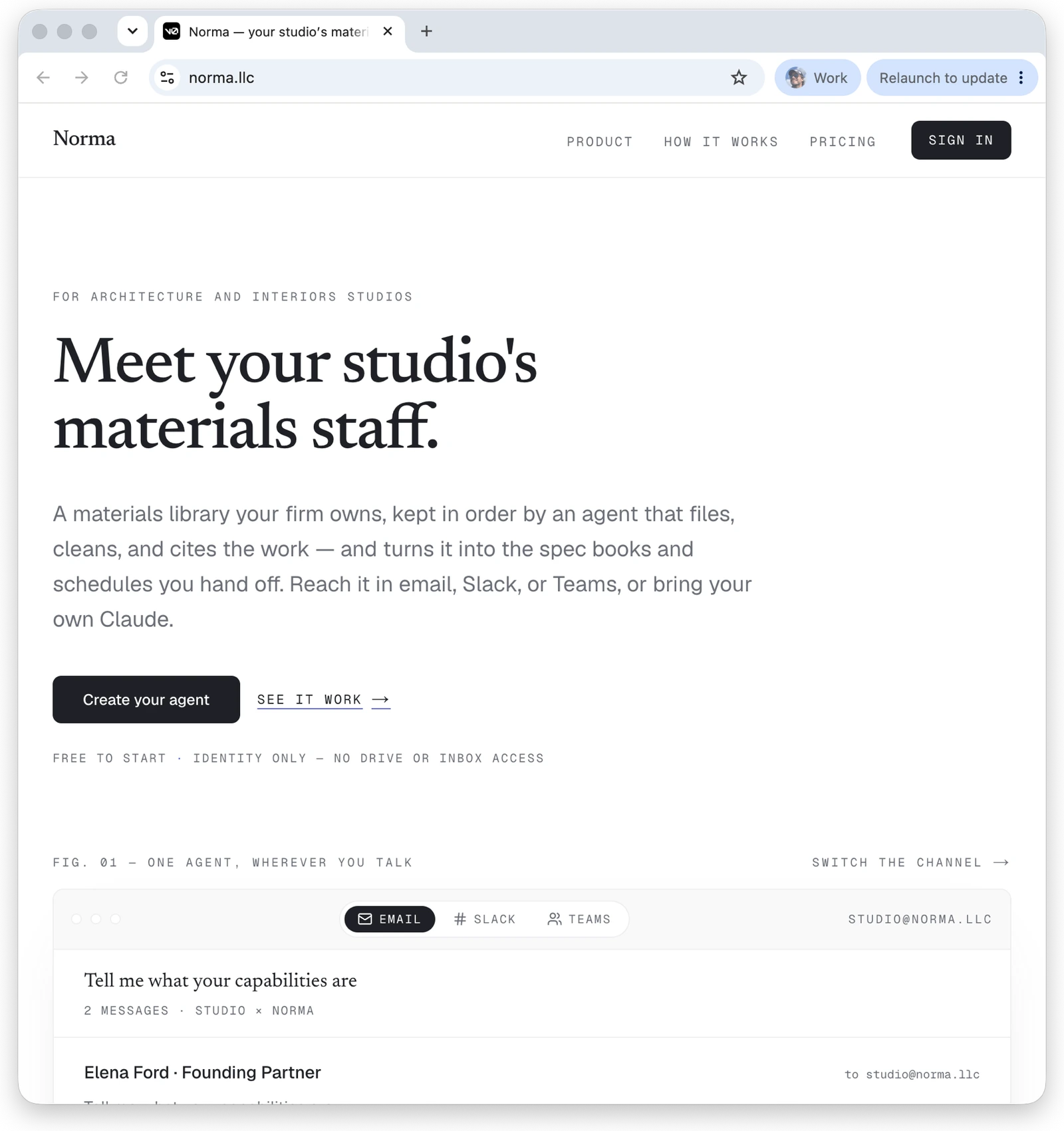
A materials library and agent for architects and designers.
- Materials library
- Materials agent
- MCP
- FF&E
02 What it is
A materials library agents can actually use — with a worker already inside.
Norma is the product and materials memory layer for architects and designers, with a ready-to-use agent on top. It is not just a searchable catalog. It is a structured, source-backed library where every source, product fact, correction, review decision, vendor note, substitution, approval, and project convention becomes reusable studio knowledge — and an agent that does the materials work directly.
01
The library
A governed materials memory layer that understands industry schemas, ingests messy product sources, and exposes a 76-tool runtime. Schema-light, multi-category, self-healing, variant-ready.
02
The agent
Forward emails, PDFs, quotes, links, and schedules. Norma extracts product data, cites evidence, stages review, and updates the library — through email and chat.
03
Bring your own agents
Studios using Claude, ChatGPT, Vercel Eve, or custom multi-agent systems can connect directly to Norma through MCP with the same library, tools, permissions, and provenance.
03 Why it exists
Product and material data in architecture does not live in one clean database.
It lives in FF&E schedules, spec books, vendor quotes, cut sheets, public product pages, PDFs, spreadsheets, emails, substitutions, lead-time notes, pricing context, and prior project decisions. Norma gives that messy practice knowledge a governed structure that agents can use.
01
Industry schemas
Norma understands FF&E rows, spec-book sections, material schedules, product lists, project tags, alternates, approvals, substitutions, source authority, freshness, uncertainty, review state, and provenance.
02
Firm memory
Approved facts, corrections, vendor notes, source evidence, preferences, substitutions, and decisions become reusable knowledge scoped to the firm.
03
Agent access
Work through Norma's own agent, or connect approved AI tools such as Claude, ChatGPT, Vercel Eve, and custom firm workflows through MCP.
04 Ingestion
Ingestion is not just upload.
Norma ingests the sources where material decisions actually live: vendor pages, PDFs, quotes, spreadsheets, schedules, cut sheets, catalogs, email attachments, and product lists. It classifies the source, extracts product facts, preserves evidence, maps columns, detects missing fields, identifies possible duplicates, stages ambiguous records for review, and adds approved products to the firm library.
Classify
Understands the source
Norma distinguishes vendor pages, manufacturer PDFs, dealer quotes, studio spreadsheets, schedules, catalogs, email threads, and uploaded files instead of treating every input as generic text.
Extract
Turns artifacts into records
Product names, manufacturers, variants, finishes, dimensions, certifications, pricing context, lead times, URLs, and source evidence become structured product records.
Review
Stages uncertainty
Ambiguous matches, low-confidence fields, duplicates, conflicts, and consequential changes become review state instead of silent overwrites.
Admit
Builds library memory
Useful facts and products become governed library records that future agents can search, audit, correct, and reuse.
05 Schema value
Flexible enough for messy product data, structured enough for reliable reuse.
Norma is schema-light, multi-category, self-healing, and variant-ready. It gives agents enough structure to reason, compare, audit, and export product data without forcing the studio into a brittle universal schema. Behind the scenes, 76 specialized tools parse product URLs, read PDFs, normalize schedule rows, resolve product identity, enrich missing fields, audit stale links, generate spec sheets, and project trusted records into Google Sheets.
Schema-light
Works before your data is clean
Norma maps inconsistent columns and project-specific terminology into reviewable product records while preserving source context, unmapped fields, and original evidence.
Multi-category
Built for mixed libraries
Norma supports FF&E, materials, fixtures, lighting, appliances, hardware, surfaces, assemblies, acoustic products, systems, and project-specific categories. The schema adapts by product type instead of pretending every row has the same fields.
Self-healing
Learns from corrections
When a designer fixes a manufacturer, remaps a column, rejects a duplicate, corrects a finish, or reverts an import, Norma records that decision as a future signal. The same mistake should become less likely next time.
Variant-ready
Handles configurations
Norma treats variants and configurations as first-class enough for specification, comparison, substitution, and export: finish, color, size, upholstery, SKU, option set, performance rating, lead time, and project-specific selection.
06 Working with Norma
Email is where product work already happens.
Vendors send quotes by email. Reps send cut sheets by email. Designers forward product links, PDFs, alternates, pricing notes, and substitution questions by email. Norma meets the work where it already lives: forward a message and get a useful, cited, reviewable result without opening a new system or copying data between tools.
Read
Reads real sources
Norma works from vendor emails, product links, PDFs, quotes, spreadsheets, schedules, catalogs, cut sheets, and spec books.
Extract
Extracts product data
It identifies products, manufacturers, variants, finishes, dimensions, certifications, lead times, pricing context, URLs, and source evidence.
Review
Asks for review
When work is ambiguous, low-confidence, or consequential, Norma stages the result for review instead of silently overwriting the record.
Update
Updates the library
Approved facts, corrections, notes, substitutions, and decisions become part of the firm library.
Prepare
Prepares outputs
Norma prepares rows, notes, comparisons, source refreshes, spec sheets, export candidates, and Sheet projections.
07 Example workflows
Quote
Vendor quote to library record
Forward a vendor quote. Norma extracts product names, pricing context, lead times, variants, and source evidence, then stages reviewable library updates.
URL
Product page to spec-ready data
Send a product URL. Norma parses the page, captures product facts, cites the source, and adds the record to the library.
Sheet
Schedule cleanup
Send a messy spreadsheet. Norma maps inconsistent columns, normalizes rows, flags missing fields, and prepares clean review state.
Audit
Stale-product audit
Ask Norma to check a product list. It reviews URLs, lead times, availability, pricing context, and broken links.
08 Library layers
| Layer | What it contains | Privacy |
|---|---|---|
| Firm library | Specs, quotes, pricing, corrections, preferences, vendor history, approvals, substitutions, project conventions | Private to the firm |
| Review state | Verified, review, stale, missing fields, duplicate hints, import receipts, permission history | Visible to the firm |
| Shared product facts | Manufacturer specs, public SKUs, dimensions, finishes, certifications, source URLs | Shared only through explicit admission rules |
The library is the product boundary. Public facts can improve the baseline. Review state keeps the work accountable. Firm memory preserves the practice. Sheets and spec books remain useful outputs, not the only source of truth.
09 Built for
01
Architects and designers
FF&E schedules, spec books, and product decisions that stay sourced, current, and reusable across projects.
02
Project teams
Product, material, finish, fixture, and substitution decisions with provenance instead of orphaned PDFs and stale spreadsheet rows.
03
Small studios
The product librarian, specs manager, procurement analyst, and data steward most teams cannot hire full time.
04
Product-heavy teams
Studios whose advantage comes from how they specify, source, substitute, approve, and remember.
10 Bring your own agents
Norma's agent is not the only way to use Norma.
Studios that already work in Claude, ChatGPT, Vercel Eve, or another agent setup can connect directly to Norma through MCP. The firm keeps its preferred agent interface; Norma remains the materials library, schema layer, tool runtime, and memory boundary — same tools, permissions, provenance, and review state.
Turnkey
When you want a ready materials worker
Work through email and chat when vendor messages, PDFs, links, quotes, and schedules already arrive in the team's normal channels and you want Norma to do the work directly.
MCP
When you have your own harness
Connect your Claude, ChatGPT, Vercel Eve, or custom agents to the same governed materials library.
Give your studio a materials library and the agent to run it.
Norma turns vendor emails, PDFs, links, quotes, and schedules into governed, cited, reusable studio knowledge.
Visit norma.llc →