Modeling a Chair in Rhino From Four Photos: Opus 5.5, Sonnet 5.5 and Three Skill Versions
We had Claude Opus 5.5 and Sonnet 5.5 model a Chieftain chair in Rhino from four photos: 12 runs, three skill versions. Opus scored 7–8 of 9; Sonnet 4–5.
On September 30, 2026 we asked Claude to model a lounge chair, Finn Juhl’s Chieftain Chair, in Rhino from four photographs and four dimensions. We ran two models, Opus 5.5 and Sonnet 5.5, in three arms: no Rhino skill, version 2 of our rhino-modeling skill and version 3. Each model and arm had two trials, 12 runs in all. The case was new to our Rhino evaluations: the model had to read the chair’s structure from photos. The skill is part of the Rhino work we are building for Arch Studio.
A separate judge scored each model against nine features read from the photos. Opus scored 7 or 8 of 9 in every arm. Sonnet scored 4 or 5 in every arm. The points summed per arm are identical within each model: 15, 15 and 15 for Opus, 9, 9 and 9 for Sonnet. All six Sonnet models scored 0 on the diagonal strut that forks into the rear post and 0 on the flared, curled armrest tips. We found no effect of skill version on which photo features appeared in the model.
The deterministic checker, after we widened one limit and regraded, passed 11 of the 12 models and did not separate the two models. The 12 runs cost $11.85 in agent spend and $4.69 in judge spend. A first attempt at the batch stopped before any agent ran; the corrections section says what happened.
Results at a glance
Figures are means of two trials. “Checker” counts models that passed all 18 checks after the regrade described under corrections.
| Model | Arm | Judge, trial 1 / trial 2 (of 9) | Checker | Cost | Time | Turns |
|---|---|---|---|---|---|---|
| Opus 5.5 | No skill | 8 / 7 | 1 of 2 | $1.70 | 273 s | 25.0 |
| Opus 5.5 | Skill v2 | 7 / 8 | 2 of 2 | $1.31 | 277 s | 19.5 |
| Opus 5.5 | Skill v3 | 8 / 7 | 2 of 2 | $1.29 | 308 s | 19.5 |
| Sonnet 5.5 | No skill | 5 / 4 | 2 of 2 | $0.63 | 140 s | 20.5 |
| Sonnet 5.5 | Skill v2 | 4 / 5 | 2 of 2 | $0.54 | 121 s | 12.5 |
| Sonnet 5.5 | Skill v3 | 5 / 4 | 2 of 2 | $0.46 | 144 s | 16.5 |
By model, across all six runs: Opus averaged 7.5 of 9, $1.43 and 286 s; Sonnet averaged 4.5 of 9, $0.54 and 135 s. Sonnet’s mean cost was 38% of Opus’s. For Opus the cost ranges of the three arms overlap. For Sonnet the no-skill runs cost $0.58 and $0.68 and the v3 runs $0.43 and $0.50, with the v2 runs ($0.44 and $0.63) overlapping both. Two trials per cell is too few to attach an interval to those differences.
Inputs
The brief. Every run received this text, unchanged:
Model the lounge chair shown in the four reference photos in the working folder: view-1-three-quarter.png, view-2-front.png, view-3-rear-three-quarter.png and view-4-post-detail.png. Overall it is 39 in wide, 34.5 in deep and 36.5 in high, with a 13.5 in seat height. Centre it on x = 0 with the front of the armrests at y = 0, the back toward +y and the floor at z = 0. Put the model under a parent layer named T5 Chieftain Chair with child layers Legs, Rails, Seat, Back, Armrests and Buttons, and name every object.
The brief fixes placement and the six child layer names. It does not say on which layer the diagonal struts go.
The photos. Four product photographs of the chair: a front three-quarter view (771 × 800 px), a front elevation (1000 × 1500 px), a rear three-quarter view (1000 × 1500 px) and a close-up of a rear post and strut fork (800 × 1229 px). They are third-party images. Our records say they were supplied on September 29 and pinned by SHA-256 hash outside version control. They carry no watermark or embedded metadata, and our records do not name the photographer or publisher. We do not reproduce them here.
Models. claude-opus-5-5 and claude-sonnet-5-5, full model IDs pinned, run through Claude Code 2.1.285.
Arms.
- No skill: no Rhino skill in the session.
- Skill v2 (commit
faf2f00, September 29):rhino-modelingwith captures only when asked, references read only when needed, and four required report lines. - Skill v3 (commit
21296f9, September 30, 08:10): v2 plus lessons from building this chair. For image briefs it says to read every supplied view first, treat stated dimensions as fixed and label everything read off the images as an estimate. It adds an import rule, a rule that booleans need clear overlap, a volume-sign check for lofts, a SubD rescale step, and an instruction to render in the script and read the saved PNG rather than use the capture tool.
Rhino and harness. Rhino 8.35.26251.13002 for Mac, Rhino MCP Platform 0.1.5, document units inches. Each run was one claude -p session with only the Rhino MCP server (--strict-mcp-config). It could use every Rhino tool, plus Read, Glob, Grep and Skill. Bash, Write, Edit and web tools were denied. The per-run spend cap was the harness default of $10, and we recorded no override; the most expensive run cost $1.85. The photos were copied into each run’s working folder. Before each run the runner backed up the open Rhino document and emptied it.
Configuration that was loaded. These runs predate our isolated harness. Every run loaded the operator’s own Claude configuration: the init event of every run lists eight plugins, including Compound Engineering and one named as, and an auto-memory path. The no-skill runs listed no Rhino skill among their 173 skills; the v2 and v3 runs listed 174, the extra one being rhino-modeling. A later evaluation (October 10 to 11) states that earlier Rhino runs loaded this configuration in every arm and that absolute costs are not comparable with isolated runs.
Graders.
- Checker. 18 checks against an expected file: units; parent layer; object counts and types on each of six child layers; overall size 39 × 34.5 × 36.5 in within 0.75 in; every object named; every object valid; every layer’s objects closed solids; seat height 13.5 in at two probe points within 0.4 in. The commit record says it was validated on a reference model (18 of 18) and on three planted defects (a missing button, a raised seat and a 90% scale), which each failed.
- Reference judge. Rhino renders the model in three shaded views (front, three-quarter, rear three-quarter, 640 × 640 px). A separate Claude call,
claude-opus-5-5, compares the renders with the photos against nine features and scores each 0 or 1, told to score 0 for anything missing, clearly different or only partly present. It sees no arm, model or trace. It cost $0.38 to $0.40 per run. The features: (1) four legs, front pair tapered and round; (2) near-vertical rear posts with tips hooking forward; (3) a diagonal strut on each side forking into the rear post; (4) a large leaning back panel with a top edge curving up toward the post tips and sides tapering to a rounded bottom; (5) four buttons in a shallow row; (6) a thin upholstered seat pad on a wooden frame above a deep front rail; (7) long thin armrest paddles whose front tips flare outward and curl down; (8) a separate horizontal rail under each armrest; (9) a horizontal rail behind the back joining the rear posts. - Judge validation. Before the runs we replayed the judge on a reference model of the chair and on a degraded copy with the buttons, arm rails and rear rail removed. With the nine-feature rubric the reference scored 9 of 9 and the degraded copy 6 of 9, with exactly features 5, 8 and 9 at 0. An earlier replay with an eight-feature rubric scored the reference 8 of 8 and the degraded copy 6 of 8. One replay each, no repeats.
Raw workflow
The sequence below comes from the run traces and the commit history.
- Setup, 08:02 to 08:10 (UTC−3). The photos were hashed and placed outside the repository. The judge replays ran at 08:05 to 08:07. The harness commit for the case, the judge and the matrix runner landed at 08:09:11.
- First batch attempt, 08:09:11. It stopped at the first run’s document reset, before any agent started.
- Restart, 08:09:56. The batch ran in blocks: Opus no skill (trials 1 and 2), Opus v2, Sonnet no skill, Sonnet v2, then Opus v3 and Sonnet v3. The first run started at 08:09:57 and the last finished at about 08:57. Arms were not interleaved.
- Per run. The runner reset the Rhino document, copied the photos into a fresh working folder, recorded the document state, started the agent, then after the agent stopped recorded the state again, ran the checker, saved the model and ran the judge.
What the agents did. All 12 runs completed (stop reason completed, no error, no permission denials). The shape of each run was the same:
- Invoke the
rhino-modelingskill (arms v2 and v3), before or after reading the photos. Skill calls: 3 of 4 v2 runs and 4 of 4 v3 runs. Sonnet v2 trial 1 never invoked it, so that run had the skill available and used none of it. - Read the four photos with the Read tool.
- Load the Rhino tool schemas with ToolSearch.
- One
run_pythoncall to read units, layers and object count. - Between 2 and 14 further
run_pythonscripts that built the parts, measured the bounding box and tested that each object was a closed solid. - Look at the result. This step differed by arm and is described next.
- Write a final report with a table of layers and objects and a list of assumptions.
Every run started from a document with 0 objects, inches, and one leftover layer named L1 Column Grid from the previous case.
Seeing the model. In the no-skill and v2 arms the agents used the get_viewport_image tool: 22 calls across the 8 runs. Six returned an error because the result exceeded the token limit. Eight returned “Viewport is empty”, all in two runs (Opus no skill trial 2 and Sonnet no skill trial 1). Eight succeeded in the sense that the tool returned its JSON, but the image arrived as base64 text inside a text block, where a Read of a PNG file returns an image block. Of the 8 no-skill and v2 runs, 7 finished without seeing their model: six final reports say the capture was unreadable, and one (Sonnet no skill trial 2) says it did not check the capture visually. The eighth, Opus no skill trial 2, wrote its own PNGs from a run_python script and read them (4 reads). All four v3 runs did the same, as the v3 skill instructs (2 to 4 reads each) and made no capture-tool calls.
Metrics
Per run. “Errors” counts run_python calls whose payload returned an exception. “Renders read” counts Read calls on PNGs the agent wrote itself. Input tokens include cache reads and writes. “Checker at run” is the verdict recorded when the run ended; “regraded” is after the limit change described under corrections.
| Model | Arm | Trial | Cost | Time | Turns | Input / output tokens | run_python (errors) | Capture-tool calls | Renders read | Objects | Judge | Checker at run | Checker regraded |
|---|---|---|---|---|---|---|---|---|---|---|---|---|---|
| Opus | None | 1 | $1.55 | 215 s | 18 | 884k / 19.6k | 8 (0) | 3 | 0 | 22 | 8 | 16/18 | 17/18 |
| Opus | None | 2 | $1.85 | 330 s | 32 | 2,080k / 29.2k | 15 (1) | 5 | 4 | 21 | 7 | 17/18 | 18/18 |
| Opus | v2 | 1 | $1.03 | 178 s | 16 | 533k / 17.8k | 6 (1) | 2 | 0 | 21 | 7 | 17/18 | 18/18 |
| Opus | v2 | 2 | $1.58 | 377 s | 23 | 1,091k / 39.6k | 14 (4) | 1 | 0 | 21 | 8 | 18/18 | 18/18 |
| Opus | v3 | 1 | $1.43 | 344 s | 21 | 793k / 36.9k | 9 (1) | 0 | 4 | 22 | 8 | 18/18 | 18/18 |
| Opus | v3 | 2 | $1.14 | 272 s | 18 | 579k / 28.5k | 7 (1) | 0 | 3 | 22 | 7 | 18/18 | 18/18 |
| Sonnet | None | 1 | $0.68 | 149 s | 28 | 970k / 15.7k | 9 (1) | 8 | 0 | 23 | 5 | 17/18 | 18/18 |
| Sonnet | None | 2 | $0.58 | 130 s | 13 | 407k / 18.5k | 6 (2) | 1 | 0 | 21 | 4 | 17/18 | 18/18 |
| Sonnet | v2 | 1 | $0.44 | 107 s | 11 | 309k / 12.4k | 3 (0) | 1 | 0 | 20 | 4 | 17/18 | 18/18 |
| Sonnet | v2 | 2 | $0.63 | 135 s | 14 | 363k / 20.8k | 5 (2) | 1 | 0 | 25 | 5 | 17/18 | 18/18 |
| Sonnet | v3 | 1 | $0.43 | 143 s | 14 | 342k / 17.5k | 4 (0) | 0 | 2 | 24 | 5 | 17/18 | 18/18 |
| Sonnet | v3 | 2 | $0.50 | 145 s | 19 | 669k / 17.9k | 8 (0) | 0 | 2 | 21 | 4 | 17/18 | 18/18 |
Sonnet v3 trial 2 also made one call to a tool that does not exist (run_python_placeholder), which returned an error; it is counted in the 19 turns. Script errors totaled 4 across the 4 no-skill runs (38 scripts), 7 across the 4 v2 runs (28 scripts) and 2 across the 4 v3 runs (28 scripts). The 13 errors were 7 AttributeError, 3 IndexError, 2 NameError and 1 TypeError.
Judge features by model, number of runs scoring 1 (six runs each):
| Feature | Opus | Sonnet |
|---|---|---|
| 1. Four legs, front pair tapered | 6 | 5 |
| 2. Rear posts with forward-hooked tips | 5 | 1 |
| 3. Diagonal strut forking into the rear post | 5 | 0 |
| 4. Leaning back panel, shaped top edge and tapered bottom | 4 | 1 |
| 5. Four buttons | 6 | 6 |
| 6. Thin seat pad on a wooden frame | 3 | 4 |
| 7. Armrest tips flared and curled | 4 | 0 |
| 8. Separate arm rails | 6 | 6 |
| 9. Rear rail joining the posts | 6 | 4 |
| Total | 45 | 27 |
By arm, the judge points are: Opus 15, 15 and 15 for no skill, v2 and v3; Sonnet 9, 9 and 9. Sonnet scored 0 on features 3 and 7 in all six runs and on feature 2 in five of six. Opus’s three misses on feature 6 (the seat) were two v2 runs and one v3 run.
Ladder regression, run the same day. The same session also re-ran our 20-case complexity ladder, one run per case, with the same skill versions. These numbers come from other batches and are included for context.
| Ladder (20 cases) | Cost, first attempts | Cost with retries | Time | Turns per case |
|---|---|---|---|---|
| Opus, no skill | $6.31 | $6.94 | 13.0 min | 5.5 |
| Opus, v2 | $6.44 | $6.44 | 11.5 min | 6.5 |
| Opus, v3 | $6.30 | $6.30 | 11.4 min | 6.5 |
| Sonnet, no skill | $4.48 | $5.49 | 13.8 min | 16.1 |
| Sonnet, v3 | $3.51 | $3.51 | 8.7 min | 6.7 |
Against no-skill Sonnet, Sonnet v3 cost 22% less on first attempts and 36% less with retries, took 37% less time and used 58% fewer turns. Its cost was 56% of Opus v3’s. The Opus no-skill and v2 ladders ran on September 28 and 29, the others on September 30. One case shows the spread: the window-wall Grasshopper case took no-skill Sonnet 216 turns, $1.66 and 367 s in its first trial, and v3 Sonnet 13 turns, $0.48 and 122 s. The stored first-attempt checker results were 19 of 20 for Opus no skill and 17 of 20 for Sonnet no skill; every other ladder was 20 of 20. Our September 30 report counts all five ladders as 20 of 20 after retries and regrading; we did not re-derive that classification here.
Outputs
Each run left a saved Rhino model, the trace, the checker output, three judge renders and the judge’s scores. The models are in our local run folders and are not published. The objects per model ranged from 20 to 25. Every model held one parent layer, T5 Chieftain Chair, with the six child layers, and every object was named.
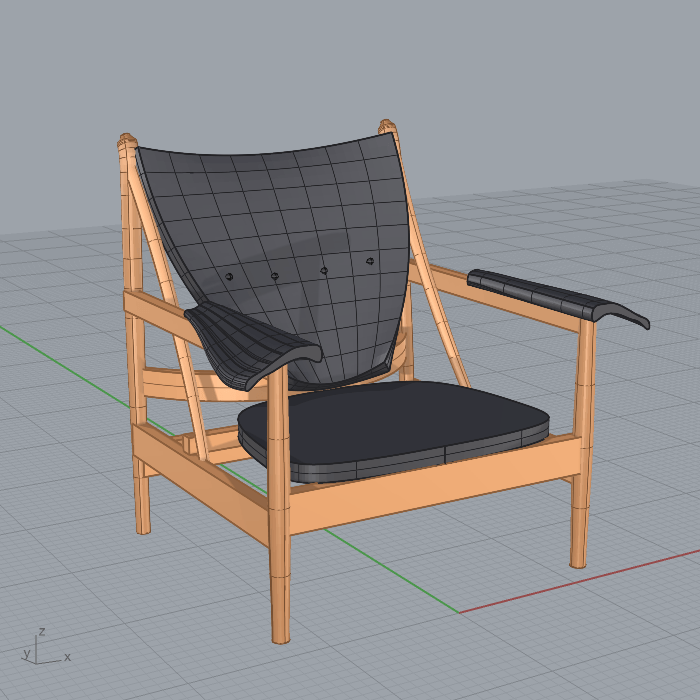
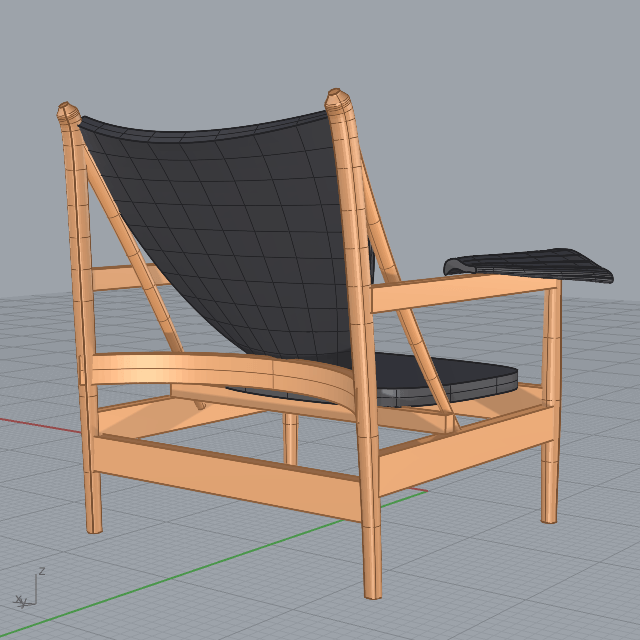
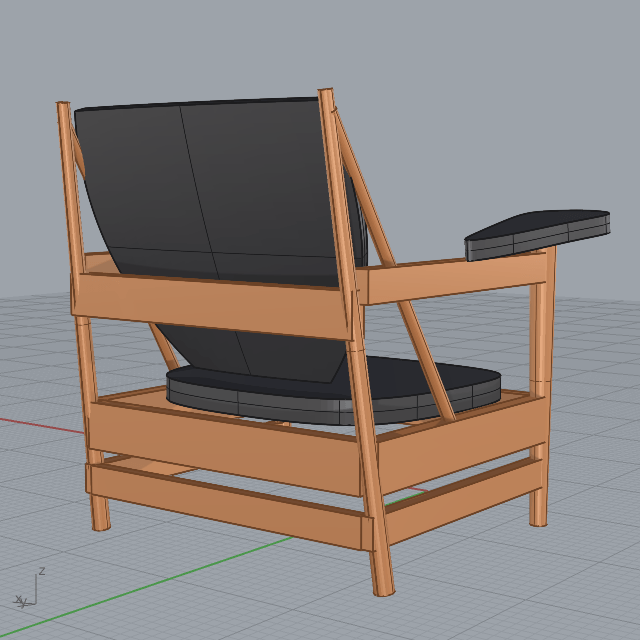
Where the models put the diagonal back members differs by run. Nine of 12 models put diagonal members, ribs or posts on the Back layer next to the back panel (Opus no skill ×2, Opus v2 trial 1 and all six Sonnet runs). Opus v2 trial 2 and Opus v3 trial 1 put their back stiles on Rails, and Opus v3 trial 2 put its back struts on Legs.
Corrections and failures
The aborted batch. The directory 2026-09-30-chieftain-aborted holds the first attempt at this batch, 08:09:11. Its log ends in a traceback from the document reset that precedes each run: TypeError: getattr(): attribute name must be string. No agent ran and no cost was incurred; the folder holds only the backup of the Rhino document taken before the reset (4.7 MB, with one open Grasshopper definition). The cause is in the code at that commit. The batch runner read the units from the expected file as Inches and passed that to the reset command, which accepts in or mm, looked the value up in a map and got None, and then called getattr with it. The failure came after the reset had already removed the Grasshopper documents, purged the objects and purged the layers it could, so the document was partly emptied. A one-line fix to the runner (commit “run-reference: pass reset units as in/mm”, 08:09:56) was made 45 seconds later and the batch was started again as 2026-09-30-chieftain. The link between that commit and the traceback comes from the code and the timestamps; we did not re-run the failing command.
A leftover layer. The reset purged every layer except the current one, and the current layer at that point was the parent of the previous case, L1 Column Grid. All 12 runs started with 0 objects and that layer. In Sonnet no skill trial 1 the trace shows the 23 objects counted on layers named L1 Column Grid::Legs, L1 Column Grid::Rails and the other four child names; the agent’s report says it noticed and moved them under T5 Chieftain Chair. The checker’s parent-layer check passed in all 12 runs. We fixed the reset on October 2 so that it purges every layer and the runner refuses to start on leftover layers.
The Back-layer limit and the regrade. The expected file allowed 1 or 2 objects on Back. Nine of the 12 models put 3 objects there (8 runs) or 7 (Sonnet v2 trial 2) and failed that check. Of the 8 no-skill and v2 runs, 7 failed the Back count. At 11:35, after the last run had finished, we changed the limit to a maximum of 8 and regraded all 12 saved models through the harness’s load command, which rebuilds layers and objects from each saved file and reruns the checker with no agent.
| Arm | Passed at run | Passed after regrade |
|---|---|---|
| Opus, no skill | 0 of 2 | 1 of 2 |
| Opus, v2 | 1 of 2 | 2 of 2 |
| Opus, v3 | 2 of 2 | 2 of 2 |
| Sonnet, all three arms | 0 of 6 | 6 of 6 |
| All | 3 of 12 | 11 of 12 |
At run time the checker had the Opus v3 arm ahead of every other arm. After the regrade it did not. The limit change came after we saw the results, and it applies to every run. The one model that still fails is Opus no skill trial 1, which measured a seat top of 13.151 in at the first probe point and 12.963 in at the second (13.5 in, tolerance 0.4). That model also failed the Back count at run time.
The capture tool. Of 22 get_viewport_image calls, 6 errored for size, 8 reported an empty viewport and 8 returned the image as text (workflow section). We did not investigate why the viewport reported empty in two runs. The v3 skill’s instruction to render in the script came from this failure.
Two statements in our September 30 report that the run data do not support as written. The report says 7 of 8 first-batch runs failed only on the Back count. Seven of the eight failed that check, and six failed only that check; Opus no skill trial 1 also failed the seat height. The report also says that every v3 run rendered and read its own model while no-skill and v2 runs got unviewable capture-tool images. That holds for all four v3 runs, and Opus no skill trial 2 also rendered through a script and read its images.
Later records. We found no later record that re-ran the chair case or reversed a chair result. The October 10 to 11 evaluation changes how to read the costs here: it states that runs before October 11 loaded the operator’s Claude configuration in every arm.
Lessons learned
- Judge scores followed the model. The skill version did not change them. Summed judge points per arm were 15, 15, 15 (Opus) and 9, 9, 9 (Sonnet). Check it by re-scoring the saved models with the judge; the renders and scores are in the run folders. Version 3 contains lessons from building this chair, so its chair results are in-sample, and its scores are the same as version 2’s and the no-skill arm’s.
- For an image brief, the checker does not measure resemblance. After regrade it passed 5 of 6 Opus models and 6 of 6 Sonnet models, while the judge averaged 7.5 for Opus and 4.5 for Sonnet. The checker tests the numbers in the brief; the strut fork, post tips and armrest tips are not among its 18 checks. Check it by listing the checks against the nine judge features.
- Say in the brief where ambiguous parts go, or grade by geometry. The brief fixed six layer names and said nothing about the diagonal struts. Nine models put extra members on
Backand failed a count limit; three put them onRailsorLegsand passed. We changed the limit after the results; a rule in the brief would have avoided changing the grader. - Render inside the script and read the PNG. In this setup the capture tool returned an image block in none of 8 successful calls. Of the 8 no-skill and v2 runs, 7 finished without seeing their model; the five runs that read their own renders were the four v3 runs and Opus no skill trial 2. Check it in the traces: tool results of type
textfromget_viewport_imageagainst typeimagefrom Read. - Seeing the model did not change the judge score in these runs. Opus runs that read their renders averaged 7.33 (3 runs), those that did not 7.67 (3 runs). Sonnet runs that read their renders averaged 4.5 (2 runs), those that did not 4.5 (4 runs). The numbers are too small to say more than that.
- An agent’s self-check covers what it checks. Sonnet v2 trial 2 reported “5 of 5 passed” on bounding box, solids, seat height, names and counts, and scored 5 of 9 on the judge. Opus v3 trial 1’s report says the rear posts have “the hooked tip from the detail photo”; the judge scored them as plain rounded caps, and the agent’s own capture shows a round knob. Compare each report’s feature claims against the judge’s evidence column.
- Reset to an empty layer table. The leftover
L1 Column Gridlayer put objects on the wrong layers in one run. The fix is in the harness history (October 2).
Limits
- Two trials per model and arm; 12 runs. A one-point change in a judge score is within the spread between trials of the same arm.
- The judge ran once per run. Its repeat variance is unmeasured. It is a Claude Opus 5.5 call, and Opus 5.5 is also one of the two models it scored. Validation was one replay on a reference model and one on a degraded copy.
- Features are scored 0 or 1 from three renders. They do not measure dimensional accuracy beyond what the checker covers.
- The arms ran in blocks over 48 minutes on one morning, not interleaved.
- Every run loaded the operator’s Claude configuration, including an auto-memory path. We did not test for contamination from it.
- One operator, one machine, Rhino 8.35 for Mac, Rhino MCP Platform 0.1.5. Windows was not tested.
- One object, one set of four photos, with its four dimensions given. We did not test another product, fewer photos or photos without dimensions. Version 3’s chair lessons came from this chair, and no held-out reference object was run in the records we read.
- We tested Opus 5.5 and Sonnet 5.5 only.
- The checker’s Back limit was changed after the runs.
- The input photos are third-party, and we have not identified their source.