Does a Rhino Skill Help Claude Model a Chair From Four Photos?
Claude modeled a chair in Rhino from four photos in 12 runs. Skill version did not change the score: Opus scored 7 or 8 of 9, Sonnet 4 or 5.
The question and the answer
The question: does a Rhino skill help Claude model a chair from four photos?
The answer: not in this test. We ran two models with no skill and with two versions of our modeling skill, two trials each. A separate judge scored each model against nine features read from the photos. The score depended on the model, not on the skill: Opus scored 7 or 8 of 9 in every arm, and Sonnet 4 or 5.
| Model | Arm | Judge score, trial 1 / trial 2 (of 9) | Checker, passed of 2 | Mean cost | Mean time |
|---|---|---|---|---|---|
| Opus 5.5 | No skill | 8 / 7 | 1 | $1.70 | 273 s |
| Opus 5.5 | Skill v2 | 7 / 8 | 2 | $1.31 | 277 s |
| Opus 5.5 | Skill v3 | 8 / 7 | 2 | $1.29 | 308 s |
| Sonnet 5.5 | No skill | 5 / 4 | 2 | $0.63 | 140 s |
| Sonnet 5.5 | Skill v2 | 4 / 5 | 2 | $0.54 | 121 s |
| Sonnet 5.5 | Skill v3 | 5 / 4 | 2 | $0.46 | 144 s |
How to read it
- Arm. A skill condition. No skill: no Rhino skill in the session. Skill v2 and skill v3: two versions of our
rhino-modelingskill. Skill v3 adds lessons from building this chair. For image briefs it says to read every supplied view first, treat stated dimensions as fixed and label what is read off the images as an estimate. It also says to render inside the script and read the saved PNG. - Trial. One run. Each model and arm had two.
- Judge score. A separate Claude call (
claude-opus-5-5) compared three shaded renders of the finished model with the photos. It scored nine features 0 or 1 each, scoring 0 for anything missing, clearly different or only partly present. The score is the sum, out of 9. It saw no arm, model or trace. - Checker. A deterministic check of 18 things against an expected file: units, layers, object counts and types, overall size, names, valid closed solids and seat height. “Passed” means all 18. The column uses the regraded checker. The checker as first run passed fewer: 3 of the 12 models at run time, against 11 of 12 after the regrade (see the observations).
Set-up
| Item | What we used |
|---|---|
| Models | claude-opus-5-5 and claude-sonnet-5-5, run in Claude Code 2.1.285. The judge was claude-opus-5-5. |
| Skills | None, rhino-modeling v2, or rhino-modeling v3. Not public. |
| Tools | The Rhino MCP server only, plus Read, Glob, Grep and Skill. |
| Rhino | Rhino 8.35 for Mac, Rhino MCP Platform 0.1.5, document in inches. |
| Limits | Spend cap per run: the harness default of $10; we recorded no override. The most expensive run cost $1.85. |
| Given to the agent | Four product photos of Finn Juhl’s Chieftain Chair, four dimensions (39 in wide, 34.5 in deep, 36.5 in high, 13.5 in seat height), a placement rule, and a parent layer with six named child layers. The brief did not say where the diagonal struts go. |
| Run date | 2026-09-30, 08:09 to about 08:57 (UTC−3), in blocks by arm. |
| Configuration | Not isolated. Every run loaded the operator’s own Claude configuration, including eight plugins. |
| Data | Not public. The photos are third-party and we have not identified their source. |
How we tested
We gave Claude four photos of a lounge chair and four dimensions. It had to build the chair in Rhino, with a set layer structure. We ran each model with no skill, with skill v2 and with skill v3, twice each: 12 runs.
Two graders looked at each finished model. The checker tested the numbers in the brief. The judge tested whether the chair looked like the photos, on nine features such as hooked rear-post tips, a diagonal strut forking into each rear post, four buttons and flared, curled armrest tips. Before the runs we checked the judge on a reference model (9 of 9) and on a copy with three features removed (6 of 9, with exactly those three at 0).
What we observed
Judge scores. Summed per arm: Opus 15, 15 and 15 for no skill, v2 and v3. Sonnet 9, 9 and 9. Opus averaged 7.5 of 9 and Sonnet 4.5 of 9.
Which features. Number of runs scoring 1, out of six per model:
| Feature | Opus | Sonnet |
|---|---|---|
| Rear posts with forward-hooked tips | 5 | 1 |
| Diagonal strut forking into the rear post | 5 | 0 |
| Leaning back panel with shaped edges | 4 | 1 |
| Armrest tips flared and curled | 4 | 0 |
| Thin seat pad on a wooden frame | 3 | 4 |
All six Sonnet models scored 0 on the strut fork and on the armrest tips. Both models scored 6 of 6 on the four buttons and on the arm rails.
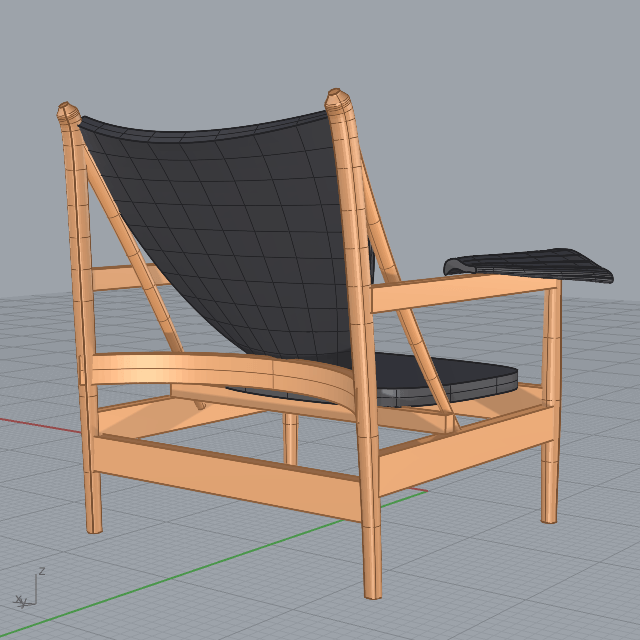
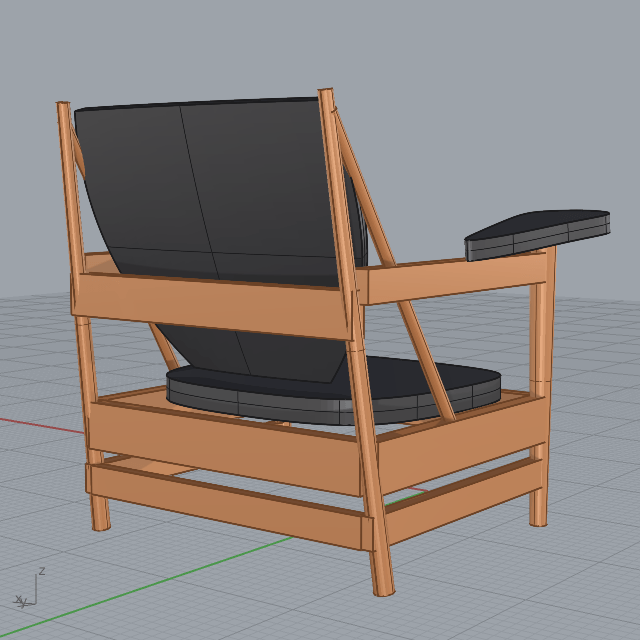
Checker. At run time 3 of the 12 models passed all 18 checks. Nine models put 3 or 7 objects on the Back layer, where the expected file allowed 1 or 2. After the last run finished we raised that limit to 8 and regraded all 12 saved models. Then 11 of 12 passed: Opus no skill 1 of 2, every other arm 2 of 2. At run time the Opus v3 arm had been ahead of every other arm. After the regrade it was not. The one model that still fails measured a seat top of 13.151 in and 12.963 in at its two probe points (13.5 in specified, 0.4 in tolerance).
Cost. Opus averaged $1.43 and 286 s per run; Sonnet $0.54 and 135 s. Judge spend was $4.69 on top of $11.85 for the agents.
Seeing the model. The capture tool returned 22 results across the eight no-skill and v2 runs: 6 errors for size, 8 reports of an empty viewport, and 8 images delivered as text. Seven of those eight runs finished without seeing their model. The four v3 runs rendered inside the script and read the PNG. Opus runs that read their renders averaged 7.33 of 9 (3 runs); those that did not, 7.67 (3 runs). Sonnet: 4.5 (2 runs) and 4.5 (4 runs).
Our reading
The model, not the skill, set the score. The features that separated the models were the ones that need reading a shape from a photo: the forked strut, the hooked post tips and the curled armrest tips. The same pattern appeared elsewhere: all three arms passed 20 of 20 on the Rhino ladder, and the skill changed cost, and code scores on an egress stair followed the model.
The checker does not measure resemblance. After the regrade it passed 5 of 6 Opus models and 6 of 6 Sonnet models, while the judge averaged 7.5 and 4.5. None of the strut fork, post tips or armrest tips is among its 18 checks. In our error-helper test the same chair brief passed the checker in all six Sonnet runs, which says nothing about resemblance either.
Skill v3 may still help with workflow: its Sonnet runs were the cheapest cell and all four v3 runs saw their model. But with two trials per cell the cost ranges overlap, and seeing the model did not move the score.
Not tested: another object, fewer photos, photos without dimensions, any model beyond these two, or a skill written without reference to this chair.
What this doesn’t show
- Small n. Two trials per cell, 12 runs. A one-point change in the judge score is within the spread between two trials of the same arm.
- The skill was written with this chair in view. Skill v3 contains lessons from building it. Its results here are in-sample, and no held-out object was run.
- The judge is one Claude call per run. Its repeat variance is unmeasured. It is the same model as one of the two it scored. Validation was one replay on a reference and one on a degraded copy.
- The checker’s limit changed after the results. We raised the
Backlimit after seeing them. It applies to every run, but it was a post-hoc change. - Configuration. Every run loaded the operator’s plugins and memory path. We did not test for contamination from it. A later evaluation states that absolute costs from runs like these are not comparable with isolated runs.
- Blocks, not interleaving. The arms ran in blocks on one morning, on one machine.
What we take from it
For a task that depends on reading a shape from photos, expect the model choice to matter more than the skill version, and don’t expect a numeric checker to tell you the model looks right. If you use a checker, state in the brief where ambiguous parts go, or grade by geometry; we had to change a limit after the results because the brief did not.
Full record: Modeling a Chair in Rhino From Four Photos: Opus 5.5, Sonnet 5.5 and Three Skill Versions
More evals
Does a five-skill plan, build, review and learn loop help Claude model a code-compliant egress stair in Rhino?
No gain in this test. Opus met 12 of 13 code items in both loop runs, the same as with one skill, at 70% more cost. Sonnet scored 7 and 8 with the loop against 10 and 11 with one skill.
Does Arch Studio 1.5 produce valid project records more often than vanilla Claude when the project has no earlier example of the requested operation?
Yes: 15 of 27 cold-start runs passed against 4 of 27 for vanilla Claude (55.6% against 14.8%). With prior examples present no difference was detected, and on isolated product-page tasks it scored 0.86 against 0.87.