One Egress Stair in Rhino: A Single Skill Against a Five-Skill Loop
We had Claude model an IBC egress stair in Rhino with no skill, one skill, a five-skill loop and a lean skill. Code scores followed the model in every arm.
On September 30, 2026 we asked Claude to model one exit stair for a ten-story office building in Rhino, working from Chapter 10 of the 2021 International Building Code (IBC), and graded 20 runs. We ran Opus 5.5 and Sonnet 5.5 with no skill, with one skill (version 3 of our Rhino skill), with a five-skill plan, build, review and learn loop (version 4) and with a lean one-skill rewrite (version 5). Each cell had two runs. Version 3 had two cells, four runs in all, because we repeated it. Version 6, which adds a helper that explains API errors, was not run on the stair. It was run on a separate 20-case ladder, and we report that result at the end.
The code-compliance score followed the model. Opus met 11 to 13 of 13 IBC requirements in every arm, and Sonnet met 7 to 11. The five-skill loop cost 70% more than version 3 on Opus at the same score (12 of 13 in both runs of each arm) and, on Sonnet, scored 7 and 8 against 10 and 11 for version 3 in the same batch. In 19 of 20 runs the saved model passed every geometric measurement rule. In 5 of 10 Opus runs and 0 of 10 Sonnet runs the report stated the 10 foot-candle lighting level that the code requires on exit-stair walking surfaces.
Version 3 of the skill had come out of the same day’s chair evaluation, and the stair was the next test of it.
Results at a glance
Code items are the score of the code judge (13 IBC 2021 requirements, one point each). Cost and time are means per run. Version 3 appears in two batches, so its row pools four runs.
| Arm | Model | Runs | Code items met, of 13 | Mean cost | Mean time |
|---|---|---|---|---|---|
| No skill | Opus 5.5 | 2 | 13, 12 | $1.83 | 412 s |
| v3, one skill | Opus 5.5 | 4 | 11, 13, 12, 12 | $1.40 | 413 s |
| v4, five-skill loop | Opus 5.5 | 2 | 12, 12 | $2.03 | 569 s |
| v5, lean skill | Opus 5.5 | 2 | 12, 11 | $1.95 | 789 s |
| No skill | Sonnet 5.5 | 2 | 9, 10 | $1.23 | 533 s |
| v3, one skill | Sonnet 5.5 | 4 | 11, 9, 10, 11 | $1.48 | 664 s |
| v4, five-skill loop | Sonnet 5.5 | 2 | 8, 7 | $1.96 | 862 s |
| v5, lean skill | Sonnet 5.5 | 2 | 9, 7 | $1.25 | 577 s |
| Measure | Result |
|---|---|
| Runs graded | 20, in three batches on September 30 |
| Runs passing every measurement rule | 19 of 20 (one Opus v3 run had an inner handrail that dips to 30.16 in) |
| Runs whose report states 10 fc stair lighting | Opus 5 of 10, Sonnet 0 of 10 |
| Runs that read the code text | 0 of 20; every web fetch of a code page returned 403 or 404 |
| Run spend | $32.03 for 20 runs; $5.55 for the 20 final judge calls |
run_python scripts | 102, of which 15 returned a Python error |
| Most expensive run | Sonnet v4, $2.34, 997 s, 12 scripts |
| Longest run | Opus v5, $2.34, 1,092 s, 14 scripts |
Inputs
The brief. Every run received the same text, written by Federico:
Using this IBC egress staircase definition, model a code compliant egress stair needed to egress a 10 story office building: [the ICC Chapter 10 URL]. Only model 1 of the minimum of 2 stairs required. Assume a loading of standard 1:100 sf and floor plates of 10,000 sf each. Assume a ground floor lobby. Make sure width, railings, steps, doors, swings and lighting are all considered. Model only 2 floors’ worth: the ground floor and the floor above. Put the model under a parent layer named T6 Egress Stair with child layers Stair, Landings, Handrails, Guards, Walls, Doors, Door Swings, Lighting, Signage and Floors, and name every object. Report the code basis for each decision.
Models. claude-opus-5-5 and claude-sonnet-5-5, run through Claude Code 2.1.285 in non-interactive mode, one fresh session per run.
Rhino. Rhino 8.35.26251.13002 on a Mac, driven through McNeel’s Rhino MCP Platform (router 0.1.5.0). The document was empty and in inches at the start of each run. The agent’s only Rhino tool that built geometry was run_python, which runs a Python script inside Rhino.
Tools given. The Rhino MCP tools, plus Read, Glob, Grep, Skill, WebFetch and WebSearch. Bash, Write and Edit were disabled. We enabled web tools because ICC’s page returns 403 to automated requests, and Federico chose to let the agents try the web. The harness default budget cap was $10 a run; no run exceeded $2.34.
Arms and skills.
- No skill. No plugin loaded.
- v3. One skill,
rhino-modeling, with the lessons from the same day’s chair evaluation. - v4. Five skills:
rhino-setup,rhino-plan,rhino-model,rhino-reviewandrhino-learn, which together run a plan, build, review and learn loop. It also added the tooling rules from that day’s traces and a recipe for stair handrail transitions. The plan’s code guidance was written from the first batch’s egress misses, so v4 had been partly taught this case. - v5. A lean skill made of
rhino-modelandrhino-setup. It keeps v3’s procedure and adds the Rhino MCP tool map, the v4 tooling rules, a rule to keep parameters in one generator script, measurement patterns, and an instruction to look up API calls (by reflection, or in theRhinoCommon.xmlthat ships with Rhino) instead of guessing them. - v6. v5 plus
rh_help, a helper that reflects on the loaded Rhino assemblies and prints what the installed build offers when a script fails. Not run on the stair.
Batches.
| Batch | Contents | Runs |
|---|---|---|
| A | No skill and v3, both models, 2 runs each | 8 |
| B | v3 and v4, both models, 2 runs each | 8 |
| C | v5, both models, 2 runs each | 4 |
Graders. Three, none of which saw the arm during grading.
- Layer and structure checks. 14 checks on the saved model: units, parent layer, object counts and name matches on seven layers, every object named, every object valid, and closed solids on Stair, Landings and Walls.
- Measurement extractor. A script that measures the saved model independent of how it was built: riser height and uniformity (per flight), tread depth, stair width, landing depth, flight rise, handrails on both sides, handrail height at every nosing, door leaf width and light fixture count. We validated it on a compliant reference stair (all rules pass) and on four planted defects (a raised step, lowered rails, a narrow door and a missing rail), each of which failed only its own rule.
- Code judge. Opus 5.5 scores 13 IBC 2021 requirements from the agent’s final report plus the measurements, one point each. It sees the brief, the report, the measurements and the rubric, and not the arm, model or trace. We replayed it before use: a compliant report scored 13 of 13 and a degraded one (wrong upper-door swing, no smokeproof enclosure, 1 fc lighting, no signs) scored 8 of 13. The 13 requirements are occupant load, stair width, risers and treads, landings and flights, handrails, guards, door width and swing direction, door encroachment on landings, the 2-hour enclosure, the high-rise smokeproof enclosure, lighting, signage and exit discharge. ICC’s own text was not readable by script, so we confirmed the requirement values against public IBC 2021 sources.
Configuration. These runs did not yet isolate the agent from the operator’s Claude configuration. The operator’s plugins and CLAUDE.md were loaded in every arm. The harness later added isolation.
Raw workflow
For each run the harness reset Rhino to an empty document, started claude -p with the brief in a fresh working folder, and recorded the full stream as a trace. After the agent finished, the harness read the document state, ran the layer checks, saved the model, ran the extractor and then the judge. The agent saved nothing itself in most runs; the harness saved each model.
What the agents did, from the traces.
- Skill arms opened with a
Skillcall (v3:rhino-modeling; v5:rhino-model), then loaded the Rhino tool schemas and read the skill’s reference files. - No-skill arms loaded the Rhino tool schemas and fetched the ICC page within their first three calls.
- The code page. 19 of 20 runs fetched the ICC URL, and every fetch returned 403. One run (Opus v3, batch B, run 1) never tried it; its report says it did not open the link. The four v4 runs each made a second fetch of an UpCodes page, and all four returned 404.
- One web search. Sonnet v3 (batch B, run 1) searched for the stairway width exception. The results listed ICC and secondary pages. The run fetched none of them.
- Building. Every run then wrote a build script and ran it with
run_python. Most also ran scripts that measured their own result (risers, handrail heights, door clearances, closed solids) and adjusted. Runs used 2 to 14 scripts. - Screenshots. The four no-skill runs called the viewport-image tool 10 times (Opus 4 and 2, Sonnet 1 and 3). The 16 skill-arm runs called it 0 times; they saved their own captures from scripts.
- The report. Each run ended with a markdown report of decisions with a code basis. All 20 reports say the section numbers come from the model’s own knowledge of the code and were not checked against the text.
What stood out in individual runs.
- Sonnet v4, run 1 (batch B) ran 12 scripts, $2.34 and 997 s, the most of the v4 runs. It tried to write a shared
common.pywith the Write tool, which the harness disables, and kept its constants in Rhino’s session store instead. - Opus v5, run 2 (batch C) ran 14 scripts, $2.34 and 1,092 s. It calculated illuminance at points on the stair, found its first build missed 10 fc at the Level 2 landing (5.4 fc), moved the landing fixtures to the centre of the end wall, raised them to 4,000 lm and rebuilt from its script. It is the only run that computed illuminance, and it scored the lighting item.
- Opus v3, run 2 (batch A) modeled from the ground floor up to a third level; the brief asked for two floors. Sonnet v4, run 2 also modeled a third level.
Which skills ran in the v4 arm.
| Run | Skills invoked |
|---|---|
| Opus v4, run 1 | rhino-plan, rhino-model, rhino-review |
| Opus v4, run 2 | rhino-plan, rhino-model |
| Sonnet v4, run 1 | rhino-plan |
| Sonnet v4, run 2 | rhino-plan |
rhino-learn and rhino-setup were invoked in none of the four runs. Sonnet’s report in run 1 states that it did not run the review skill.
Metrics
Every run
Batch letters are defined under Inputs. Scripts are run_python calls; script errors are calls whose result carried a Python traceback. Objects are counted in the saved model.
| Batch | Model | Arm | Run | Code items | Cost | Time | Turns | Scripts | Script errors | Objects |
|---|---|---|---|---|---|---|---|---|---|---|
| A | Opus | No skill | 1 | 13 | $2.21 | 464 s | 15 | 7 | 2 | 106 |
| A | Opus | No skill | 2 | 12 | $1.46 | 361 s | 8 | 2 | 1 | 62 |
| A | Opus | v3 | 1 | 11 | $1.33 | 352 s | 12 | 5 | 1 | 175 |
| A | Opus | v3 | 2 | 13 | $1.90 | 615 s | 11 | 3 | 0 | 124 |
| A | Sonnet | No skill | 1 | 9 | $1.08 | 529 s | 7 | 3 | 0 | 204 |
| A | Sonnet | No skill | 2 | 10 | $1.38 | 537 s | 12 | 4 | 0 | 224 |
| A | Sonnet | v3 | 1 | 11 | $1.36 | 623 s | 11 | 4 | 1 | 181 |
| A | Sonnet | v3 | 2 | 9 | $1.69 | 676 s | 15 | 7 | 3 | 109 |
| B | Opus | v3 | 1 | 12 | $1.24 | 373 s | 8 | 3 | 0 | 104 |
| B | Opus | v3 | 2 | 12 | $1.14 | 314 s | 11 | 3 | 0 | 98 |
| B | Opus | v4 | 1 | 12 | $2.12 | 598 s | 18 | 7 | 3 | 88 |
| B | Opus | v4 | 2 | 12 | $1.93 | 540 s | 16 | 6 | 0 | 87 |
| B | Sonnet | v3 | 1 | 10 | $1.30 | 619 s | 11 | 3 | 0 | 194 |
| B | Sonnet | v3 | 2 | 11 | $1.56 | 736 s | 11 | 4 | 1 | 117 |
| B | Sonnet | v4 | 1 | 8 | $2.34 | 997 s | 22 | 12 | 0 | 186 |
| B | Sonnet | v4 | 2 | 7 | $1.58 | 728 s | 18 | 6 | 0 | 327 |
| C | Opus | v5 | 1 | 12 | $1.56 | 485 s | 9 | 2 | 0 | 96 |
| C | Opus | v5 | 2 | 11 | $2.34 | 1,092 s | 22 | 14 | 2 | 74 |
| C | Sonnet | v5 | 1 | 9 | $1.31 | 590 s | 11 | 4 | 1 | 203 |
| C | Sonnet | v5 | 2 | 7 | $1.19 | 564 s | 10 | 3 | 0 | 234 |
Comparisons inside a batch
| Comparison | Opus | Sonnet |
|---|---|---|
| Batch A: no skill, mean cost | $1.83 | $1.23 |
| Batch A: v3, mean cost | $1.62 | $1.53 |
| Batch A: no skill, code items | 13, 12 | 9, 10 |
| Batch A: v3, code items | 11, 13 | 11, 9 |
| Batch B: v3, mean cost / mean time | $1.19 / 344 s | $1.43 / 678 s |
| Batch B: v4, mean cost / mean time | $2.03 / 569 s | $1.96 / 862 s |
| Batch B: v3, code items | 12, 12 | 10, 11 |
| Batch B: v4, code items | 12, 12 | 8, 7 |
| Batch B: v4 cost over v3 | +70% | +37% |
| Batch B: v4 time over v3 | +66% | +27% |
Within one arm, run-to-run cost varied as much as it did between arms. Opus with v3 cost $1.14 to $1.90 across four runs, and Opus with no skill cost $1.46 and $2.21.
Code judge, by requirement
Misses across all 20 runs, 10 per model.
| Requirement | Opus missed | Sonnet missed |
|---|---|---|
| Occupant load | 0 | 1 |
| Stair width | 0 | 3 |
| Risers and treads | 0 | 0 |
| Landings and flights | 0 | 2 |
| Handrails | 2 | 2 |
| Guards | 0 | 4 |
| Doors | 0 | 1 |
| Door encroachment on landings | 0 | 3 |
| 2-hour enclosure | 0 | 6 |
| High-rise smokeproof enclosure | 1 | 4 |
| Lighting, 10 fc | 5 | 10 |
| Signage | 0 | 0 |
| Exit discharge | 2 | 3 |
Lighting by arm, runs that stated 10 fc: Opus no skill 1 of 2, v3 1 of 4, v4 1 of 2, v5 2 of 2. Sonnet 0 of 2, 0 of 4, 0 of 2 and 0 of 2. Four of the five Opus reports that stated 10 fc asked the reader to confirm it (no skill run 1, v3 batch A run 2, v4 run 2, v5 run 2).
Measurement and layer checks
- Measurement rules. 19 of 20 runs passed all 11. The failure was Opus v3, batch A, run 1: on one side of the second flight the handrail measures 30.16 in above the nosing at the first tread after the landing and rises by about half an inch per tread to 36.49 in. Eight treads sit below the 34 in minimum (30.16 to 33.85 in). IBC 1014.2 allows a handrail transition to exceed 38 in and does not allow it to drop below 34 in.
- Layer checks. All 14 checks passed in 17 of 20 runs as first graded. Two Sonnet v4 runs failed the Doors layer on an object cap (see Corrections). One Opus v5 run failed the closed-solid check on a ground-floor landing.
Tool calls across the 20 runs
| Tool | Calls |
|---|---|
run_python | 102 |
get_viewport_image | 10 (all in no-skill runs) |
list_slots | 3 |
save_doc | 2 |
Skill | 19 (every skill-arm run once, plus extra v4 calls) |
Read | 29 |
WebFetch | 23 |
WebSearch | 1 |
v5 and v6 on the 20-case ladder
The ladder is a separate set of 20 modeling cases in ten levels, graded by a deterministic checker, with Opus and Sonnet. The egress stair is not part of it. Costs are for the first attempt of each case.
| Ladder, 20 cases | Cost | Scripts with an error |
|---|---|---|
| Opus v3 / v5 / v6 | $6.30 / $6.51 / $7.33 | 3 of 43 / 4 of 46 / 3 of 45 |
| Sonnet v3 / v5 / v6 | $3.51 / $3.65 / $3.65 | 5 of 49 / 9 of 50 / 2 of 44 |
As percentages, Opus 7.0%, 8.7%, 6.7% and Sonnet 10.2%, 18.0%, 4.5%.
- v5’s look-up instruction. Across the 44 v5 runs (40 ladder cases and the four stair runs), we found 4 scripts that looked up an API member by reflection, in 3 runs: one Opus run on a SubD case (two scripts), one Sonnet run on another SubD case and one Opus stair run. None opened
RhinoCommon.xml. - v6’s helper. Its call appeared in the error handler of 44 of 45 Opus v6 scripts and 26 of 44 Sonnet v6 scripts. It printed output once: in an Opus run on a SubD canopy case, where a script failed with
'SubDVertexList' object is not iterableand the helper listed the collection’s members. The next script in that run succeeded. In v5, the same case had cost Sonnet 4 script errors in 6 scripts. - Cost of v6 on Opus. $7.33 against $6.30 for v3, 16% more. The harness resets Rhino between cases, so the helper is installed again in every case; in a continuous session it would install once.
Outputs
Each of the 20 runs produced three things.
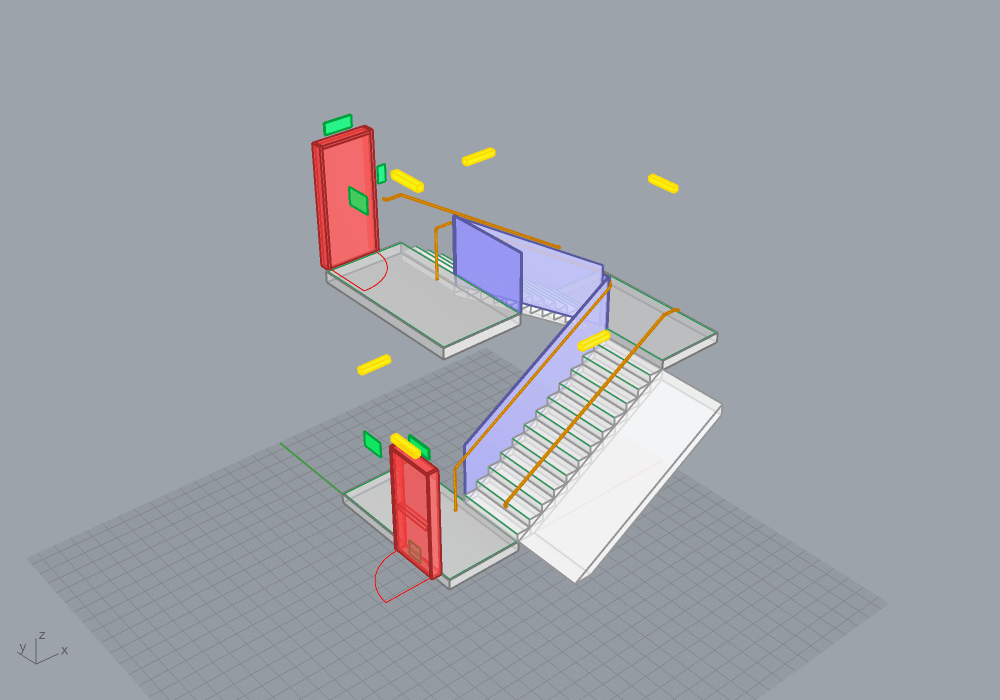
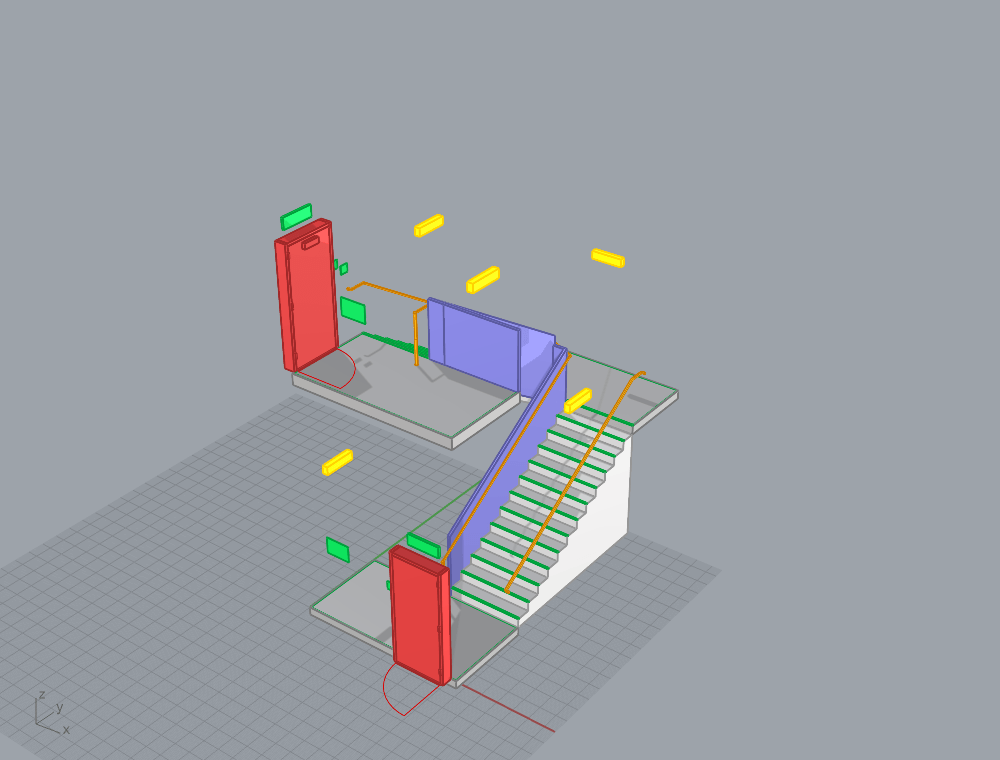
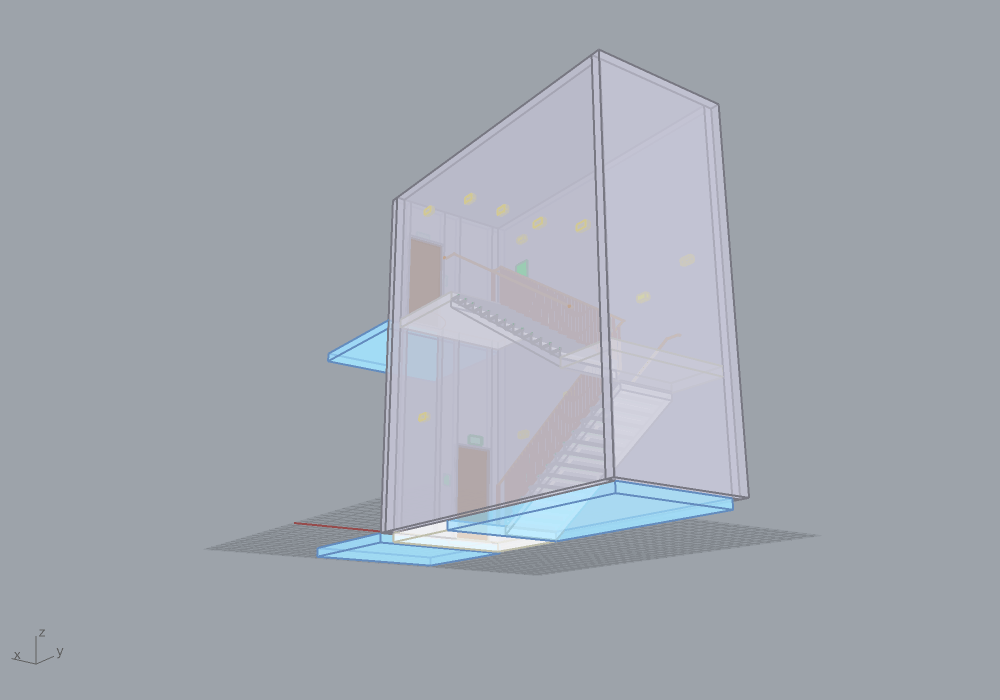
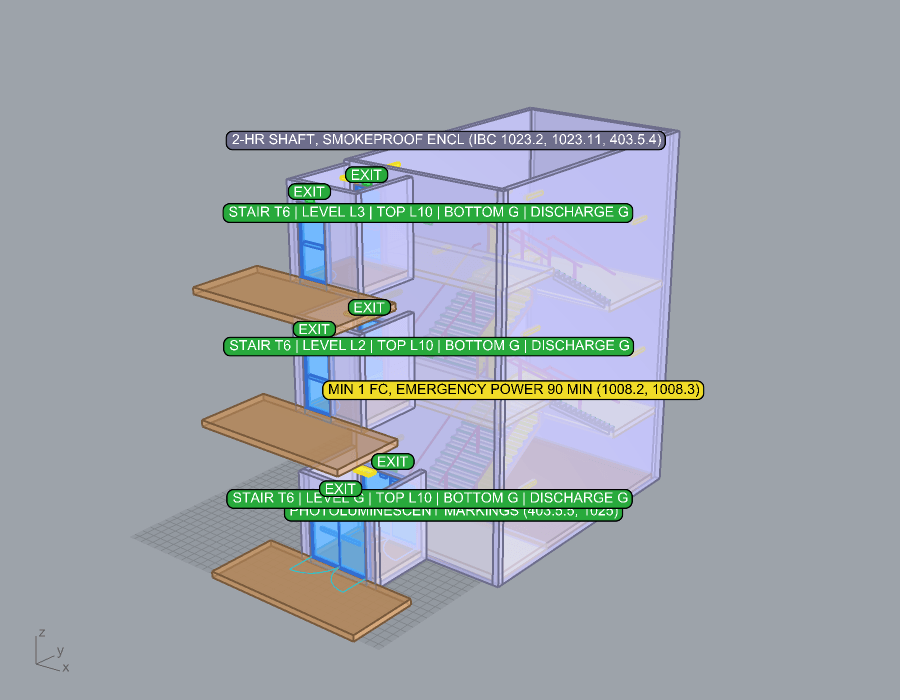
- A saved Rhino model. 62 to 327 named objects under the parent layer T6 Egress Stair on the ten requested child layers: a switchback stair of two flights, landings, enclosure walls, guards, doors with swing arcs, light fixtures and signs. The harness saved the model after the agent finished.
- A final report. A markdown table of decisions with a code basis for each, followed by assumptions and a list of what was not modeled. All 20 reports state that the section numbers come from the model’s own knowledge, not from the code text.
- A trace of every tool call and result.
The figures below are the agents’ own scripted captures from the later runs. They were not retouched.
The models and reports remain in our local evaluation records. We have not published them.
Corrections and failures
Grader defects found after the first pass. After batch A we found three defects in the measurement extractor and fixed them. Tread detection depended on face orientation and missed an inside-out flight. Risers were measured across the whole stair, so a half-inch step to an exterior landing counted as a riser. Riser uniformity was checked across flights instead of within each flight, which is what IBC 1011.5.4 requires. We applied the fixes to all saved models and revalidated on the reference stair and the four planted defects. Three batch A runs (Opus no skill runs 1 and 2, Opus v3 run 2) failed measurement rules in the first pass and passed after the fixes. The report’s results table shows post-fix numbers only; the first-pass numbers are in the batch log.
| Batch A run | First-pass code items | Final code items |
|---|---|---|
| Opus no skill, run 1 | 11 | 13 |
| Opus no skill, run 2 | 10 | 12 |
| Opus v3, run 1 | 11 | 11 |
| Opus v3, run 2 | 12 | 13 |
| Sonnet no skill, run 1 | 9 | 9 |
| Sonnet no skill, run 2 | 10 | 10 |
| Sonnet v3, run 1 | 9 | 11 |
| Sonnet v3, run 2 | 9 | 9 |
The judge changed scores where the inputs did not change. Re-judging moved four of the eight batch A totals, all upward (by 2, 2, 1 and 2). Seven items changed in those four runs. Three follow the extractor fix: risers and treads in both Opus no-skill runs, and handrails in run 2, where the first pass had read 10 of 12 treads. The other four do not. Opus no-skill run 1 gained the guards item, where the first pass said the report admitted an unmodeled guard and the second said it provided guards. Opus v3 run 2 gained the lighting item with its report unchanged. Sonnet v3 run 1 moved from 9 to 11 on items 4 (landings) and 13 (exit discharge) with identical measured landings of 60, 48 and 61 in; the final evidence for item 4 says the 48 in mid-landing is under the 53 in stair width on a switchback and still scores it 1. The judge is a model, and a re-run moved a total by 2 on identical measurements. Batches B and C have one judge pass each, so we have no repeat measure for them.
Layer object caps. The first layer rule capped Doors at 20 objects. The brief sets no limit, and detailed door frames and hardware put 29 and 72 objects on Doors in the two Sonnet v4 runs, which failed only that cap. We raised the caps and regraded the 16 runs of batches A and B; all pass. The report describes the change as no upper limit. In the grader data the caps are now 400 on six layers and still 20 on Landings. Batch C was not regraded. Its Opus v5 run 2 failed the closed-solid check on a ground-floor landing, a failure the report does not mention.
Disagreements between the report and the run data.
- Handrail dip. The report says the continuous inner handrail dips to 30 to 32 in over four treads at the switchback. The measurements show eight treads below 34 in, from 30.16 in to 33.85 in.
- Lighting. The report says 7 of 8 runs missed the 10 fc requirement or its emergency power. The final judge data for those 8 runs shows 6 of 8 (items scored 0). The 7 of 8 matches the first judge pass, where Opus v3 run 2 also scored 0. Across all 20 runs the count is 15 of 20.
- Cost of v4 on Opus. The report says 71% more. The unrounded means ($2.027 and $1.191) give 70%. The report’s figure comes from the rounded means.
- Web use. The report says each run tried the ICC URL once and none searched for another source. That holds for batch A. In batch B, one run made no attempt, one ran a web search, and all four v4 runs fetched a second URL, which returned 404.
- Ladder pass rate. The report says all versions passed all 20 ladder cases on both models. Sonnet v6 failed its first attempt at the l2-stair-plan case on the layer checks (16 curves on layers that expect 15 and 1) and passed on its second. The cost in the report’s table, $3.65, includes the failed first attempt; both attempts together cost $3.82.
- The helper’s one firing. The report says the helper fired once, on the SubD error that cost Sonnet four retries in v5. The helper fired once in an Opus v6 run on the same case, and 0 times in the Sonnet v6 runs.
Scope and reasoning errors in the runs.
- Third level. Opus v3 (batch A, run 2) and Sonnet v4 (batch B, run 2) modeled a third level. The judge rubric does not score scope.
- Occupant load. Both Sonnet v4 runs summed occupants across floors to size the stair (450 at the lowest flight, a 90 in required width, 100 in built). Stair capacity is set per story, so 100 occupants per floor, 50 per stair, needs the 44 in minimum. Sonnet run 1 flagged this in its report as a decision for the reader. The judge scored width as a miss in both.
- Unverified code claims. Lighting levels and pressurization appear in the reports as claims. No run measured them, apart from the one Opus run that computed point illuminance by its own script.
What later records changed.
- The helper. The v5 and v6 report says the helper works when it fires. On October 11 we tested it alone on Sonnet 5.5, in 36 runs with run isolation: it was installed in 9 of 18 runs, fired twice, and cost 16% more per run ($0.44 against $0.38). We removed it.
- The loop. The v4 pull request was closed as not recommended; the October 16 tracking issue records that.
- Loops and instruction. The v4 report found that skills chained by instruction did not run as a loop and said a loop driven from the agent or the harness was untested. A one-skill workflow with a check command, run in Rhino 9 in November, did write requirements before building and run the check afterward in every run without enforcement hooks in which the agent was told to read the skill. Those runs are not comparable to this stair; we cite them because they bear on the conclusion that instruction-chained steps get skipped.
Lessons learned
- The code score followed the model. Opus scored 11 to 13 and Sonnet 7 to 11, in every arm. With v3 alone, Opus scored 11, 13, 12 and 12 across two batches. The spread within one arm is as wide as the spread across arms. Add the judge’s repeat noise of 2 items on identical inputs, and these 20 runs cannot rank no skill, v3 and v5 against each other.
- The five-skill loop raised cost without raising the score on Opus. Opus v4 held 12 of 13 in both runs at $2.03 against $1.19 for v3 in the same batch. Time rose 66%.
- The loop scored lower on Sonnet in these runs, and the reports show two decisions behind it. Sonnet v4 scored 8 and 7 against 10 and 11 for v3. Both runs summed occupant load across floors, and one modeled a third level. The v4 report’s reading was that planning amplified these errors; the runs do not isolate the plan step, and the two runs give no rate.
- Chained skills did not chain. Sonnet invoked only
rhino-plan, in both runs. Opus invokedrhino-reviewonce in two runs. No run invokedrhino-learn. The loop’s later steps ran when the model chose to run them. - Process did not supply code knowledge. No run read the code: all 23 web fetches returned 403 or 404, and the one search returned links and snippets that no run followed. Sonnet missed the 10 fc lighting level in 10 of 10 runs and Opus in 5 of 10. Four of the five Opus reports that got it right asked the reader to confirm the figure, and one of those also calculated it. A check that would settle this is to rerun the same 20 runs with the Chapter 10 text available to the agent. We have not run it.
- Geometry was rarely the failure. 19 of 20 runs passed every measurement rule. The one failure, a handrail that dips below 34 in at the switchback, appeared in one batch A run with v3. The six later Opus runs passed, including the two batch B v3 runs, which did not have the handrail recipe that v4 added. Our data cannot credit the recipe.
- A model judge needs repeats and a stored first pass. Four of eight totals moved on re-judging, all upward, and four of the seven changed items had no measurement change behind them. We kept the first-pass files, which is how we can report this. We did not repeat the judge in batches B and C, so their totals carry the same unmeasured noise.
- Grader rules need a check against saved runs before they decide an arm. A cap of 20 objects per layer failed two correct Sonnet runs, and extractor defects failed three Opus runs on measurements. We found both by reading the failures. Regrading the saved models took no new runs.
- The API look-up rule in v5 was followed in 3 of 44 runs. The XML reference was never opened, and v6’s helper printed once in 41 ladder runs. The ladder produces too few API errors for the error-rate differences between versions to mean anything: the 18.0% for Sonnet v5 is 9 errors in 50 scripts, 4 of them in one SubD case.
Limits
- Run counts. Two runs per cell, four for v3 across two batches. One stair case. We cannot give a rate for any difference reported here.
- One operator and one setup. Federico wrote the brief and ran the harness on one Mac with Rhino 8.35, Rhino MCP 0.1.5 and Claude Code 2.1.285. The agent was not isolated from the operator’s Claude configuration.
- A single judge model. The judge is Opus 5.5, the same model as half the runs it graded. We did not test for self-preference.
- The judge scores the report. Lighting levels, pressurization and fire ratings are claims in the report. We did not run a photometric or engineering check. The requirement values come from public secondary sources, not ICC’s own text.
- The judge was repeated only in batch A. Batches B and C have one pass.
- v6 on the stair. Not run. v6 was evaluated on the ladder only, where API errors are rare.
- Not tested. A retrievable code text for the agent, a loop driven by the harness instead of by skill text, deterministic measurement tools in place of
run_pythonscripts, a Windows or other Rhino build, other code editions, and other model families. - Spend. $32.03 for the 20 runs and $5.55 for the final judge calls. The first-pass judge calls for batch A and the grader validation runs are not in these totals.
Records: IBC egress stair report (Sep 30, 2026); skill v4 loop report (Sep 30, 2026); skill v5 and v6 report and findings (Sep 30, 2026); rh_help consistency evaluation (Oct 11, 2026). Run data: three egress batches and six ladder batches from September 30, 2026.