Does a Five-Skill Loop Help Claude Model a Code-Compliant Stair in Rhino?
20 Claude runs modeling an IBC egress stair in Rhino. Scores followed the model, not the skill; a five-skill loop cost 70% more on Opus at 12 of 13.
The question and the answer
The question: does a five-skill plan, build, review and learn loop help Claude model a code-compliant egress stair in Rhino?
The answer: not in this test. In the same batch, Opus met 12 of 13 code requirements in both loop runs and in both one-skill runs, and the loop cost 70% more. Sonnet met 8 and 7 with the loop against 10 and 11 with one skill. The score followed the model in every arm: Opus 11 to 13, Sonnet 7 to 11.
| Arm | Model | Runs | Code items met, of 13 | Mean cost | Mean time |
|---|---|---|---|---|---|
| No skill | Opus 5.5 | 2 | 13, 12 | $1.83 | 412 s |
| v3, one skill | Opus 5.5 | 4 | 11, 13, 12, 12 | $1.40 | 413 s |
| v4, five-skill loop | Opus 5.5 | 2 | 12, 12 | $2.03 | 569 s |
| v5, lean skill | Opus 5.5 | 2 | 12, 11 | $1.95 | 789 s |
| No skill | Sonnet 5.5 | 2 | 9, 10 | $1.23 | 533 s |
| v3, one skill | Sonnet 5.5 | 4 | 11, 9, 10, 11 | $1.48 | 664 s |
| v4, five-skill loop | Sonnet 5.5 | 2 | 8, 7 | $1.96 | 862 s |
| v5, lean skill | Sonnet 5.5 | 2 | 9, 7 | $1.25 | 577 s |
How to read it
- Arm. A skill condition. No skill: no plugin. v3: one skill,
rhino-modeling, with lessons from our chair evaluation. v4: five skills that run a plan, build, review and learn loop, with its code guidance written from the first batch’s misses on this stair. v5: a lean rewrite of v3 with a tool map and a rule to look up API calls. - Code items met. Our judge,
claude-opus-5-5, scored 13 IBC 2021 requirements from the agent’s final report and the measurements, one point each: occupant load, width, risers and treads, landings, handrails, guards, doors, door encroachment, 2-hour enclosure, smokeproof enclosure, lighting, signage and exit discharge. It never saw the arm, model or trace. - Measurement rules. 11 geometric rules measured on the saved model by a script, independent of how it was built, such as riser uniformity and handrail height.
- Batch. A, B and C. Batch A: no skill and v3. Batch B: v3 and v4. Batch C: v5. v3 ran in two batches, so its row has four runs.
Set-up
| Item | What we used |
|---|---|
| Models | claude-opus-5-5 and claude-sonnet-5-5, one fresh Claude Code 2.1.285 session per run. |
| Skills | v3, v4 and v5 as above. Not public. v6, a helper for API errors, was not run on the stair. |
| Tools | Rhino MCP tools, Read, Glob, Grep, Skill, WebFetch and WebSearch. Bash, Write and Edit were off. The agent built geometry with run_python. |
| Rhino | Rhino 8.35 for Mac, Rhino MCP Platform router 0.1.5.0, empty document in inches. |
| Limits | $10 spend cap per run. No run exceeded $2.34. |
| Given to the agent | One brief: model one exit stair for a ten-story office building from IBC 2021 Chapter 10, with a link, 1:100 sf loading, 10,000 sf floors, two floors modeled, a named layer structure, and a code basis for each decision. |
| Run date | 2026-09-30, in three batches. |
| Configuration | Not isolated: the operator’s plugins and CLAUDE.md loaded in every arm. |
| Data | Not public. Requirement values were confirmed against public secondary IBC sources, since ICC’s own page was not readable by script. |
How we tested
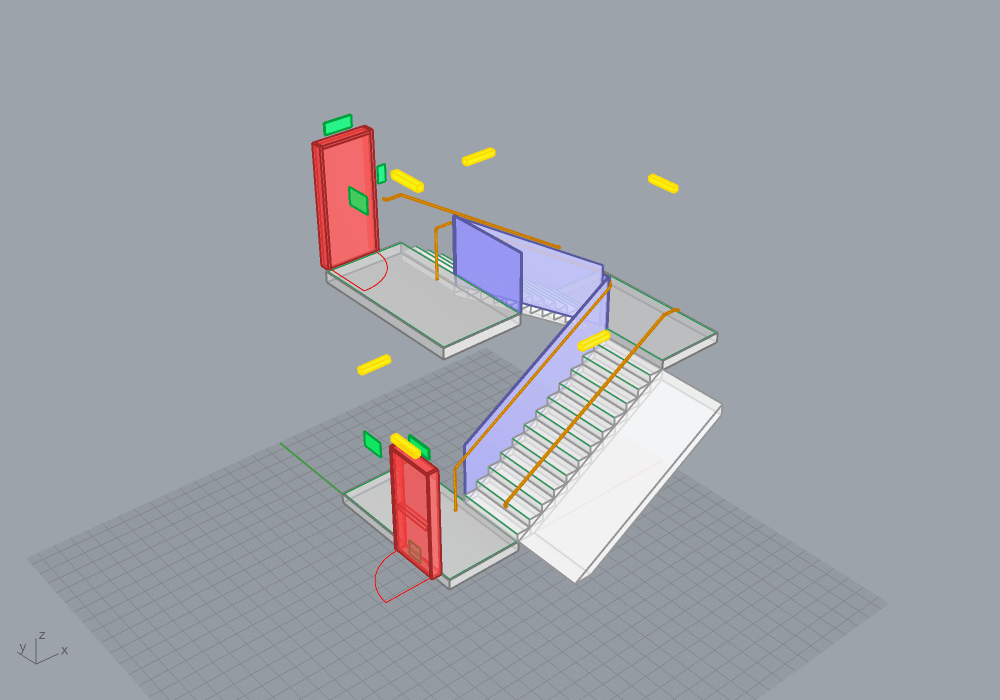
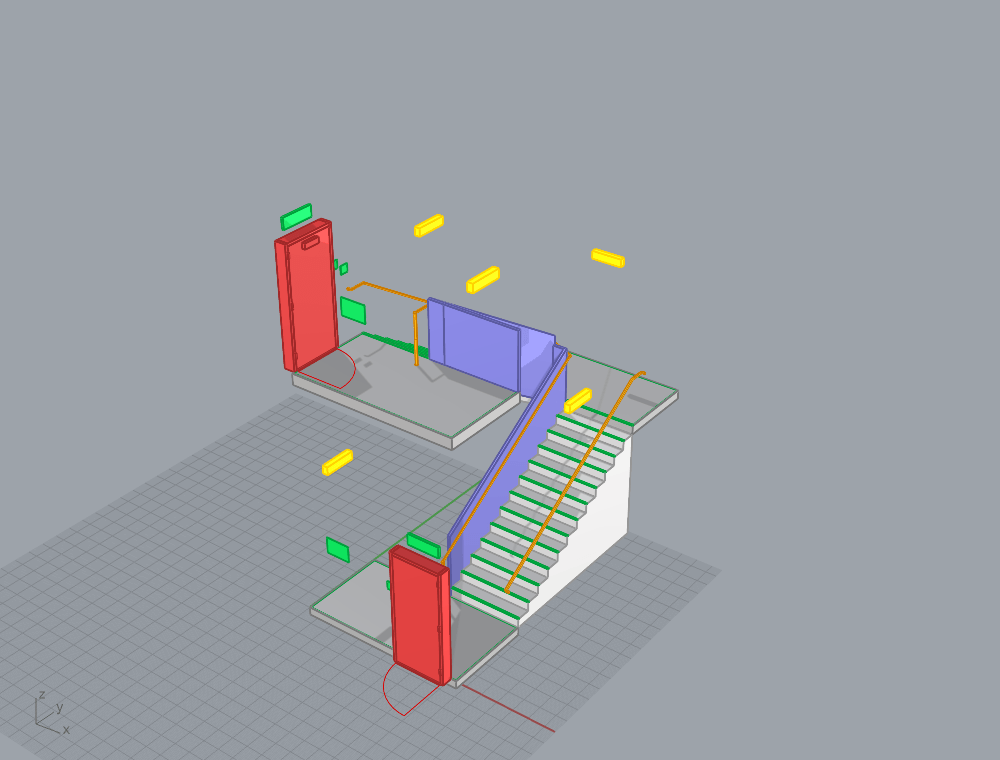
We asked Claude to model one exit stair for a ten-story office building, working from the 2021 International Building Code. Each arm ran twice per model, and we graded 20 runs.
Three graders looked at each saved model. A layer check tested structure: 14 checks on units, layers, counts, names and closed solids. A measurement script tested geometry. The code judge scored the report against 13 requirements. We validated the script on a compliant reference stair and four planted defects, and the judge on a compliant report (13 of 13) and a degraded one (8 of 13).
What we observed
Code score by arm. See the table above. In batch B, comparing v4 with v3: Opus 12, 12 against 12, 12 at $2.03 against $1.19 (+70% cost, +66% time). Sonnet 8, 7 against 10, 11 at $1.96 against $1.43 (+37% cost, +27% time).
Measurement rules. 19 of 20 runs passed all 11. The one failure was an Opus v3 run whose inner handrail measured 30.16 in above the nosing at one tread, against a 34 in minimum.
Lighting. The 10 foot-candle requirement was stated in the report in 5 of 10 Opus runs and 0 of 10 Sonnet runs. Opus: no skill 1 of 2, v3 1 of 4, v4 1 of 2, v5 2 of 2.
The code text. No run read it. 19 of 20 runs fetched the ICC page and every fetch returned 403. The four v4 runs each fetched a second page, which returned 404. 23 web fetches in all and one search.
Skills invoked. In the v4 arm, Sonnet invoked only rhino-plan, in both runs. Opus invoked rhino-review in 1 of 2 runs. No run invoked rhino-learn.
Run to run. Opus with v3 cost $1.14 to $1.90 across four runs. Opus with no skill cost $1.46 and $2.21. In batch A, re-judging moved four of eight totals, all upward, by 2, 2, 1 and 2. Four of the seven changed items had no measurement change behind them.
API look-up. v5 told agents to look up API calls. Across 44 v5 runs (40 ladder cases and the four stair runs), 3 runs looked up a member by reflection. None opened the reference file.
Our reading
The model set the score. Opus met 11 to 13 items and Sonnet 7 to 11, whichever skill we gave them. The spread within one arm is as wide as the spread across arms, and the judge moved a total by 2 on identical measurements. These 20 runs cannot rank no skill, v3 and v5.
The loop cost more and did not raise the score on Opus. On Sonnet it scored lower. The reports show two decisions behind that: both Sonnet v4 runs summed occupant load across floors to size the stair, and one modeled a third level. Whether planning amplified those errors is a reading; the runs don’t isolate the plan step.
Process did not supply code knowledge. No agent read the code, and the lighting level was the item most often missed. Geometry was rarely the failure: 19 of 20 runs passed every measurement rule, and our audit of single builds found a geometry fault in 1 of 306.
Two neighbouring tests point the same way. Skill v3 came out of the chair test, where skill version also left the score unchanged. And v6, which adds an error helper, did not change the pass rate when tested alone.
Not tested: the code text made available to the agent, a loop driven by the harness instead of by skill text, a retrievable lighting calculation, other code editions, other models.
What this doesn’t show
- Small n. Two runs per cell, four for v3. We can’t give a rate for any difference here.
- v4 had seen this case. Its code guidance was written from the first batch’s misses on this stair.
- The judge is one model, and one of the two it graded. Opus 5.5 judged half the runs. We did not test for self-preference. It was repeated only in batch A; batches B and C have one pass.
- The judge scores the report. Lighting levels and pressurization are claims in the report. No photometric or engineering check was run, apart from one Opus v5 run that computed illuminance itself.
- Grader changes. After batch A we fixed three extractor defects, and later raised object caps on six layers from 20 to 400. Batch A first-pass totals were 11, 10, 11, 12, 9, 10, 9 and 9, against final totals of 13, 12, 11, 13, 9, 10, 11 and 9.
- Configuration and one operator. One Mac, one set-up, operator plugins loaded.
- Scope. The judge does not score scope; two runs modeled a third level.
What we take from it
Don’t expect extra skills to make a model know the building code. Give it the code text, and check the report’s code claims separately. Where a loop of skills is chained by instruction, the later steps ran only when the model chose to run them. A later bathroom test is not the same test, but there the agent wrote requirements first and ran its check after its last change in every model-changing turn once it was told to read a single skill.
Full record: One Egress Stair in Rhino: A Single Skill Against a Five-Skill Loop
More evals
Do agents build a Rhino model more cheaply when each call does more of the work?
On turns, yes: building a Grasshopper definition in larger operations cut turns by 52% to 86%. On cost, less so: 5% to 42%. One Python script was cheapest with Sonnet ($0.16, 3 of 3 passed) but passed only 1 of 3 with Opus.
Does a Rhino skill help Claude model a chair from four photos?
Not in this test. The judge's score did not change with skill version (Opus 15, 15, 15 points per arm; Sonnet 9, 9, 9). The model mattered: Opus scored 7 or 8 of 9, Sonnet 4 or 5.