Two Agents, One Rhino Model, and the Notes They Left Each Other
Two Claude agents built one stair in Rhino 9 through notes in the model, 12 runs. All passed the 21 geometry checks; a shared text channel did not help.
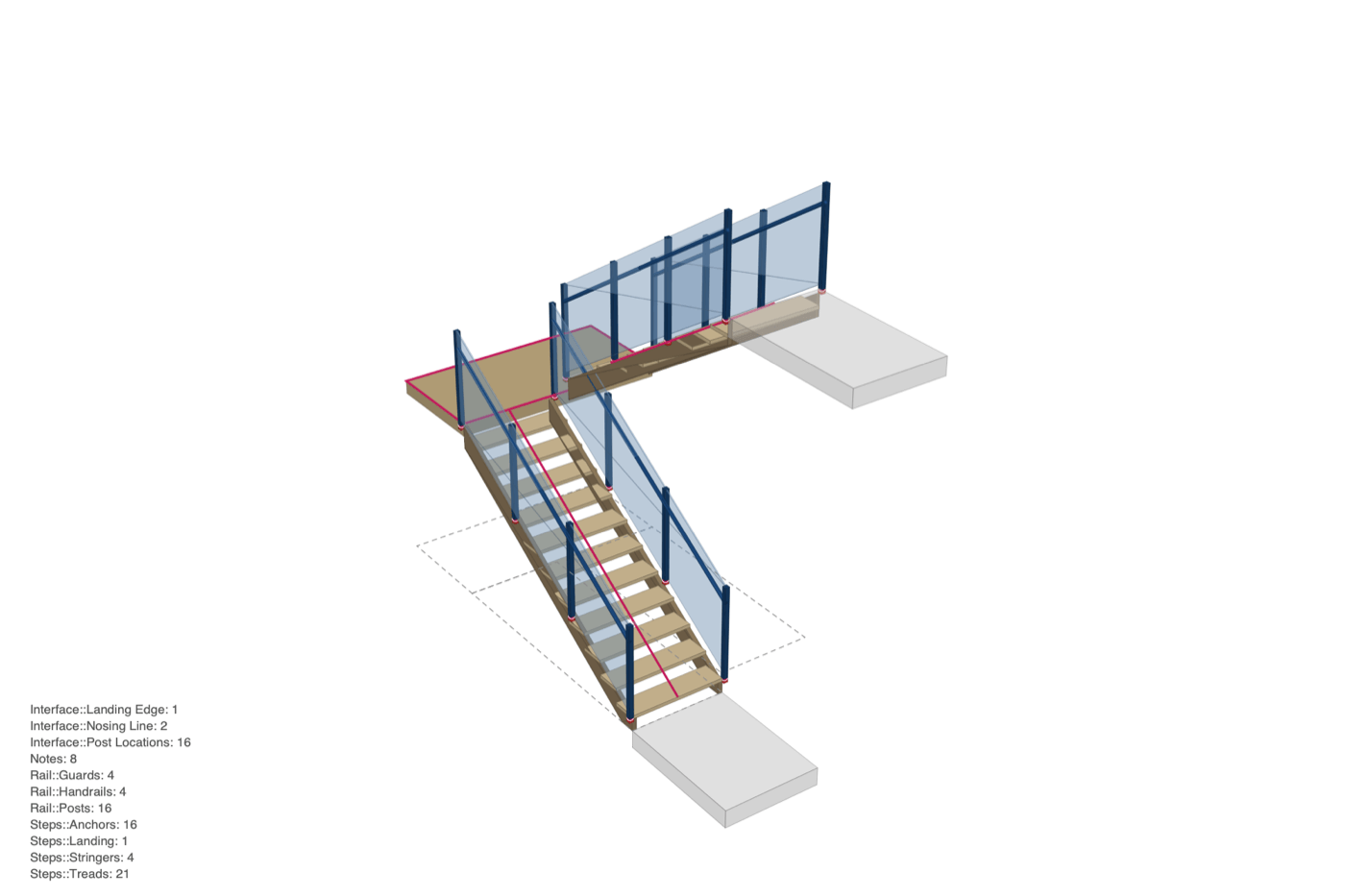
Cover: the finished stair from the Opus notes run, drawn from the saved files, not a Rhino render.
The question and the answer
The question: can two Claude agents build one Rhino model by leaving each other notes in it, and does a shared text channel on top of the notes help?
The answer: notes were enough. All 12 runs built a correct stair and handled a mid-run change order. The channel did not help. On Haiku, the notes arm passed all 24 checks in four of four runs, and the channel arm scored 24, 23, 22 and 23. We did not test an arm without notes.
| Model | Arm | Runs | Checks passed, of 24 | Mean cost per run |
|---|---|---|---|---|
| Haiku 5.5 | Notes | 4 | 24, 24, 24, 24 | $0.0812 |
| Haiku 5.5 | Notes plus channel | 4 | 24, 23, 22, 23 | $0.0986 |
| Sonnet 5.5 | Notes | 1 | 23 | $0.6275 |
| Sonnet 5.5 | Notes plus channel | 1 | 24 | $0.5936 |
| Opus 5.5 | Notes | 1 | 24 | $1.2847 |
| Opus 5.5 | Notes plus channel | 1 | 24 | $1.4344 |
Runs of 2026-11-11. Costs are the command-line tool’s own totals.
How to read it
- Run. One five-round build by two agents, with a change order at round 3.
- Round. Both agents work, each in its own file; then every file is saved and reopened. Each agent starts every round with no memory.
- Steps and rail. The two agents. Steps owns treads, landing, stringers and anchors. Rail owns handrails, guards and posts. Each needs geometry the other publishes.
- Notes. A text dot on a
Noteslayer: from, to, request or reply, status (open, answered, closed) and round. - Channel. A shared text file both agents can read and post to at any time, in addition to the notes. The channel arm’s brief still requires the notes.
- Check and passed. A script with no model in the loop runs 24 checks in four groups: code (6), fit (7), ownership (8) and communication (3). “Checks passed” is how many of the 24 held at the end. All misses here were communication checks.
- Avoidable rework. Objects removed after a reload beyond the one rebuild per agent that the change order requires. Our own metric.
Set-up
| Item | What we used |
|---|---|
| Models | claude-haiku-5-5 (8 runs, 4 per arm), claude-sonnet-5-5 (2) and claude-opus-5-5 (2). The same model ran both agents. Sampling settings were the command-line defaults, which we did not verify. |
| Agent runtime | Claude Code 2.1.321, two sessions per round; no setting sources, memory or skills. |
| Tools | One MCP server built for the test: a script tool and, in the channel arm, two channel tools. A small helper layer we wrote over RhinoCommon, not McNeel’s Rhino MCP tools. |
| Rhino | Rhino 9.0.26300.9402 on a Mac, headless documents only, in the one Rhino 9 already running. |
| Limits | $10 total. Per run: Haiku $0.90 or $0.60, Sonnet $2.20, Opus $4.01 (notes) or $6.74 (channel). No run hit a cap. |
| Given to the agent | A role brief, a protocol brief, a channel brief (channel arm only) and a round message. No dimensions in the briefs; the agents read them from a control file. |
| Run date | 2026-11-11, 17:31 to 21:22 (local time, inferred from file times). |
| Data | The harness and run files are not public. The write-up is. |
How we tested
We split an IBC egress stair, a switchback with two flights and a landing, between two agents. Each publishes interface objects for the other: nosing lines from steps, post locations from rail. Each file is stamped with the control revision it was built from. Each document holds the other agent’s file as a linked block, readable but not editable, refreshed only at the start of a round, so each agent sees the other’s work one round late. No person was in the loop during a run.
In round 3 the control file changes: floor-to-floor drops from 168 in to 160 in, so the stair needs 23 risers of 6.957 in instead of 24 of 7 in. Five rounds is the minimum the task allows.
Two arms ran: notes only, and notes plus the channel. In every pair the notes run went first, and each run took 10 to 12 minutes. A grader checked the published files. We tested the grader on 11 cases, including a good model, damaged copies and one that must pass, and all 11 agreed. A scripted full run passes 24 of 24.
What we observed
Geometry. All 12 runs passed all 21 code, fit and ownership checks: 23 risers of 6.957 in, a post on every published location, an anchor at every post, no clashes, both files and every interface object at revision 2. All 12 runs followed one sequence: in round 3 steps rebuilt and asked for new post locations while rail saw its nosing lines were still revision 1 and did not build from them; in round 4 steps answered and rail rebuilt; in round 5 steps built the anchors.
Misses. Four runs missed a communication check: Haiku channel runs 1, 2 and 3, and Sonnet notes. Haiku channel run 2 missed two. The misses were an unanswered request, requests left open, a last-round status note filed as a request, and post locations published with no reply note.
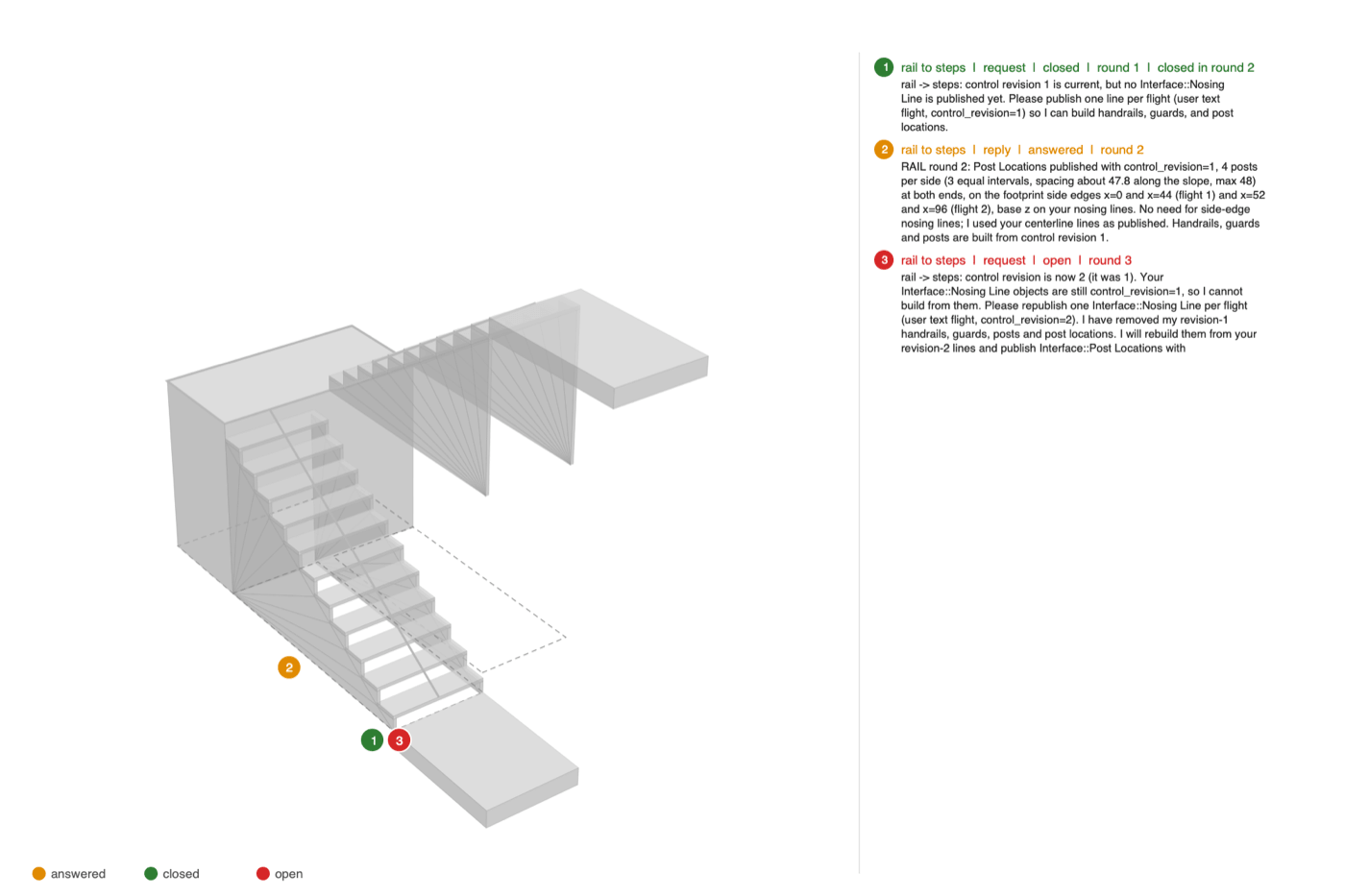
Notes against channel, Haiku, four runs per arm.
| Notes | Channel | |
|---|---|---|
| Checks passed | 24, 24, 24, 24 | 24, 23, 22, 23 |
| Runs that missed a communication check | 0 of 4 | 3 of 4 |
| Avoidable rework (objects) | 0, 0, 0, 0 | 59, 0, 29, 68 |
| Mean cost per run | $0.0812 | $0.0986 |
A two-sided Fisher exact test on the missed checks gives p of about 0.14; that is our arithmetic. The channel arm’s cost was 21% higher, and its output tokens 22% higher. Most of that is one run: without the first channel run the gap is about 7% ($0.0870 against $0.0812). On Sonnet and Opus, one run per arm, the channel was no better: Sonnet’s notes run missed a check and its channel run passed, and both Opus runs passed 24 of 24.
Models. Haiku in the notes arm passed 24 of 24 four times, as Opus did in its one run. Haiku wrote about four times the output tokens of Sonnet or Opus. Its mean cost over eight runs was $0.090; Opus’s was $1.36 (about 15 times more) and Sonnet’s $0.61 (about 7 times). The 12 runs cost $4.659.
The grader fix. The first clash check counted a guard resting on the tread nosings as 38 clashes. After the fix, two Haiku notes runs went from fail to pass.
Our reading
This is our interpretation.
With no shared memory, what carried the change order was the geometry, the revision stamps and the notes. Rail did not need to be told its lines were stale: the stamp said so. The note was how it asked for a fix.
The channel may have had little to add. Geometry arrives only at the start of a round, so a mid-round message cannot change what the other agent builds until the next one, and the grader reads only the notes, so a request made only on the channel counts as missing. We did not test this explanation.
Notes in the model also featured in our brownstone test with three trades, where open notes kept runs from settling. And a drawing-sheet test with the same two agents reversed the channel result, which suggests the result depends on what the agents have to agree.
Not tested: more than two agents, more than five rounds, more than one change order, an arm without notes, and Haiku against larger models at more than one run each.
What this doesn’t show
- Small n. Haiku has four runs per arm; Sonnet and Opus one each. The Haiku difference is not conclusive at p of about 0.14.
- Compounding was not tested (five rounds, the minimum), and there is no arm without notes.
- Order. The notes run always went first in its pair, so time of day and model drift are not controlled.
- Grader. We fixed it after seeing results, on the same data. The “code” checks are this harness’s own, not a general egress-code grader.
- Cost and time. Costs are the tool’s own totals, not checked against a price list; how the runs were billed is unverified. Time is confounded by one shared Rhino and script pipe.
- Unverified. Whether the model versions stayed the same across 4.5 hours of runs; that no agent built from a stale object beyond the end-state checks; the cause of each script error; whether predictions were written before the runs. The p-value, the percentage gaps and the cost ratios are our arithmetic.
- Not McNeel’s MCP, so results may differ from our MCP-based wall tests. The images are diagrams drawn from saved files, not Rhino renders.
What we take from it
When two agents each own part of a model, publish what the other depends on, stamp what is current and write requests as notes in the model, a change order gets through. A channel adds little when geometry refreshes only between rounds; test it where the agents must agree on something that isn’t geometry.
Full record: Two agents build one egress stair in Rhino 9
More evals
Can two Claude agents draw one dimensioned stair sheet together in Rhino 9, and does the rhino-fineline skill help?
Yes, with the skill: all 11 skill-on runs produced a real sheet and handled a scale change, and 4 of 11 passed all 26 checks. Without the skill, two Haiku runs passed 18 and 22 of 26.
Does an agent follow a requirements-first, check-last process in Rhino, and does its own check agree with an independent grader?
It followed the process in all 7 model-changing turns of the six runs without hooks. Its own check did not always agree with the independent key: in one run it passed 24 of 24 while the independent key passed 21 of 22 items and failed one, the dispenser, which neither the requirements nor the model had.