What Skills Fix When Agents Split a Rhino Model
On a brownstone split across three trades, a team using our Rhino skills ended coordinated in 3 of 3 runs; trades alone, 1 of 3. A small eval.
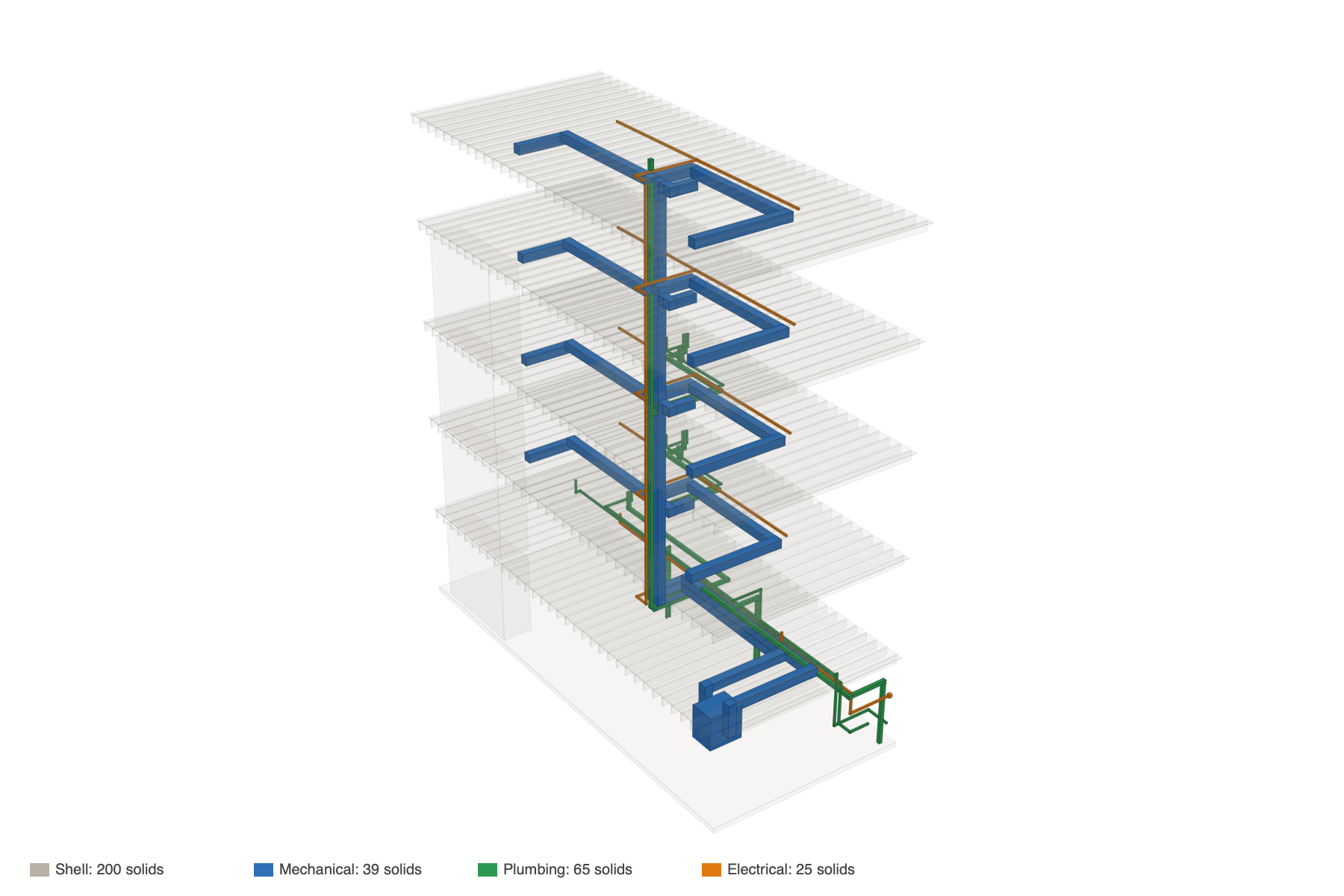
The question and the answer
The question: do our Rhino skills for Claude improve what AI agents produce in Rhino?
The answer: not general modeling. In our audit of saved models, single builds were almost always clean already. The skills helped when a model is split across several agents that have to fit together. In our main test, a brownstone split across three trades, a team using the skills ended coordinated in 3 of 3 runs. The same trades working alone, with only the modeling skill, ended coordinated in 1 of 3.
| Set-up | Runs | Passed | Ended coordinated | First coordinated in round | Cost per run |
|---|---|---|---|---|---|
| Team with skills | 3 | 2 | 3 | 4, 5, 2 | $6.19 |
| Trades alone, modeling skill only | 3 | 1 | 1 | never, never, 3 | $5.19 |
Brownstone, Sonnet, runs of 2026-11-19. The team cost about 20% more per run.
How to read it:
- Round. One pass in which every agent works on its own file. Brownstone runs have at most 8 rounds.
- Clash. Two elements from different trades occupying the same space.
- Coordinated. A script checks this at the end of each round: no clash, nothing routed through structure, no trade outside its assigned zone, every required point served, no service run under its minimum size, no open note. Ended coordinated means the last round met all of that.
- Passed. Graded on the final model: it ended coordinated, and also no agent edited another’s file, no file was built to a stale revision of the brief, no modeling-hygiene fault, and, in the team set-up, no fault in the coordinator’s set-out (for example, two zones overlapping).
- Settled. The skills’ own team check printing “settled”. That is the team’s signal. “Coordinated” and “passed” are the grader’s. They are different checks.
- Fault. A failed check. In the audit, a model fault is a failed check on our 17-check modeling-quality checker, such as an open polysurface or stacked duplicates. In the team evals, a fault is an item on the team-check script’s list.
The evidence is thin: two buildings, a handful of runs, one change per run. Read it as a direction, not a measurement.
Set-up
| Item | What we used |
|---|---|
| Model | claude-sonnet-5-5 for every agent, coordinator and trades alike, in both buildings. |
| Skills | Coordinator: rhino-agent-team. Trade agents: rhino-model. Trades-alone set-up: rhino-model only. A pre-release build, not yet public. |
| Brownstone | 3 runs per set-up, 2026-11-19. At most 8 rounds and an $8 spend cap per run. The post is added in round 5. |
| Barn | 2 team runs, 2026-11-19 and 20. $10 spend cap per run. The change comes in round 3. |
| Brief | Each agent gets the points its trade must serve (42 in total across trades), minimum sizes, and the brief’s revision number. No levels, datum, routes or zones are given. In the team set-up the coordinator has to set those out. |
| Data and skills | Not public. |
How we tested
On a real project, the mechanical, plumbing and electrical designers each draw their own part of the building, and then someone has to find out where those parts collide. We gave that job to AI agents.
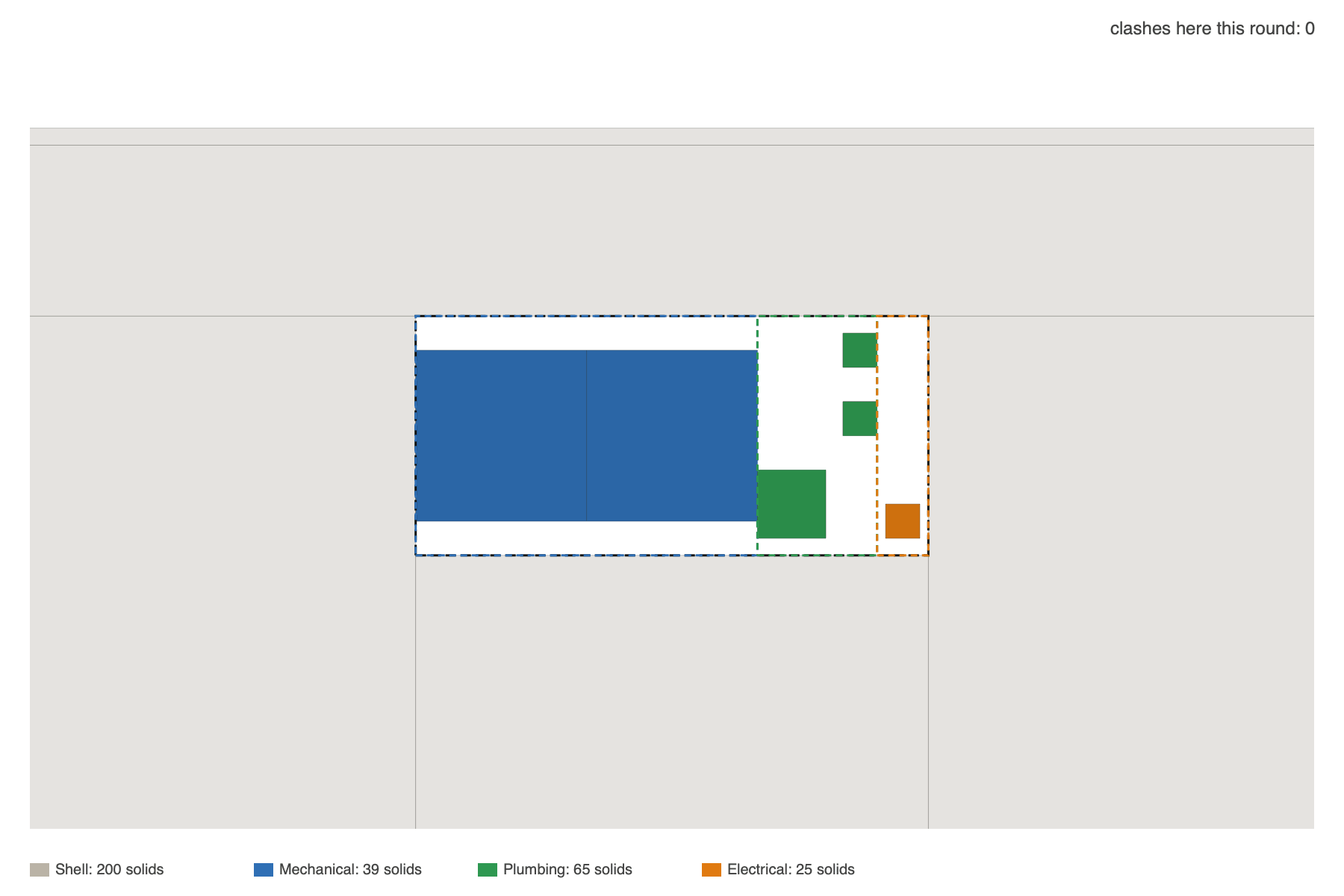
The building. A brownstone, split across three trades: mechanical, plumbing and electrical. Each trade is one agent with its own Rhino file. All three have to get through the same vertical shaft and the same slot in the cellar cross wall, so they have to share the space. In the pictures below, blue is mechanical, green is plumbing and orange is electrical. The cover image shows the whole building in perspective, from the first round of a team run. In round 5 we change the brief by adding a post in the shaft, and every trade has to adapt.
Two set-ups, compared. In the first, a team with the skills: a coordinator that sets out the zones, and three trade agents that model. In the second, the three trades work alone, with only the modeling skill and no coordinator. Each set-up ran three times on the same building.
Rounds. In each round every agent works in its own file. Then a script checks the whole building.
Pictures of every round. After each round we capture the model from four views: a perspective, the shaft, the slot and the cellar. So we can see a run round by round, not only at the end.
A second building. A barn, where an agent modeled the structure as well. Team set-up only, with no comparison arm.
What we do with what a run finds. The runs also exposed faults in the skills themselves. One example: a slot shared by all trades was being given to just one of them. We fix those, then re-prove the fix with a scripted rerun that costs nothing, including a clash planted on purpose, before paying for another run.
Study 1: the audit
Method. On 2026-11-16 our 17-check modeling-quality checker scored 389 saved models from our Rhino tests since September.
Observed.
- 306 single-build models: 1 had a geometry fault.
- 69 models from a stair series, where agents build, then revise, then continue a model: 30 had faults, mostly open polysurfaces and stacked duplicates. By job: build 3 of 22, revise 15 of 26, continue 12 of 21.
- The remaining 14 come from a second stair task: 5 had a geometry fault.
Faults were more common once a model was revised or continued than in a single build. Our reading: that is where modeling quality has room to improve.
Study 2: the brownstone, team with skills vs trades alone
Method. Three runs per set-up, same building, same model, a post added in round 5. Clashes below are counted across the whole building at the end of each round.
Observed.
| Run | Clashes by round | First coordinated | Passed | Cost |
|---|---|---|---|---|
| Team 1 | 21, 5, 0, 0, 0, 0, 0, 0 | 4 | Yes | $6.89 |
| Team 2 | 21, 6, 0, 0, 0, 0 | 5 | Yes | $5.71 |
| Team 3 | 0, 0, 0, 0, 8, 0, 0 | 2 | No | $5.98 |
| Alone 1 | 65, 9, 0, 0, 2, 2, 2, 0 | never | No | $5.73 |
| Alone 2 | 79, 28, 2, 0, 23, 23, 2, 0 | never | No | $5.11 |
| Alone 3 | 48, 7, 0, 0, 24, 1, 0, 0 | 3 | Yes | $4.74 |
- Early clashes. In round 1 the team runs had 21, 21 and 0 clashes. The trades alone had 65, 79 and 48.
- After the change. In round 5, when the post is added, the team runs had 0, 0 and 8 clashes. The trades alone had 2, 23 and 24.
- Every run ended with 0 clashes, in both set-ups. What separated them was the rest of the coordinated check. Alone 1 ended with 7 open notes and 41 of 42 points served. Alone 2 ended with 1 open note.
- The one team run that didn’t pass (Team 3) failed on a single overlapping zone after the change.
- Coordinator review. The coordinator’s review covered 55 of 55 faults in Team 1, 27 of 27 in Team 2 and 1 of 20 in Team 3.
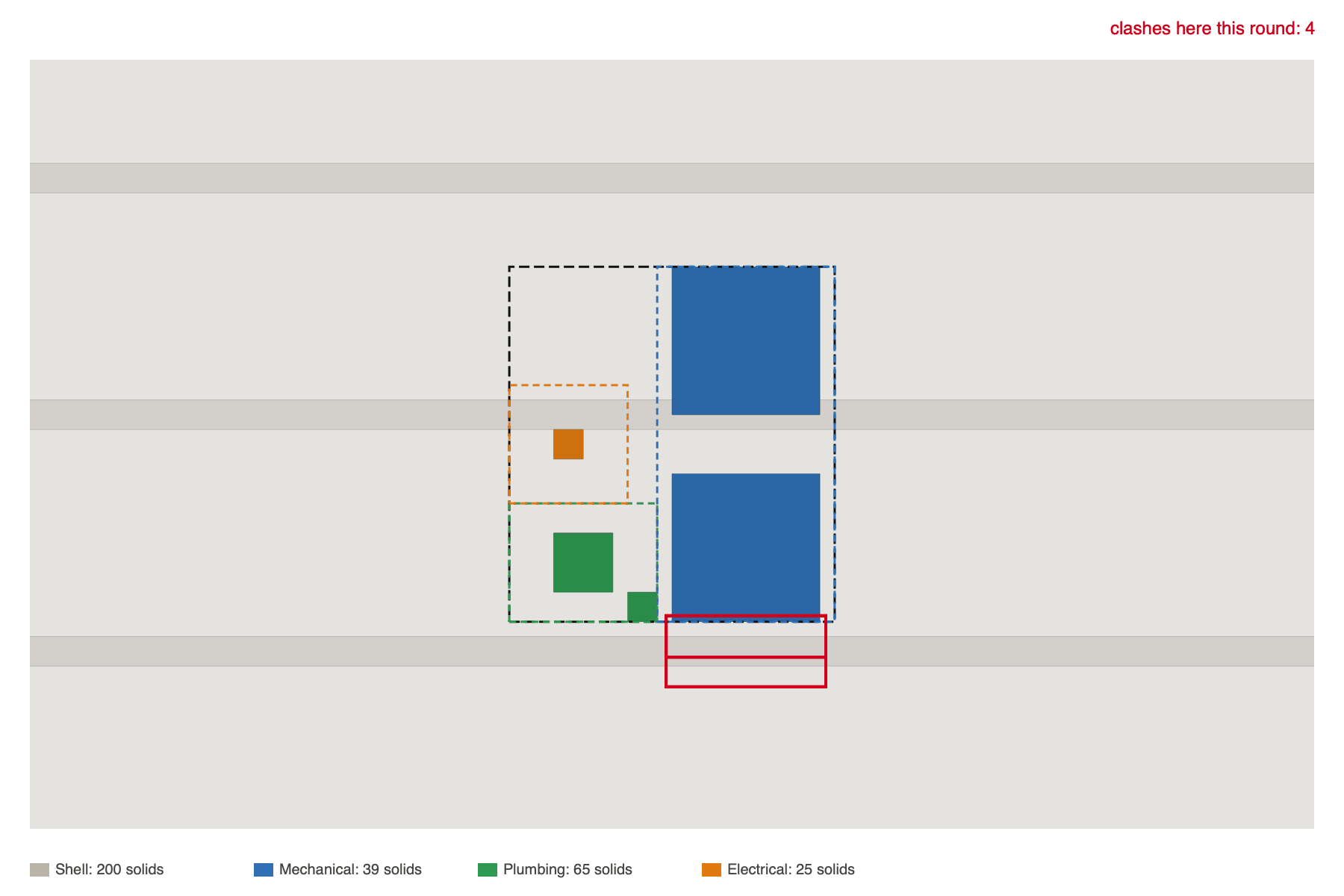
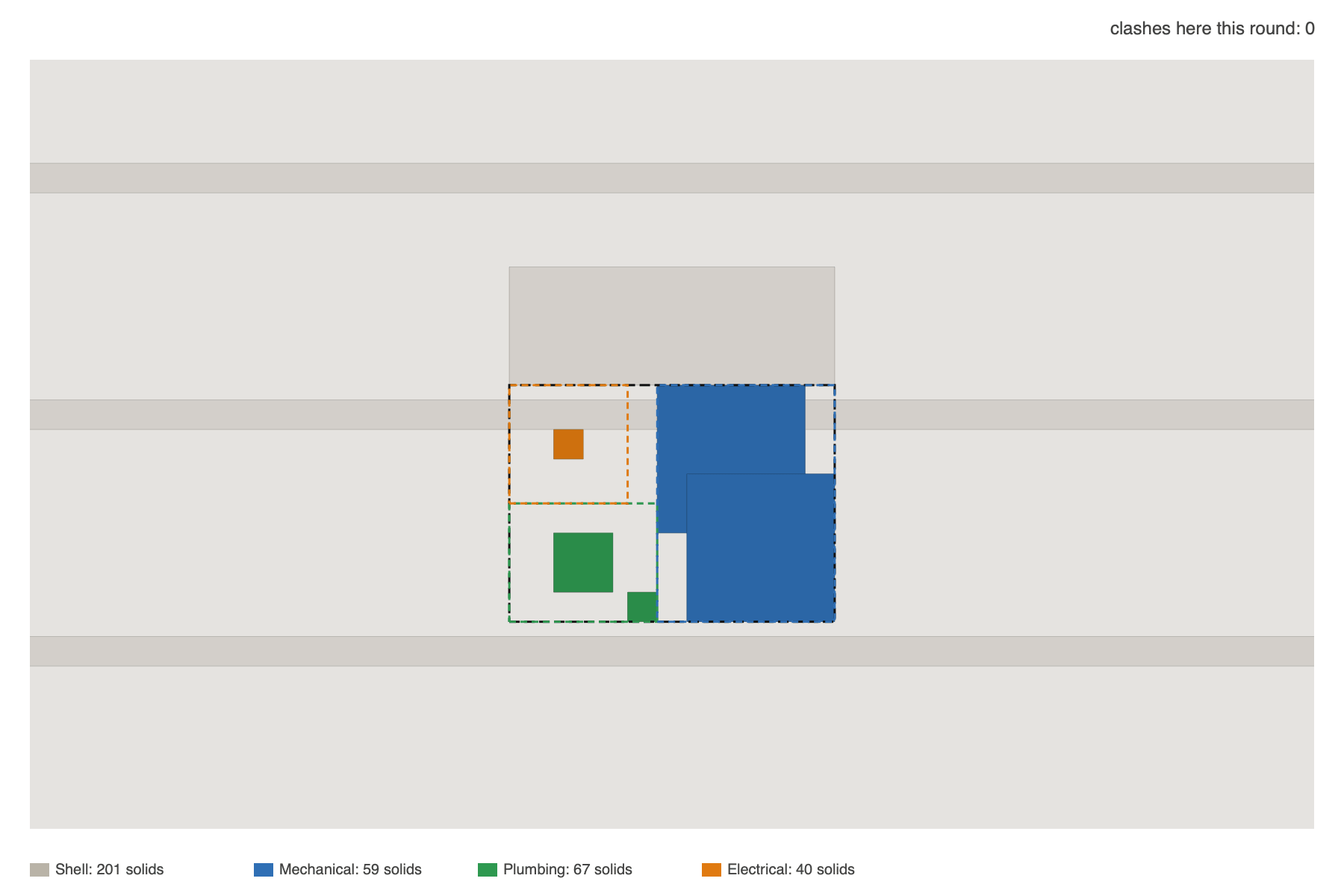
Confound. The team set-up adds two things at once: a coordinator and the coordination skills. The trades alone have neither. So this comparison can’t tell us how much of the result comes from the coordinator and how much from the skills.
Study 3: the barn
Method. A second building, with the structure modeled by an agent. Two team runs on 2026-11-19 and 20, each capped at $10, with a change in round 3. The cap stopped the runs after 5 and 6 rounds.
Observed.
- Neither run reached coordinated, and the team check never printed “settled”.
- There were no clashes in any round and the frame was 14 of 14 correct in every round.
- The faults were on the team check’s list: services routed through structure outside an opening, and trades outside their zones. In the second run there were 27 across the rounds, and the coordinator’s review covered 10 of them and raised 15 issues that were wrong. In the first run it covered 18 of 37.
- The second run ended round 6 with zero geometry faults, 3 open notes and 20 stale references.
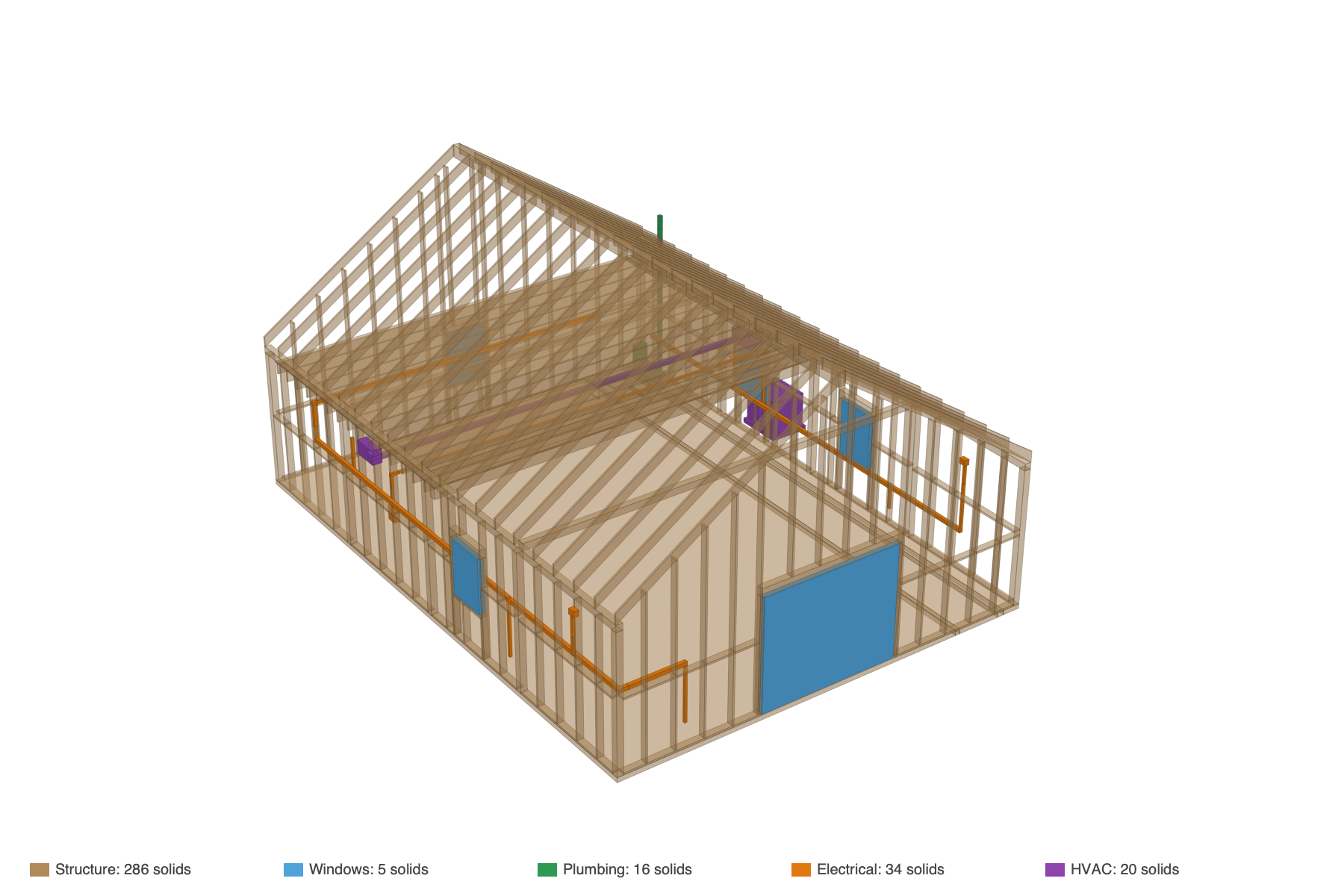
Why a barn with no clashes still didn’t settle. No clashes and a correct frame don’t make a model settled: the check also looks at open notes, stale references, services through structure and zones. Four faults in the skills were behind this. They have been fixed and re-proven on free scripted reruns, not on a new paid run, so we haven’t shown that the barn now settles with real agents.
The four tactics
These are what the skills tell the agents to do.
A zone per trade. We call them shares. The coordinator reserves a zone for each trade, and each trade routes only inside its share. The only crossings are through structure, at an opening or against an opening request.
Notes in the model. Requests and rulings are notes attached to geometry. Each owner reads what it owes and closes it. Open notes were what kept runs from settling.
One owner per file, and a shared set-out. Each agent edits only its own file. The governing numbers and the building reference sit in one control file with a revision number, so when something is redrawn, everyone can see what is now stale.
An automatic team check. After every round a script checks for clashes, anything routed through structure, share breaks, open notes (the coordinator’s too) and stale references. It prints “settled” only when everything is clear. Agents don’t declare themselves done.
Observed. Zones didn’t keep clashes at zero: two team runs opened with 21 clashes. Team runs started with fewer clashes than the trades alone. All three team runs were at 0 clashes by round 3, and so were two of the three trades-alone runs.
Our reading, not tested. We think shares and the set-out helped the team start cleaner, and that the set-out and the check are what make shares and notes reliable. We never ran a set-up with one tactic removed, so we can’t say which tactic did what.
What this doesn’t show
- The coordinator and the skills are confounded. See Study 2.
- No tactic was tested on its own. The reading above is our interpretation.
- Few runs, few buildings. Two buildings, one change each. Three runs per set-up on the brownstone, two team runs on the barn.
- The barn has no comparison arm, and neither barn run reached coordinated.
- Coordinator review is uneven. It covered everything in two brownstone runs and 1 of 20 in the third. On the barn it covered 10 of 27 in one run and 18 of 37 in the other.
- Single builds vs a team. An earlier test of ours, not reported in this article, found one agent alone as good as a team and cheaper when the work didn’t need splitting.
- Revision series untested. We haven’t tested whether skills reduce faults across a series of revisions to one model, which is where the audit found faults.
What we take from it
Our audit gave no reason to reach for skills to make a single build clean; it already was, and single-agent tests agree: Opus passed all 20 ladder cases with no skill, and 19 of 20 egress stairs passed every measurement rule. Reach for them when you split the model, because splitting creates the problem of agreeing, and that needs a structure: a zone for each trade, notes tied to geometry, one owner per file and a check that nobody gets to overrule. A report can say everything passed while a fault remains: in our stair pilot one delivered report said “accepted on every measured check” while a planted fault sat in the model. Whether that structure or the coordinator carries the result is the next thing to test. Two later tests used the notes without a coordinator: in a two-agent stair test notes in the model carried a change order across rounds in all 12 runs, and in a two-agent drawing-sheet test a shared text channel on top of the notes helped when the agents had to agree on callout numbers.
Related articles
More evals
Can two Claude agents draw one dimensioned stair sheet together in Rhino 9, and does the rhino-fineline skill help?
Yes, with the skill: all 11 skill-on runs produced a real sheet and handled a scale change, and 4 of 11 passed all 26 checks. Without the skill, two Haiku runs passed 18 and 22 of 26.
Can two Claude agents build one Rhino model by leaving each other notes in it, and does a shared text channel on top of the notes help?
Notes were enough: all 12 runs built a correct stair, passing 21 of 21 geometry, fit and ownership checks. The channel did not help: on Haiku the notes arm passed 24 of 24 four times; the channel arm scored 24, 23, 22 and 23.